
Agentic AI vs Generative AI: What’s the Difference & How to Combine?

By Prosanjit Dhar
January 27, 2026
Last Modified: March 13, 2026


If 2022 was the year of chatting with AI, 2026 is the year of letting AI do the work.
More specifically, the buzz is shifting from Generative AI to Agentic AI, systems that can autonomously manage workflows, make decisions, and execute multi-step tasks.
As a result, for business leaders and tech teams, the question is no longer “What can this AI write?” but “What problem can this AI solve on its own?”
With this mind shift, this blog explores the differences between Generative AI and Agentic AI, the powerful “hybrid loop” that combines them, and how tools like Fluent Support are already bringing this future into your WordPress dashboard.
Generative AI vs Agentic AI: Summary comparison
|
Characteristic |
Generative AI |
Agentic AI |
|
Primary focus |
Creating/generating |
Doing/deciding |
|
Response style |
Reactive (waits for prompt) |
Proactive (takes initiative) |
|
Autonomy level |
Low (human-guided) |
High (autonomous) |
|
Goal type |
Single output |
Multi-step objective |
The fundamental differences: Generative AI vs. Agentic AI
At a fundamental level, the differences between generative AI (GenAI) and agentic AI lie in their operational intent, level of autonomy, and relationship with human users.
While both rely on large language models (LLMs), Generative AI is designed to create content, whereas Agentic AI is built to achieve goals and execute actions.
In practice, these differences emerge across several key dimensions:
1. Core purpose: Creation vs. Action
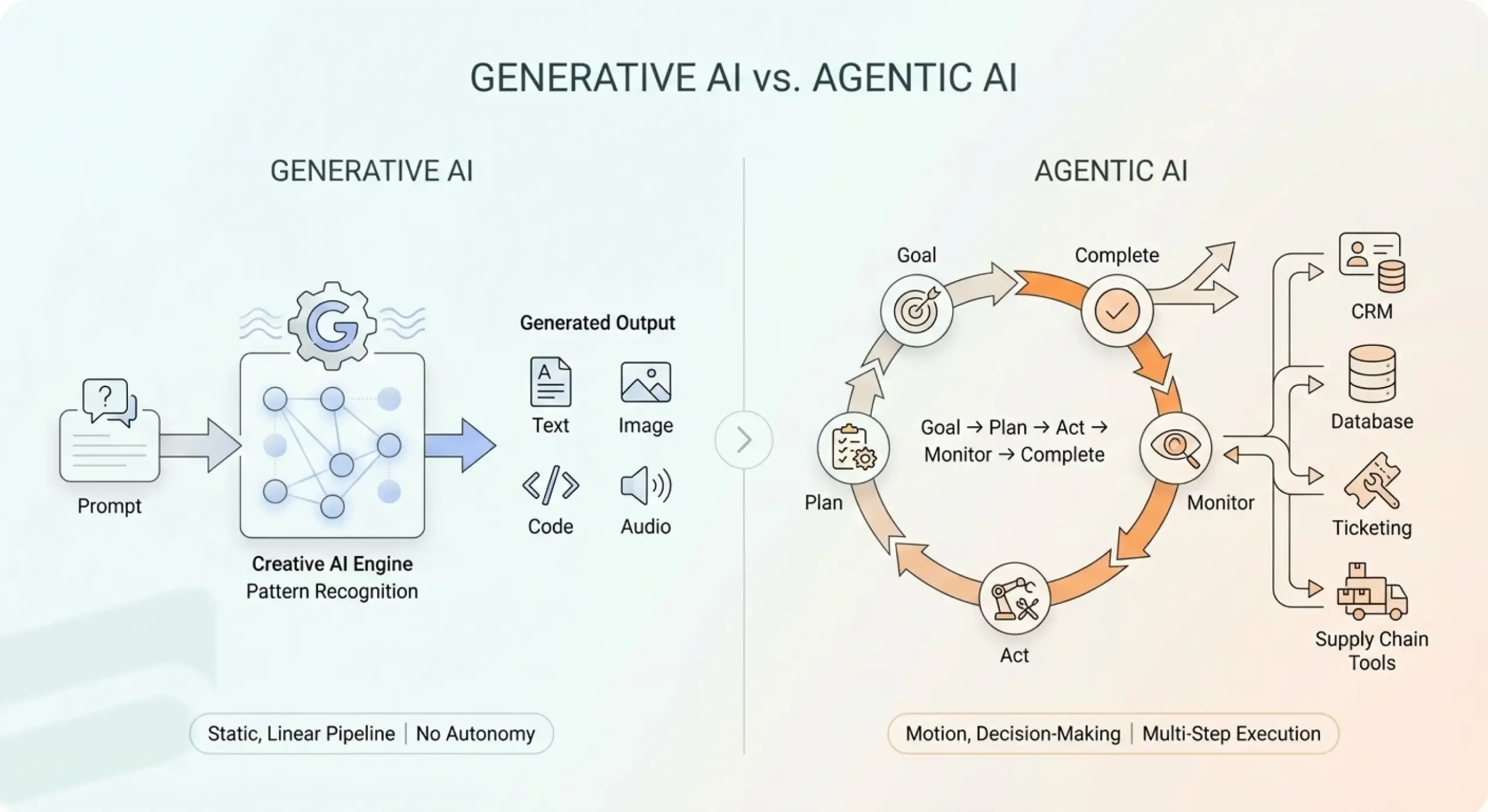
Generative AI functions as a creative engine optimized for linguistic fluency and pattern recognition. Its primary purpose is to synthesize new material, such as text, images, code, or audio, by predicting the next logical element in a sequence based on training data.
Agentic AI transcends content creation to focus on goal attainment. It is an autonomous system capable of independently pursuing defined, multi-step objectives, such as resolving customer support tickets or managing a supply chain.
2. Operational mode: Reactive vs. Proactive
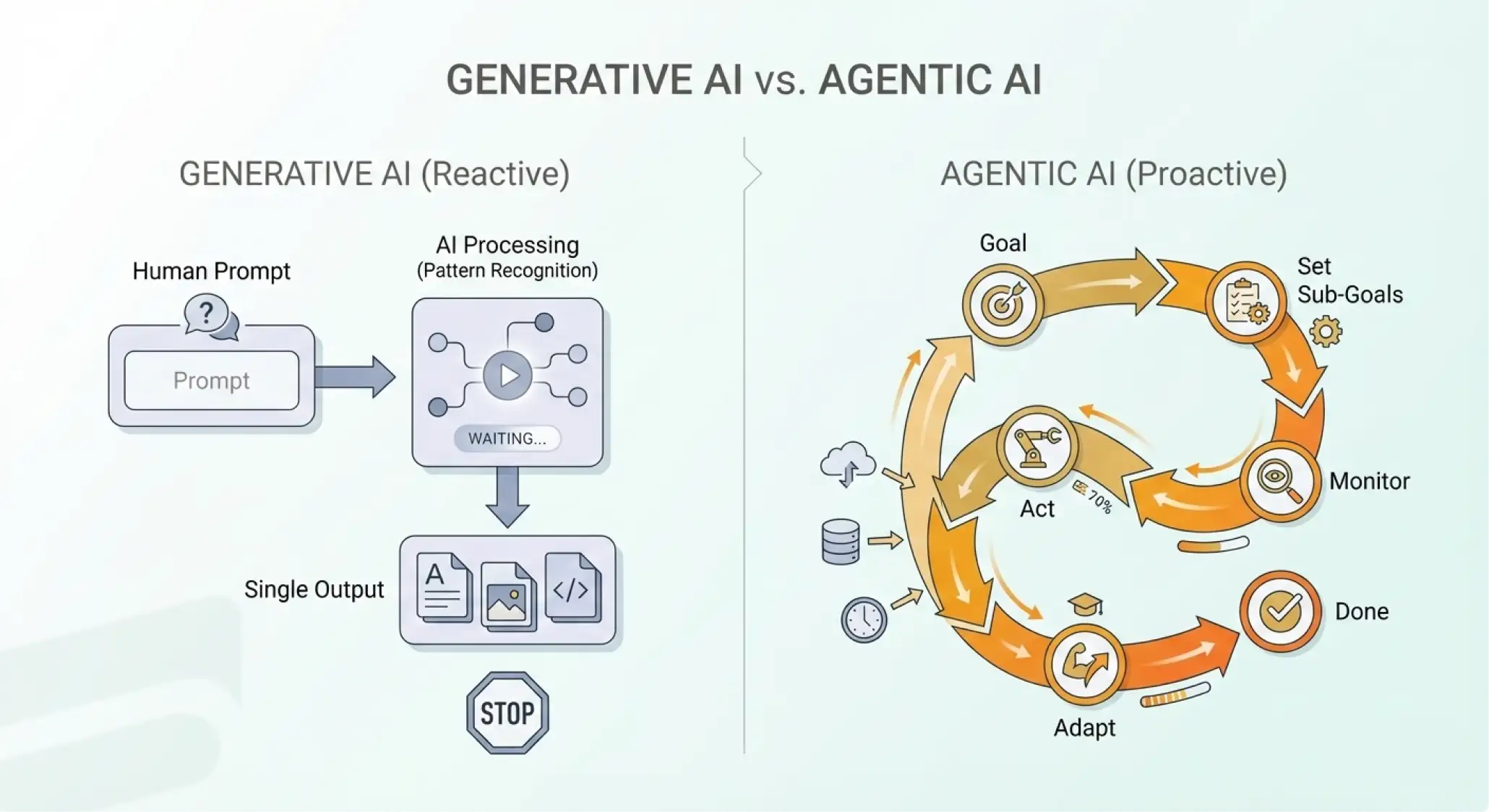
Generative AI is fundamentally reactive. In other words, it remains dormant until it receives a human prompt. Once activated, it processes a specific request and provides a single output, after which its operation concludes.
By contrast, Agentic AI acts proactively rather than waiting for direct input. It can set its own sub-goals, monitor its environment, and take initiative to move a workflow from “to-do” to “done” without constant human nudging. It continuously evaluates its progress toward a high-level goal and adapts its actions based on real-time feedback.
3. Human dependencies and decision-making abilities
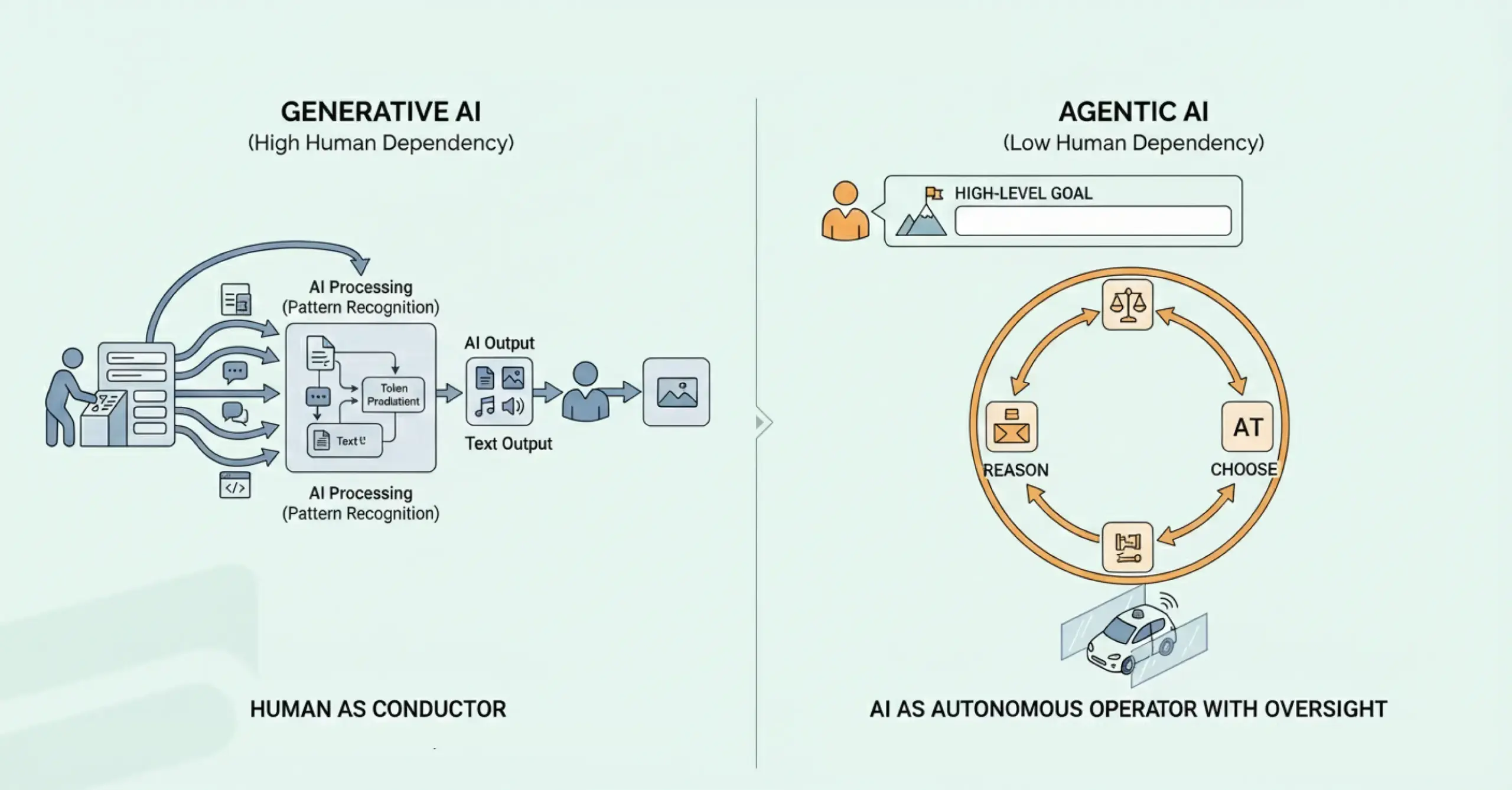
Human dependency: Generative AI requires high human interaction. Where the user acts as the primary orchestrator, providing prompts and manually integrating the AI’s output into broader workflows.
In contrast, agentic AI operates with low human interaction, requiring only initial goal setting and periodic supervisory oversight.
Decision-making: Generative AI makes basic statistical decisions about word or pixel placement. Agentic AI performs complex reasoning, weighing multiple options and choosing the best course of action based on current conditions and intended outcomes.
4. Interaction cycle and memory
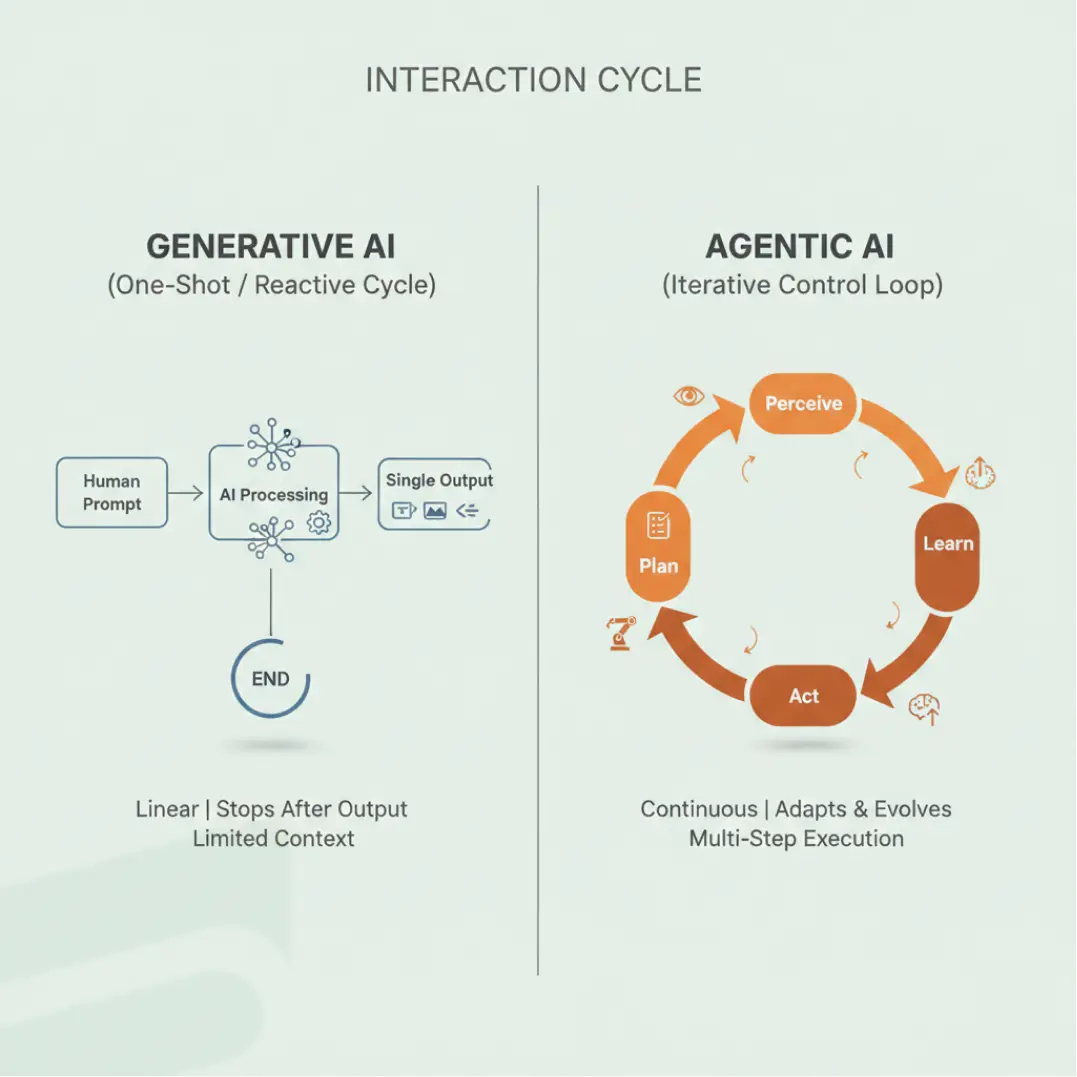
Interaction cycle: Generative AI typically operates in a reactive, single-turn, or “one-shot” cycle. When given a prompt, it generates an output, and the interaction ends unless a new prompt is provided. While generative AI can maintain short-term context within a conversation, it does not autonomously plan or execute multi-step processes.
In contrast, Agentic AI is designed to operate within an iterative control loop, often described as Perceive → Plan → Act → Learn. In this framework, the system continuously:
- Perceives its environment or task state,
- Plans a sequence of actions toward a goal,
- Acts by executing those actions (e.g., calling tools, running code, querying APIs),
- Learns by updating its internal state or memory based on outcomes.
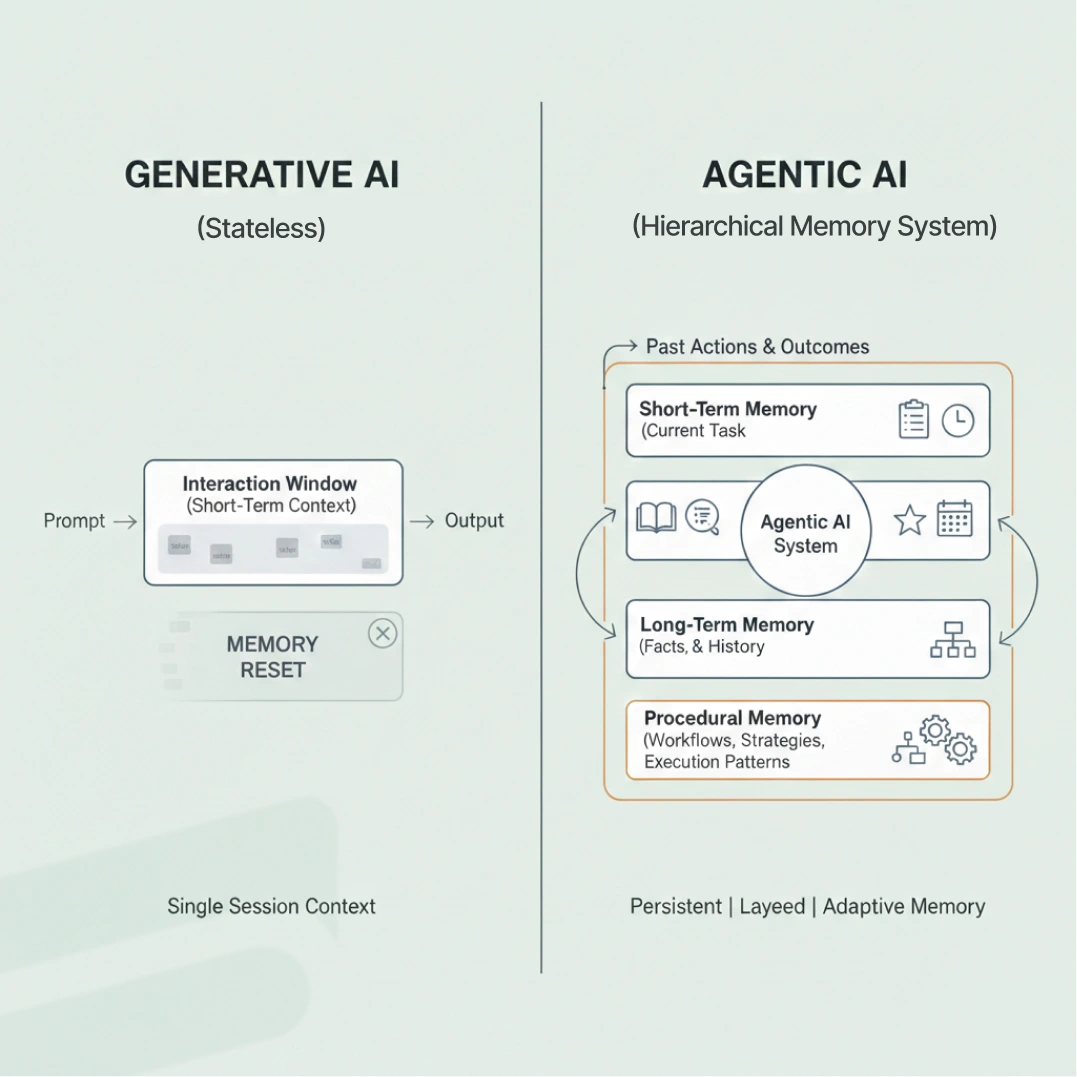
Memory systems: Generative AI is generally stateless across sessions, meaning it does not retain knowledge once a session ends. Within a single session, it can maintain a limited short-term context via the token window, allowing it to reference recent interactions.
On the other hand, Agentic AI is designed to leverage hierarchical memory, which may include:
- Short-term memory for the current task state,
- Long-term memory for facts, user preferences, or prior actions,
- Procedural memory for workflows and task execution strategies.
This memory system enables agentic AI to remember past actions, learn from outcomes, and apply that knowledge to future tasks, supporting autonomous, goal-directed behavior over long-running, multi-step processes.
5. Tool integration and environment
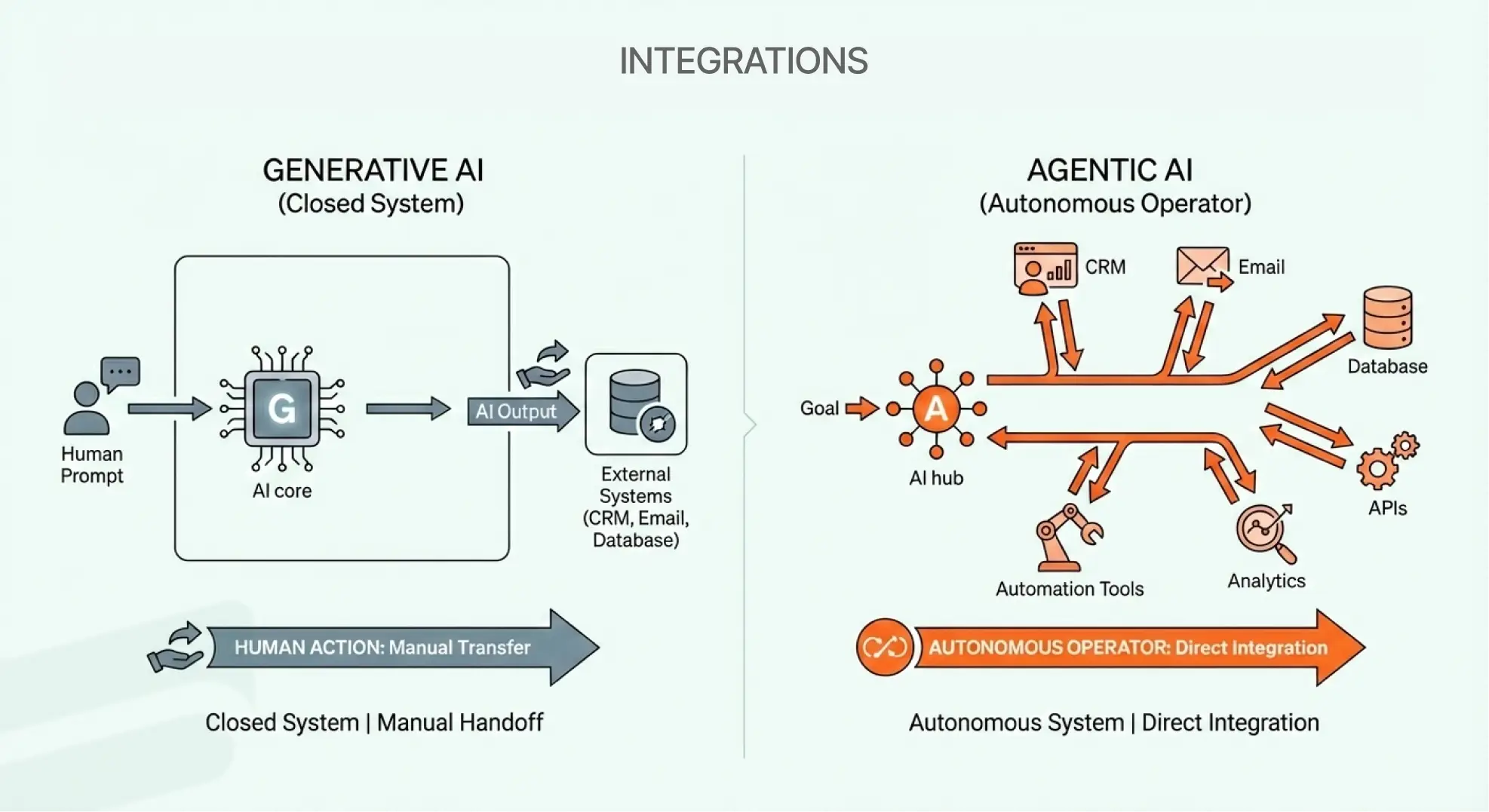
Generative AI primarily operates within a closed system. It generates outputs based on prompts, but cannot autonomously interact with external tools or databases. Human intervention is required to act upon its output.
For example, copying generated text into another system, sending an email, or updating a record.
Agentic AI functions as a digital operator to autonomously integrate with external tools, APIs, and databases. It can execute system-level actions such as updating CRM records, sending emails, triggering robotic actuators, or querying live data sources.
Long story short,
- Generative AI (GenAI) is your Talented Intern. It is incredibly creative and knowledgeable, but waits for instructions. If you ask it to “write an email,” it writes a great email. If you don’t ask, it sits idle. It is reactive.
- Agentic AI is your Project Manager. It has a goal (e.g., “resolve this customer complaint”) and the autonomy to figure out how to do it. It might check a database, make a decision, draft a response, and update a CRM all without you holding its hand. It is proactive.
The hybrid loop: How to combine Generative AI and Agentic AI
Many believe Agentic AI will make Generative AI obsolete. But the actual truth is they’re stronger together.
Successful enterprises are building Hybrid Loops. In this architecture, Agentic principles act as the “spine” (managing the workflow and context), while Generative AI acts as the “muscle” (drafting the specific communications).
The “Human-in-the-Loop” architecture
In customer support, we are seeing a shift toward Augmented Agency. The AI doesn’t just “chat”; it prepares the workspace for the human agent.
- Perceive: The AI reads the entire ticket conversation to understand context.
- Plan: It analyzes sentiment to gauge urgency.
- Act: It drafts a response for the human to review.
This allows the human to move from “Writer” to “Editor/Manager,” significantly increasing ROI and operational efficiency.
How Fluent Support uses OpenAI to assist support agents
Fluent Support integrates OpenAI directly into its ticket interface, helping support agents work faster and more effectively without replacing them.
The AI tools handle repetitive or time-consuming tasks like summarizing conversations, analyzing customer tone, generating draft responses, and refining text. This allows agents to focus on review, editing, and sending final replies.
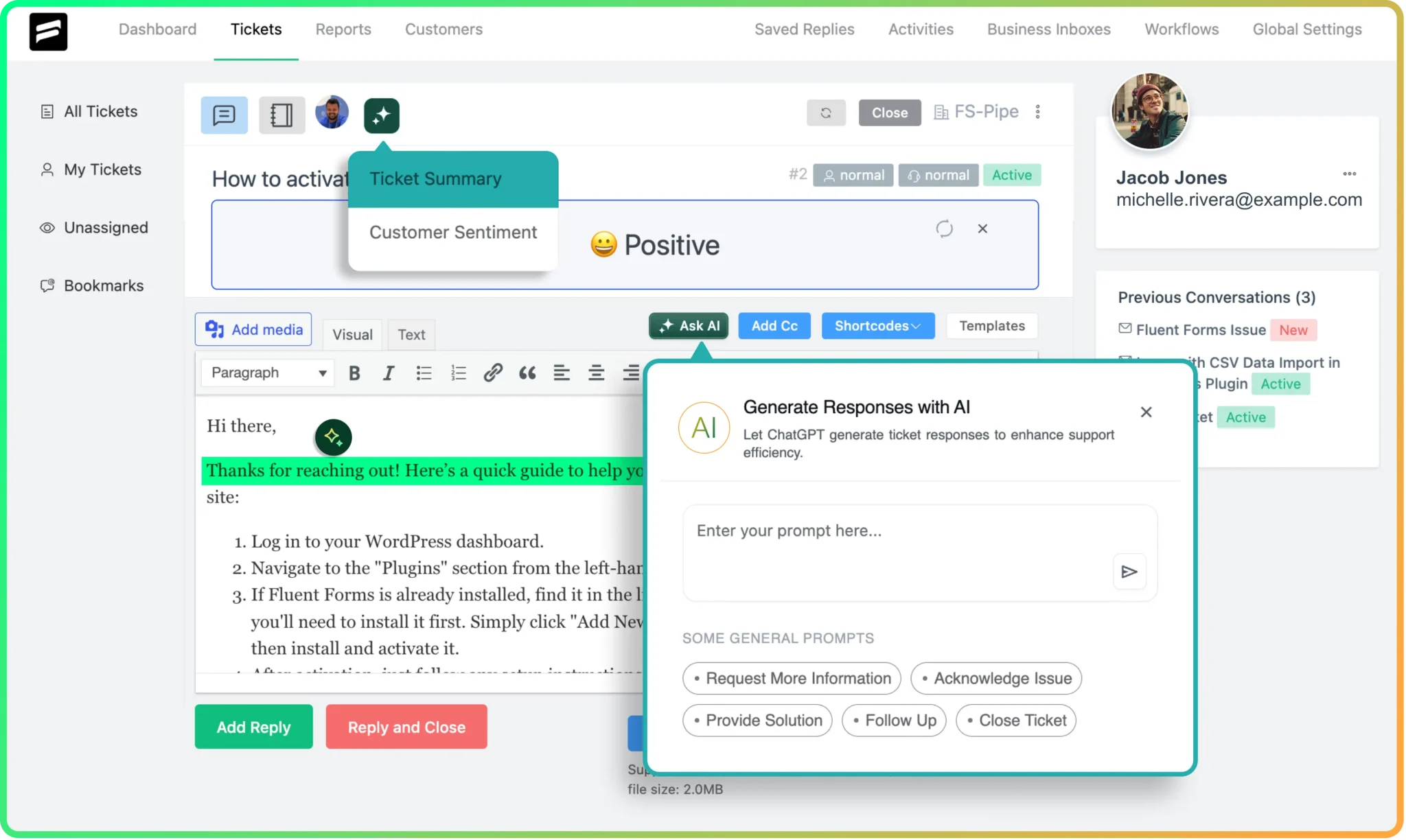
Here’s how Fluent Support does it:
- Ticket Summary: With one click, OpenAI reads the full query and generates a concise summary of the ticket in short bullet points.
- Sentiment analysis: OpenAI analyzes the customer’s queries and provides a short statement on their satisfaction level, including a representative emoji (e.g., “😡Negative”, “😃Positive”).
- AI-Generated reply: Generate instant, accurate replies with the help of AI, ensuring fast and consistent responses.
- Ticket fine-tuning: Customize replies to match your support team’s style and tone, ensuring perfect communication.
Improve your customer support by 64% with AI-powered Fluent Support.
Final thoughts
As we move deeper into 2026, the barrier between “using AI” and “hiring AI” will vanish. The combination frameworks are making it easier for developers to build complex multi-agent teams, while user-friendly tools like Fluent Support are bringing those capabilities to non-technical business owners.
However, a word of caution: Governance is key.
The more autonomous your AI becomes, the more you need “Human-in-the-Loop” (HITL) oversight. Whether it’s a human approving a code push or a support engineer reviewing an auto-drafted refund email, trust is built on verification.
Start off with a powerful ticketing system that delivers smooth collaboration right out of the box.
Related Articles
502 Bad Gateway Error: What Is It And How To Fix
If you do not take any steps to…Error Code 520: What It Means and How to Fix It
Error code 520 means Cloudflare got an empty…




Leave a Reply