

Thank You for Your Business: Say It Like You Actually Mean It

By Md. Sajid Sadman
February 24, 2026
Last Modified: June 5, 2026


“Thank you for your business” is one of the most common phrases in customer communication.
You see it in emails, on receipts, in package inserts, and at the end of support conversations.
But here’s the thing: it usually feels hollow. Customers can tell when it’s automated, generic, or tacked on as an afterthought.
The phrase itself isn’t the problem. It’s how and when businesses use it that makes the difference between genuine appreciation and background noise.
This blog explains what “thank you for your business” actually communicates to customers, when it works, when it doesn’t, and what you can say instead to make gratitude feel real.
TL;DR
What does “thank you for your business” mean?
“Thank you for your business” expresses gratitude for a customer’s purchase or support. It’s meant to create emotional connection and show customers they’re valued, not just transactions. But the meaning depends on delivery and timing. When specific and timely, it builds relationship continuity. When automated and generic, it feels hollow. Customers immediately notice the difference.
When should you say thank you to customers?
Say thank you after first purchases, repeat orders, high-value purchases, resolved support issues, and relationship milestones like anniversaries. Don’t say it during active problems, with immediate upsells, too frequently, or when it’s automated and generic. The right timing makes it feel genuine. Poor timing makes it feel robotic or tone-deaf.
Why does “thank you for your business” feel generic?
It feels generic because it’s overused across every industry, usually automated, lacks specificity, sounds corporate, and often pairs with sales pitches. Customers hear it constantly, so it becomes background noise. The solution is making it specific and contextual. Reference what they actually bought instead of using vague language that applies to everyone.
How do you make thank you messages feel genuine?
Be specific by mentioning what they actually did or purchased. Choose the right channel for the moment. Email works for detail, SMS for quick personal touches, handwritten notes for special occasions. Adjust tone based on customer stage. Welcoming for new customers, familiar for repeat buyers, personal for long-term supporters. Keep it short but meaningful. Two specific sentences beat generic paragraphs.
What are better ways to say “thank you for your business”?
Use alternatives like “Thanks for choosing us,” “Welcome back,” “Thanks for your patience,” “Appreciate your support,” or “You’ve been with us for a year. That means a lot.” Match the message to the situation. Welcome first-time buyers. Thank repeat customers for returning. Acknowledge milestones. Specificity and context make gratitude feel real instead of automated.
What “Thank You for Your Business” actually communicates to customers
At face value, it’s straightforward. You’re expressing appreciation for a customer’s purchase or support.
But what customers actually hear depends on the context, timing, and delivery.
In B2C environments, this phrase is supposed to create an emotional connection. It’s meant to signal that you see customers as people, not just transactions.
When it’s done well, customers feel valued. They remember that your business took a moment to acknowledge them.
When it’s done poorly, it feels like a checkbox. Something automated. Something every business says because they think they’re supposed to.
Here’s a concrete example: imagine receiving a generic automated email two seconds after placing an order that says,
“Thank you for your business! Shop our new arrivals.“
Compare that to a message sent the next morning that says,
“Thanks for ordering the anniversary gift set, Sarah. We’re packing it now and it’ll ship this afternoon.“
Same basic sentiment. Completely different impact.
The first one feels like a marketing trigger. The second one feels like someone actually noticed what you bought and cared enough to tell you about it.
That difference matters more than most businesses realize.
Why a simple thank you influences customer loyalty
Gratitude isn’t just polite. It shapes how customers perceive your business and whether they come back.
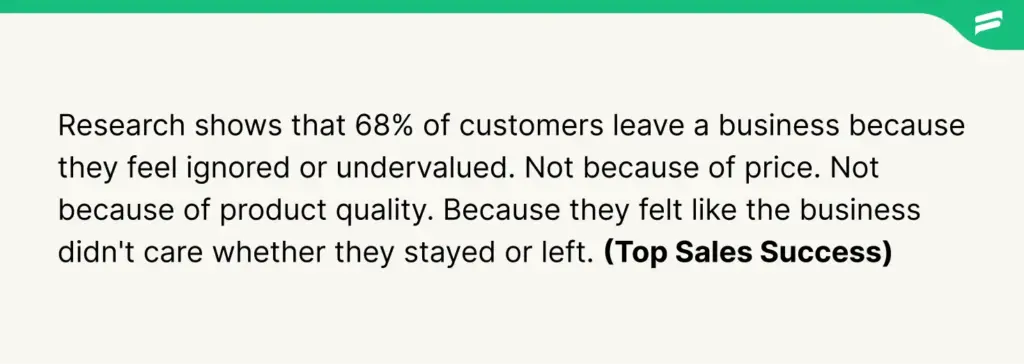
A genuine thank you addresses that directly. It signals that you notice your customers and appreciate their choice to buy from you instead of a competitor.
In competitive B2C markets where customers have dozens of options, this emotional connection becomes a differentiator. Two businesses might sell similar products at similar prices. But the one that makes customers feel valued is the one they remember.
Gratitude also creates relationship continuity. Most customer interactions end with a transaction. The order ships, the service ends, and then silence. A thank you bridges that gap. It keeps your business present in the customer’s mind without being pushy or salesy.
Let me give you a real scenario I’ve seen play out:
A customer orders from two different online shops in the same week. Both orders arrive on time. Both products are fine. But only one business sends a short, personalized thank you message.
Six months later, when that customer needs something similar, which business do you think they remember? Which one feels like a relationship instead of just a transaction?
The one that took 30 seconds to say thank you.
It’s a small thing. But small things compound over time when you’re trying to build loyalty.
The five moments that deserve a thank you (and one that doesn’t)
Timing determines whether gratitude feels genuine or automated.
Send it at the right moment, and it strengthens the relationship. Send it at the wrong moment, and it feels tone-deaf or manipulative.
Let me walk you through when it actually works.
Why this phrase has lost its impact over time
“Thank you for your business” has become background noise in customer communication.
Customers hear it so often, in so many contexts, that it barely registers anymore.
Here’s why it feels hollow most of the time.
First,
It’s overused. Every industry, every business, every automated email system defaults to this exact phrase. When everyone says the same thing, nobody stands out.
Second:
It’s almost always automated. Customers can tell when a message was triggered by a system instead of written by a person. The timing gives it away. The generic phrasing gives it away. The fact that it’s identical to what they received from ten other businesses gives it away.
Third:
It lacks specificity. “Thank you for your business” doesn’t reference anything the customer actually did. What business? What action? It’s so vague that it applies to everything and therefore means nothing.
Fourth:
It sounds corporate and distant. The phrasing is formal in a way that creates distance instead of connection. Nobody talks like this in real life. You wouldn’t say “thank you for your business” to a friend who helped you move. You’d say “thanks for helping out” or “really appreciate it.”
Fifth:
It’s frequently paired with a sales pitch. The gratitude gets undermined when the next sentence is “Shop our new arrivals!” or “Here’s 20% off your next purchase.” At that point, the thank you feels like bait, not genuine appreciation.
Okay, let me give you a side-by-side comparison.
Generic version: “Thank you for your business. We appreciate your support.”

Specific version: “Thanks for choosing the blue ceramic vase, Emma. Hope it looks great in your space.”
Both are expressing gratitude. But one is a template that could have been sent to anyone. The other shows that someone actually looked at what Emma ordered and took a second to personalize the message.
That’s the difference between a phrase that gets ignored and one that actually lands.
Four ways to make gratitude feel real, not robotic
Customers can spot fake gratitude immediately. Here’s how to make yours feel meaningful.
Generic praise doesn’t work. Specificity does.
Instead of “thanks for your business,” reference what the customer actually purchased, supported, or did.
Mention the product by name. Acknowledge the context of the interaction. Show that you’re paying attention to them specifically, not just sending the same message to everyone.
For example, compare these two messages:
Generic: “Thank you for your purchase. We appreciate your support.”
Specific: “Thanks for ordering the anniversary gift set, Chris. We packed it this morning and it’ll arrive by Friday.”
The second one takes five extra seconds to write. But it feels completely different because it’s tied to something real.
This applies beyond purchases too. If a customer left a review, mention that. If they referred a friend, acknowledge it by name. If they’ve been with you for a year, say that explicitly.
Specificity is what separates real gratitude from automated noise.
Not every thank you belongs in an email. The channel matters.
Email works well for detailed, informational messages. It gives you space to explain what happens next or include order details.
SMS works better for quick, personal check-ins. It feels more immediate and conversational. Use it for simple acknowledgments that don’t need a lot of context.
Handwritten notes work for high-value customers or special occasions. They require effort, which makes them memorable. But they don’t scale well, so save them for moments that warrant the extra touch.
Social media works for public acknowledgment. Responding to a customer’s post or thanking them in a comment shows appreciation in a visible way that other customers see too.
The key is matching the channel to the relationship stage and the type of gratitude you’re expressing. A first-time buyer might get a friendly email. A customer who’s been with you for five years might deserve something more personal.
Tone should shift based on where the customer is in their relationship with your business.
First-time buyers need a welcoming, informative tone. They’re still figuring out who you are. Your thank you should make them feel like they made a good choice and set clear expectations for what happens next.
Repeat customers deserve a familiar, appreciative tone. They already know how things work. Your thank you can be shorter and more casual because you’ve established a relationship.
Long-term customers warrant a personal, warm tone. They’ve stuck with you through multiple purchases or years of support. Your gratitude should reflect that history.
For example, here’s how tone shifts across these stages:
First purchase: “Thanks for giving us a try, Alex. Your order ships tomorrow, and we’ll send you a tracking number as soon as it’s on its way.”
Repeat purchase: “Welcome back, Alex. Always good to see you.”
Long-term customer: “You’ve been with us for three years now, Alex. That’s worth celebrating. Thanks for sticking around.”
Same customer. Different stages. Different tone.
Brevity doesn’t mean generic. It means respecting the customer’s time while still being specific.
You don’t need to write a long, heartfelt message every time you thank someone. In fact, shorter messages often feel more genuine because they don’t try too hard.
Two sentences with real specificity are more effective than a paragraph of vague praise.
For example: “Thanks for giving us a second chance after the shipping delay, Jordan. Your order is on its way now.”
That’s 18 words. But it acknowledges a specific situation, shows you remember what happened, and gives a clear update. Nothing extra. Nothing fluff.
Compare that to: “We wanted to take a moment to express our sincere gratitude for your continued support of our business. Your loyalty means the world to us, and we’re committed to providing you with the best possible experience every time you shop with us.”
That’s 44 words of nothing specific. It sounds nice, but it doesn’t actually say anything meaningful.
Keep it short. Make it specific. That’s where real gratitude lives.
Just a heads up: Making gratitude feel personal requires seeing the full customer story. Every purchase, every support conversation, every milestone.
Fluent Support gives you that visibility in WordPress. One dashboard. Complete history. Context your team can actually use.
What to Say Instead of the Same Tired Phrase
Sometimes the best approach is saying it differently. Here are alternatives that feel fresher and more genuine.
After a first purchase:
After a repeat purchase:
After a support resolution:
At a milestone:
After a referral:
After a review:
Small business context:
General alternative:
Notice what these have in common: they’re specific, conversational, and tied to something real. They don’t sound like they came from a corporate template.
That’s what makes them work.
Mistakes that make customers roll their eyes
Even well-intentioned thank yous can backfire if you make these common mistakes.
Over-thanking dilutes the meaning.
If you’re thanking customers after every minor touchpoint, the words stop carrying weight.
Customers don’t need a thank you after they open your email, visit your website, click a link, and make a purchase. One genuine thank you at the right moment is more effective than four generic ones.
For example, sending a thank you email after the purchase, a thank you SMS when it ships, a thank you note inside the package, and a follow-up thank you email asking for a review is overkill. Pick one or two moments that actually warrant gratitude.
Thanking with an immediate upsell feels transactional.
“Thanks for your purchase! Here’s 20% off your next order!” isn’t gratitude. It’s a sales pitch disguised as appreciation.
If you want to offer a discount or promote something, separate it from your thank you message. Give the gratitude room to breathe. Let it stand on its own without being tied to another transaction.
Customers notice when you’re trying to sell them something in the same breath as thanking them. And it undermines the sincerity of the gratitude.
Using the same message for everyone makes it meaningless.
If a first-time buyer and a five-year customer receive identical thank you messages, neither feels valued.
Customers can tell when you’re using a template. Even small customization makes a difference.
At minimum, reference something specific about their interaction with your business. That’s the difference between “thanks for your business” and “thanks for your order.”
Poor timing makes gratitude feel like an afterthought.
Send a thank you too late, and it feels like you forgot about the customer and remembered at the last minute.
Send it too early, and it feels automated. A thank you message that arrives two seconds after an order is placed didn’t come from a human. It came from a trigger in your email system.
The sweet spot for most interactions is 24 to 48 hours. Long enough that it doesn’t feel instant. Soon enough that the interaction is still fresh.
Thanking customers during active problems is tone-deaf.
Don’t send “thank you for your business” while a customer is still frustrated about a delayed shipment, a defective product, or an unresolved support issue.
They don’t want gratitude in that moment. They want you to fix the problem.
Wait until the issue is actually resolved. Then thank them for their patience or for working with you to sort it out.
Timing matters. Context matters. Gratitude at the wrong moment makes things worse, not better.
Wrapping up
Gratitude works when it’s real.
The phrase “thank you for your business” isn’t broken. It’s just overused and misapplied. When you make it specific, timely, and genuine, it becomes something customers actually appreciate.
Start small. Pick one moment in your customer journey where gratitude makes sense. Write a message that references something real.
What you’ve learned here gives you the foundation. Practice applying it to different situations. The more you use these principles, the more natural your messaging becomes.
Lastly, thanks for taking time reading this blog.
Start off with a powerful ticketing system that delivers smooth collaboration right out of the box.
Related Articles
How to Setup a Support Ticket System in WordPress?
Learn how to set up a support ticket…Fluent Support 2.4.0: Advanced Reports, AI Ticket Audit, and Portal Protection
Fluent Support 2.4.0 rebuilds reporting with a full…

Add your first comment to this post