

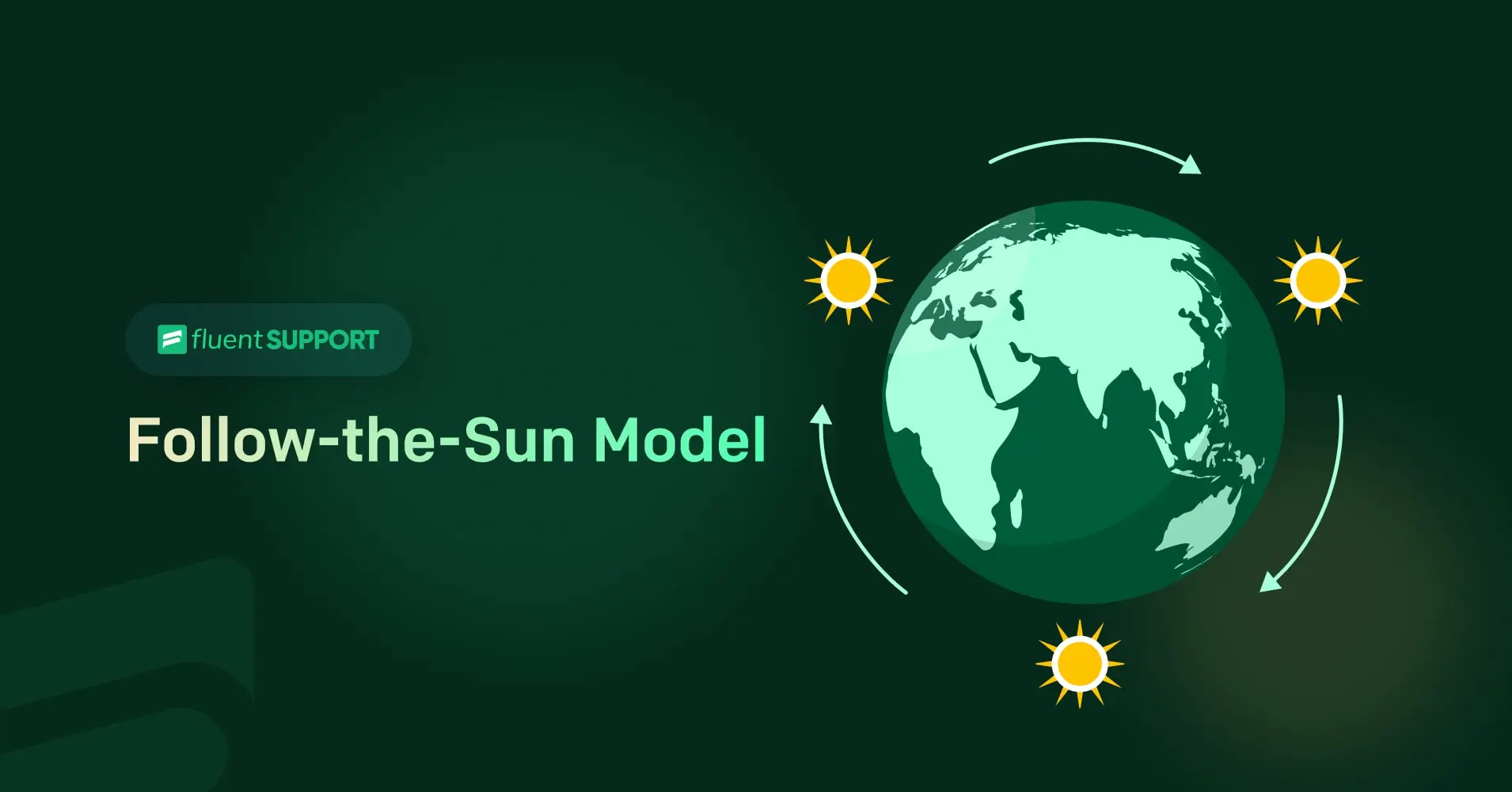
Follow the Sun Model: Run 24/7 Customer Support Smoothly

By Md. Sajid Sadman
June 5, 2026
Last Modified: June 5, 2026


A customer in Sydney hits a critical bug at 2 PM their time. Your only support team sits in Austin, fast asleep, so the ticket goes untouched for nine hours.
That gap is not a staffing problem you can patch with overtime. It is a time zone problem, and piling night shifts onto one team just trades a customer issue for an agent retention issue.
The follow-the-sun model fixes the root cause. It spreads support across regions so the workday never really ends, it simply moves west.
This blog walks through how the model works, six real benefits, six honest drawbacks with fixes, and how to tell if it fits your business.
TL;DR
What is the follow-the-sun model?
It is a customer support approach where teams in different time zones hand off open tickets to each other, so service runs around the clock without anyone working night shifts.
How does it work?
The day is split into two or three regional shifts, and each team documents and passes its open tickets to the next region as its workday ends. A ticket can be triaged in Manila, fixed in Berlin, and confirmed in Austin while the customer sleeps.
What does it need to work?
Five things: teams distributed across the right time zones, a standardized handoff process, overlapping shift windows, one unified helpdesk platform, and a central knowledge base everyone shares.
What are the benefits?
Six big ones: faster resolutions, lower coverage cost, less agent burnout, a stronger customer experience, built-in resilience when one region goes down, and a competitive edge over rivals stuck on local hours.
What are the disadvantages?
Six to watch, each with a fix: handoff gaps, communication strain across time zones, inconsistent quality between regions, cultural and language differences, coordination overhead, and high upfront setup cost.
Is it right for your business?
It fits global, high-volume, or complex-ticket operations. It is overkill if your tickets mostly cluster inside local business hours.
How do you implement it?
Roll it out in three phases. First plan around your ticket data and pick your time zones, then build the foundation with one platform, a shared knowledge base, and a handoff template, and finally launch a two-region pilot with real overlap before you align everyone on shared metrics and scale.
How is it different from regular 24/7 support?
Plain 24/7 support often leans on night shifts or on-call staff, while follow-the-sun gives round-the-clock coverage using teams working their normal daytime hours.
What is the follow-the-sun model?
The follow-the-sun model is a customer support approach where teams in different time zones hand off open tickets to each other so service continues around the clock. The work moves with the daylight, which is where the name comes from.
So instead of one team covering a brutal 24-hour stretch, each regional team works its normal daytime hours. When one team logs off, the next team to the west is just starting its day and picks up where the last one stopped.
Think of it as a relay race rather than a marathon. No single runner sprints the whole distance, and the baton is the open ticket queue passed cleanly from hand to hand.
Your business is a strong candidate for the follow-the-sun model if you:
- Serve customers spread across multiple time zones
- Get a steady flow of tickets outside your local business hours
- Support software or systems where downtime costs real money
- Want round-the-clock coverage without forcing anyone onto night shifts
How does the follow-the-sun model work?
Most teams think the hard part is hiring people abroad. The real engine is the handoff, the moment one team passes its open work to the next without dropping context.
The day gets divided into regional shifts, usually two or three, so there is always an active team that owns the queue. A common three-region split looks like this:
| Regional team | Local hours covered | Hands off to |
| APAC team (Manila) | 9 AM to 6 PM PHT | EMEA team |
| EMEA team (Berlin) | 9 AM to 6 PM CET | Americas team |
| Americas team (Austin) | 9 AM to 6 PM CT | APAC team |
Each team starts its day by reviewing what arrived overnight and picking up the tickets the previous shift could not close. At the end of the shift, the outgoing team documents the status of every open ticket, notes what has been tried, and flags anything urgent.
Here is how a single ticket travels. A customer in Tokyo reports a broken checkout at 8 PM their time, the Manila team triages it and gathers logs, then hands it to Berlin with a clear summary. Berlin pushes a fix to staging, documents the result, and passes it to Austin, who confirms the fix and closes the loop while Tokyo sleeps. By morning in Japan, the issue is already solved, which is a direct win for your first response time.
The incoming team overlaps with the outgoing one for a short window and reads those notes before diving in. Done well, the customer never repeats themselves and may not even notice that a new agent took over.
Key components that make the model work
So what makes one setup run smoothly while another leaks tickets at every shift change? It comes down to five pieces that have to be in place before you flip the switch.
Distributed teams in the right time zones
You need teams in at least two major time zones to cover extended hours without anyone working overnight. Where you place them depends on where your customers actually are, not just where talent happens to be cheap.
A standardized handoff process
Every open ticket needs a clear status note at the end of a shift. A simple template with required fields keeps notes consistent across regions, so the next team is not left guessing what happened.
Overlapping shift windows
The cleanest handoffs happen when both teams are briefly online together, usually for 30 to 60 minutes. That overlap lets the outgoing team walk through urgent cases live and answer questions before they sign off.
One unified helpdesk platform
All regions have to work from the same system. If one team uses a different tool or cannot see the full ticket history, the handoff breaks and the model collapses. This is where a single helpdesk dashboard earns its keep, and choosing the right ticketing software matters more than most teams expect.
A central knowledge base
Consistent answers across regions depend on a shared source of truth. A well-maintained knowledge base gives every agent the same product information and troubleshooting steps, so a customer gets the same quality of help at 3 AM as they would at 3 PM.
Benefits of the follow-the-sun model
Customer expectations keep climbing, and patience is shrinking.
In Zendesk’s 2026 research, 74% of customers said they now expect 24/7 availability and Salesforce found that 82% of service professionals believe expectations are higher than ever.
The follow-the-sun model is a practical way to meet that bar, and the wins go well beyond simply being awake. You can see how steeply these customer expectations have risen across recent surveys.
Disadvantages of the follow-the-sun model and how to fix them
The model is not magic, and pretending it has no downsides is exactly how implementations fall apart. Almost every problem traces back to coordination rather than the idea itself, and each one has a fix.
Is the follow-the-sun model right for your business?
Before you redraw your team’s map, it is worth asking whether the model actually fits. It is a powerful system, but it is not for every operation.
Run through these questions first:
- When do your tickets actually arrive? Pull your historical data. If 90% of tickets land between 10 AM and 4 PM local time, a follow-the-sun setup is overkill, and you can snooze the rest for the next day.
- How global is your customer base? The model pays off when customers are genuinely spread across time zones. A purely local audience rarely needs it.
- How complex are your tickets? If most issues need deep, hands-on work across a shift, continuous coverage helps. If they are quick fixes, your current team may handle them fine.
- Is night-shift staffing expensive where you are? When local overtime is costly, building a daytime team in another region can be the smarter spend.
How to implement the follow-the-sun model: a step-by-step guide
Knowing the model is one thing. Standing it up without dropping tickets is another, so here is the rollout in three phases you can move through in order.
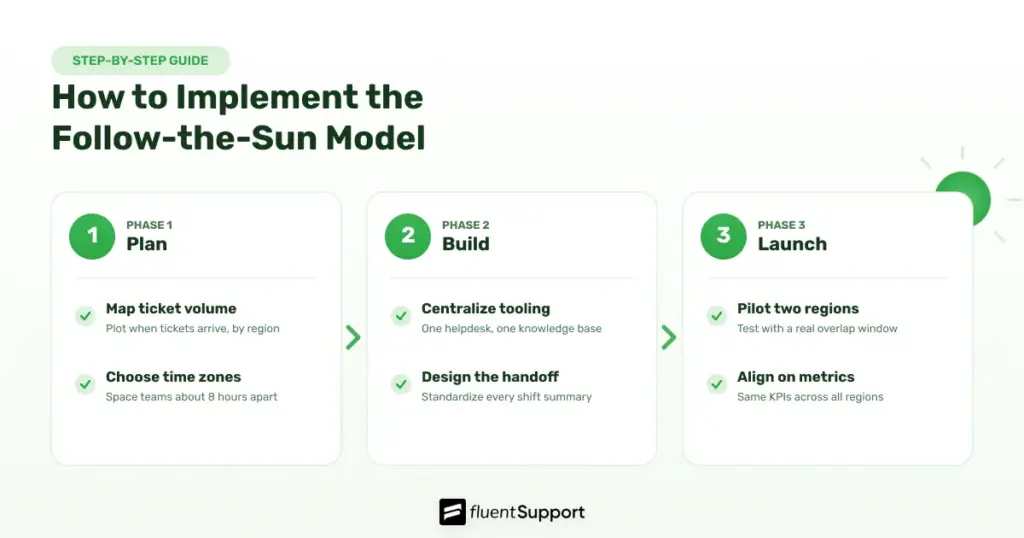
Phase 1: Plan before you hire anyone
Step 1: Map your ticket volume by hour and region
Pull at least three months of ticket data and plot when tickets arrive, by the customer’s time zone. This shows your real coverage gaps, so you build teams around demand instead of guessing.
A simple map looks like this:
| APAC (UTC+8): 18% of tickets, peak 10 AM to 2 PM local EMEA (UTC+1): 34% of tickets, peak 9 AM to 12 PM local Americas (UTC-6): 48% of tickets, peak 11 AM to 5 PM local |
If a region barely registers, skip it for now. Data, not ambition, picks your first hires.
Step 2: Choose your coverage model and time zones
Decide whether you need full 24-hour coverage or just extended hours, then pick time zones spaced roughly eight hours apart. Even spacing gives you clean shift boundaries and a built-in overlap window.
A two-region start of EMEA plus Americas already stretches coverage to around 16 hours with no night shift. Add APAC later when its volume justifies it.
Phase 2: Build the foundation
Step 3: Centralize on one platform and one knowledge base
Move every region onto a single helpdesk with a shared knowledge base before you scale headcount. If teams work from different tools or scattered docs, handoffs break and customers get different answers depending on who is awake.
At a minimum it needs a tagged article for every recurring issue, a troubleshooting flow for your top ten ticket types, and a note on how you phrase things. Treat it as the single source of truth every region updates as they learn.
Just a heads up: a follow-the-sun setup is only as good as the tool your teams hand off inside. Fluent Support keeps every region in one shared inbox with internal notes and automated ticket routing, so context travels with the ticket instead of getting lost between shifts.
Step 4: Design your handoff template
Create one mandatory handoff format the outgoing team fills in for every open ticket before logging off. A fixed template removes guesswork, so the incoming team picks up context in seconds.
A handoff entry that works:
| Ticket #4821 | Priority: High | Customer: Tokyo, JST Status: Fix deployed to staging, awaiting QA Tried: Reproduced bug, isolated to checkout API, patched Next action: Verify fix in production, then confirm with customer Watch out: Customer is on a paid plan, SLA clock at 4 hrs |
Make the fields required so a ticket cannot be handed off half-documented.
Phase 3: Launch, measure, and refine
Step 5: Run a two-region pilot with real overlap
Start with two regions and a 30 to 60 minute overlap where both teams are online together. A live overlap lets the outgoing team walk through urgent cases out loud, catching the edge cases a written note misses.
Sit in on a few handoffs yourself and watch where context gets lost. Fix the template and the routine before you add a third region, because problems multiply with every new site.
Step 6: Align everyone on the same metrics and close the loop
Measure every region against identical KPIs so you can compare fairly and spot weak handoffs early. Shared numbers turn vague impressions of slowness into something you can act on.
Track these weekly across all regions:
| First response time and average handling time, split by region Re-contact rate (a spike here usually means a bad handoff) CSAT by shift, to catch quality drift between teams |
Review the numbers in a recurring cross-region call. That habit doubles as customer service collaboration, and a glance at average handling time trends tells you fast if a region is struggling.
Wrapping Up
You just walked through what the follow-the-sun model is, how a single ticket moves across the globe, six benefits, six drawbacks with fixes, and a phased plan to roll it out. That is more than most companies grasp before they ever attempt it.
Your next step is small. Look at when your tickets come in and where your customers sit, then let that data decide whether continuous coverage is worth the coordination. If it is, start with two regions and one airtight handoff process before you add a third.
The sun never stops moving, and with the right setup, neither does your support.
Start off with a powerful ticketing system that delivers smooth collaboration right out of the box.
FAQ
24/7 support just means someone is available at all hours, which often relies on night shifts or on-call staff. The follow-the-sun model is a structured version of round-the-clock coverage where regional teams hand off work during their normal daytime hours, so no one has to work overnight.
Industries where slow responses cost money benefit most: software and SaaS, IT services, ecommerce, financial services, and healthcare. Basically any business with customers or systems active outside local hours.
The biggest challenges are poor handoff quality, communication strain across time zones, and inconsistent service between regions. All three are manageable with standardized handoffs, a shared helpdesk, and aligned metrics.
No. Many companies start with just two regional teams covering extended hours, then add more regions as ticket volume grows.
Related Articles
Customer Service Checklist: A Practical Guide for Support Teams
A practical customer service checklist covering readiness, communication,…Personalized Customer Experience: What It Is and How to Build It
A personalized customer experience is when a business…




Leave a Reply