
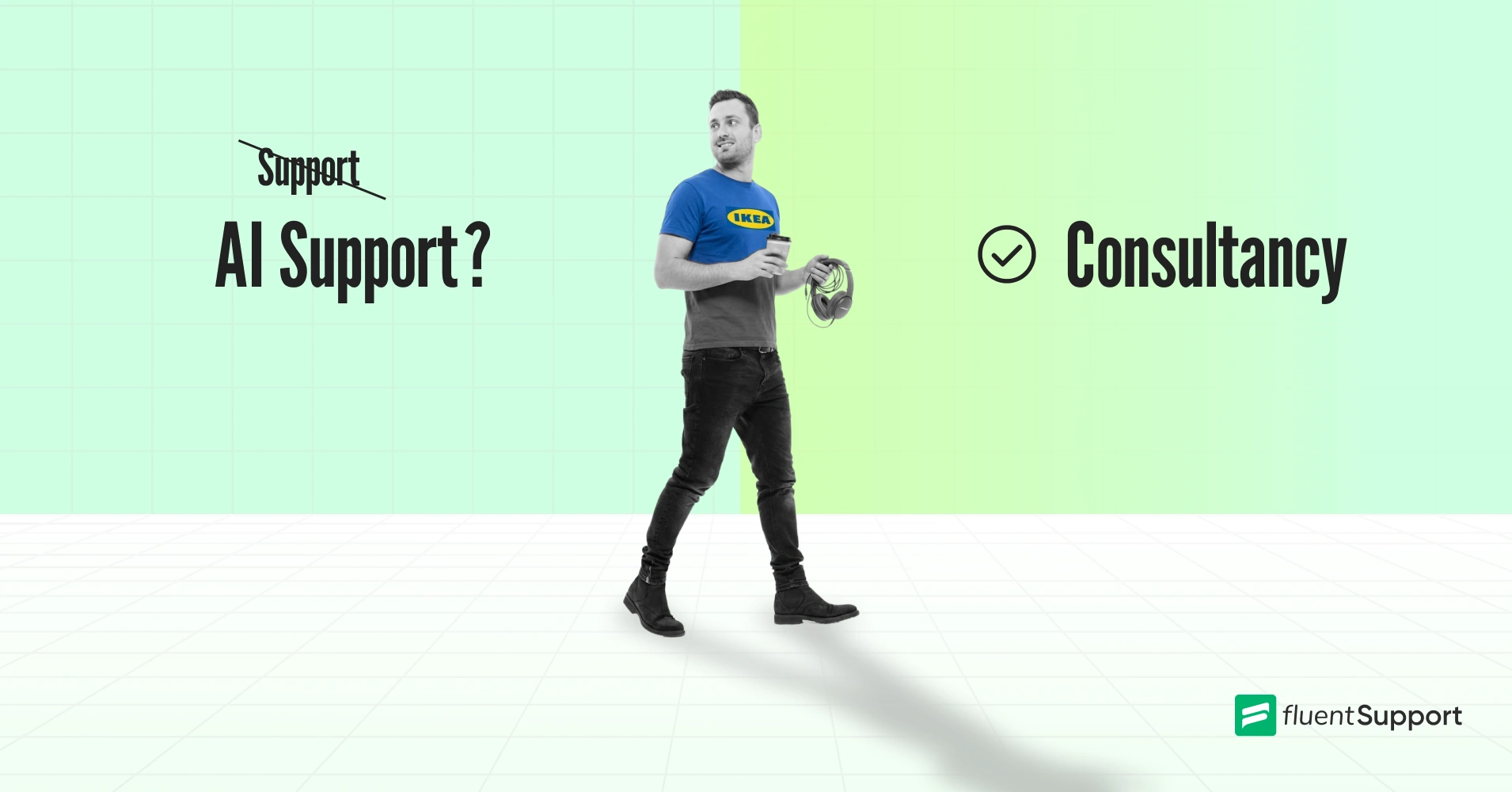
How IKEA Turned AI ‘Failures’ Into €1.3 Billion in Revenue

By Prosanjit Dhar
April 1, 2026
Last Modified: April 1, 2026


Most companies deploy an AI chatbot, watch the deflection rate climb, and call it a success.
But IKEA looked at what the AI couldn’t answer and built a €1.3 billion revenue channel from it.
That gap in thinking is worth understanding carefully, because it changes how you look at every unresolved support ticket in your queue.
AI chatbot named after iconic Billy bookcase
In 2021, Ingka Group (the largest of the 12 IKEA franchise operators worldwide) launched an AI chatbot called Billie. The name was a nod to IKEA’s iconic Billy bookcase range.
Bille deflects IKEA’s high volume of repeatable customer queries hitting call centres every day (order status, product availability, store information, return procedures.
By any standard measure, Billie performed. As reported by Reuters in June 2023 and documented by CX Today, the AI bot Billie handled 47% of all customer enquiries from 2021 onwards.
This is approximately 3.2 million interactions handled without a human agent picking up the phone.
For most companies, that number ends the conversation. And, why not?
A near-50% deflection rate is a headline metric. It goes into the board deck and justifies the investment.
But hold on!
Ingka Group didn’t stop there. They kept reading.
What lived in the other 53%
The 53% of the enquiries Billie could not resolve were not random. They were not simply harder versions of the same routine questions.
When the Ingka Group examined them for patterns, a clear signal emerged.
Customers were repeatedly reaching out for help with home planning and interior design.
Guidance on:
- How to configure a living space
- Which products worked together
- Or how a room could be arranged
These were not transactional queries. They were consultative ones.
An AI chatbot, no matter how well-trained, cannot replicate that conversation for now. But a skilled human adviser can.
This is the moment where IKEA’s response diverged entirely from the common industry norm.
8,500 people who kept their jobs and got better ones
The conventional response to a 47% automation rate in a call centre would have been to reduce headcount proportionally. Fewer calls needing human agents means fewer human agents needed. The math is straightforward.
However, Ingka Group did not run that calculation.
Instead, the company launched a structured reskilling programme and trained 8,500 call centre workers as remote interior design advisers. These were existing staff, given new skills and moved into a new role.
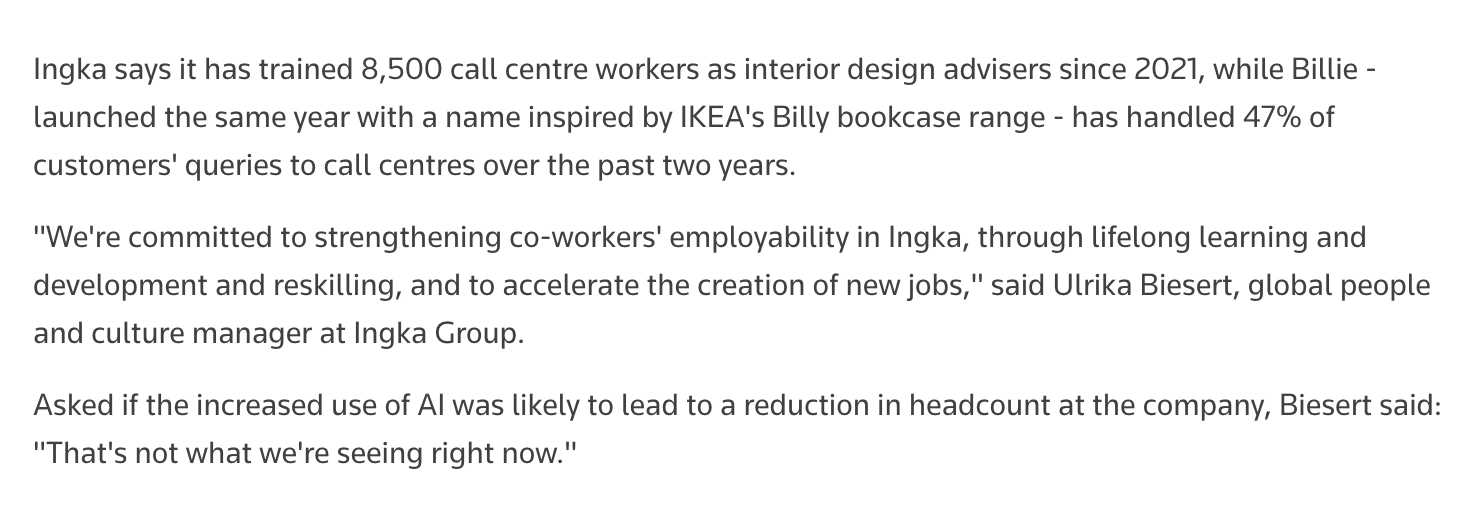
Ulrika Biesert, Global People and Culture Manager at Ingka Group, told Reuters directly:
We’re committed to strengthening co-workers’ employability in Ingka, through lifelong learning and development and reskilling, and to accelerate the creation of new jobs.
When asked whether Billie would lead to job cuts, her answer was unambiguous:
That’s not what we’re seeing right now.
The retrained advisers then began operating a dedicated remote consultation service.
They conducted interior design sessions via phone and video, guiding customers through product selections, room configurations, and home improvement plans.
The result was not a cost saving. It was a new business line.
€1.3 billion is not a projection
Ingka Group’s remote interior design channel generated €1.3 billion in revenue in FY2022. That financial year ended on August 31st, 2022. That figure represented 3.3% of Ingka’s total annual revenue.
To put that in context, Ingka’s entire online product sales for the same period totalled approximately €9.9 billion, or 25% of total sales.
The remote design channel (built from analysing what a chatbot couldn’t handle) was already producing revenue at a scale comparable to a meaningful fraction of a mature e-commerce operation.
Ingka Group has now set a target of reaching 10% of total revenue from this channel by 2028, in part as a deliberate strategy to attract a younger, Generation Z customer base.
Surprisingly, this is an effective strategic business unit that emerged from support ticket analysis.
The mistake most teams make
There is a standard model for AI in customer support: deploy automation, increase deflection, reduce cost per contact, and report the savings. It is a financially coherent model, and it is not wrong.
But the problem is what it causes teams to discard.
Unresolved or escalated tickets are typically treated as operational overflow that exceeded the system’s capability and needed human handling. Once resolved, they are closed and forgotten. The data they contain is not retained as strategic intelligence.
IKEA’s documented case is the clearest counter-example in the public record. The unresolved enquiries were not failures. They were a map. Ingka Group read the map, identified the destination, and built a route to it. One that generated €1.3 billion in its first year at scale.
The question is not whether your AI tool has a high enough deflection rate. The question is what you are doing with everything that cannot be deflected.
Where Fluent Support fits in
For WordPress-based businesses (eCommerce stores, digital agencies, SaaS products, subscription services), the operational challenge is the same, even at a smaller scale.
Routine enquiries consume agent time. Complex or unresolved cases accumulate. But the patterns within them go unexamined.
Fluent Support is a self-hosted WordPress helpdesk and ticketing plugin that addresses both sides of that equation. Its Pro version includes OpenAI integration, with documented AI capabilities:
- Ticket summarization condenses an inquiry into a structured overview. Agents reviewing a complex thread no longer need to read the full message to understand context.
- Customer sentiment analysis automatically detects whether a customer’s tone is positive, neutral, or negative across their interaction. This enables teams to prioritise responses and identify at-risk relationships before they escalate further.
- AI-generated response drafts give agents a starting point rather than a blank reply window. Drafts can be reviewed and fine-tuned line by line, and the underlying prompts can be customized to match a brand’s specific communication style.
And because Fluent Support is self-hosted, all of that data lives on your own WordPress installation. Your support data is yours to analyse, on your own terms.
For teams already using WPManageNinja products, Fluent Support integrates natively with FluentCart, Fluent Forms, and FluentCRM, connecting support operations directly to lead capture and customer relationship workflows.
Running the same play
Back to IKEA, its approach reduces to a sequence that any support operation can apply at its own scale:
Enable AI tools to handle the repetitive and routine volume. Then use filters, sentiment flags, and activity logs to examine the cases that needed human attention.
Look for the clusters and find the questions that keep appearing in different forms. Then try to understand what they have in common, and what gap in your current offering they point toward.
Not every pattern will contain a revenue opportunity. Some will reveal a product documentation problem. Others will point to a confusing checkout flow.
But none of them will reveal anything if the tickets are simply closed and the data is left unread.
All of this analysis, in Fluent Support, runs on data held entirely within your own environment. The intelligence is there, in your own system, waiting to be examined.
A Lesson from IKEA’s €1.3 billion
IKEA didn’t generate €1.3 billion by deploying a smarter chatbot. It generated €1.3 billion by being curious about what the chatbot couldn’t do.
Billie’s 47% deflection rate was the starting point, not the conclusion.
The conclusion was a new service line, 8,500 retrained employees, and a revenue channel now targeted to reach 10% of Ingka Group’s total business by 2028.
The automation was not a strategy or cost reduction campaign. The analysis was.
Wrapping up
Nowadays, many companies think that they will automate their overall service with AI and reduce costs. But that’s not what IKEA did.
They use Billie (AI Chatbot) to reduce the repetitive tasks of their support agent. And, train them for the unique or more advantageous strategy.
At the end, IKEA’s support agent became more valuable than a chatbot and contributed strategically to the company’s growth.
So, what will be your next strategy that will make 1 billion in revenue in the upcoming years?
Start off with a powerful ticketing system that delivers smooth collaboration right out of the box.
Related Articles
How to Reduce Customer Churn Rate: A Complete Guide
Customer churn rate is the percentage of customers…What Is Customer Profiling and Why Does It Matter More Than You Think
Most businesses collect customer data. Very few actually…



Leave a Reply