
Omnichannel Customer Support: The Guide for Support Teams

By Md. Sajid Sadman
March 11, 2026
Last Modified: March 11, 2026


A customer sends a message on Instagram. No response after two hours, so they email. Still nothing. They call. The agent picks up with zero knowledge of the previous two attempts. The customer has to explain everything from scratch.
This happens thousands of times a day across businesses that believe they offer good support.
That is not a staffing problem. It is a structural one. And it is exactly what omnichannel customer support is designed to solve.
This guide covers what omnichannel support actually means, why most implementations fall short, and what it takes to build a system that works as one unit rather than a collection of disconnected tools.
TL;DR
What is omnichannel customer support?
It is a support system where every channel shares the same customer history. A customer can start on chat, switch to email, and call later without repeating themselves once. Every agent sees the full picture.
How is it different from multichannel support?
Multichannel means being present on multiple platforms. Omnichannel means those platforms are connected. The difference is not the number of channels. It is whether context travels with the customer.
Why do most companies get it wrong?
They add channels without connecting them. They focus entirely on the customer experience and ignore how much friction their agents are dealing with. And they measure channel-specific metrics instead of cross-channel ones.
Is there a real business case for it?
Yes. The retention gap, the CSAT gap, and the cost of failed implementations all point in the same direction. The impact of getting this wrong accumulates quietly until it becomes very expensive.
What does it take to build it properly?
A unified customer record comes first. Everything else depends on it. From there, integration-first tooling, teams aligned around the customer journey rather than individual channels, and cross-channel metrics that actually reflect handoff quality.
Where does AI fit into this?
AI is becoming a standard support touchpoint. The systems that share context between AI interactions and human agents will define what omnichannel means going forward.
What does good omnichannel support actually feel like?
The customer feels remembered. They do not repeat themselves. The agent already knows the history. The interaction feels less like a transaction and more like a continuation.
What Omnichannel Customer Support Actually Means?
The word gets used loosely. So it is worth being precise.
Omnichannel customer support means a customer can reach out through any channel, switch channels mid-conversation, and never have to repeat themselves. Every agent sees the same history. Every interaction is part of one continuous thread.
The emphasis is on continuity. Not on how many channels you offer.
Multichannel vs. Omnichannel: They Are Not the Same Thing
Most businesses offering support across email, chat, phone, and social media think they are doing omnichannel. They are usually doing multichannel.
Multichannel means being present on multiple platforms. Each channel operates independently. A chat conversation lives in the chat tool. A phone call is logged somewhere else, maybe not at all. There is no shared view.

Omnichannel means every channel feeds into a single, unified record. The agent on the phone can see the chat from this morning. The follow-up email references what was discussed. The customer does not repeat themselves.
The practical difference is this: multichannel is being present everywhere. Omnichannel is being consistent everywhere.
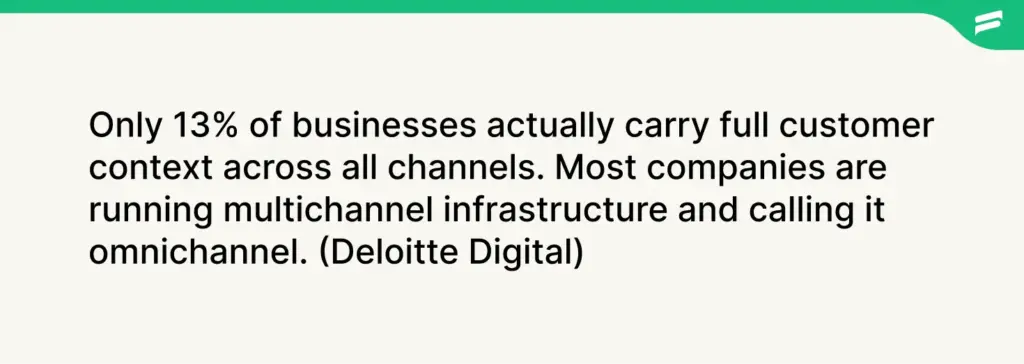
That gap between perception and reality is where most customer experience problems originate.
Why Most Omnichannel Implementations Fall Short
Teams do not fail at omnichannel because they lack ambition. They fail because they approach it as a tooling problem rather than a systems problem.
So. . . let’s look at where it typically breaks down.
# Adding Channels Without Connecting Them
The typical pattern looks like this: a business adds live chat because customers ask for it.
Then a social media inbox because someone on the marketing team thinks it is important.
Then a help center.
Each tool is added in isolation, managed by a different team, and logging data in a different place.
The result is more channels and more fragmentation. Customers have more ways to reach out. Agents have more places to check. Nothing is connected.
Adding a channel without integrating it into a unified system does not improve support. It adds noise.
# Overlooking the Agent Side of the Equation
Omnichannel conversations tend to focus entirely on the customer experience. The agent experience gets much less attention, and that is a real blind spot.
When agents have to toggle between five separate tools to understand a customer’s history, they slow down.
Context-switching between disconnected systems cuts agent productivity by around 40%. More importantly, it leads to mistakes.
Agents miss prior conversations. They give advice that contradicts what a colleague said last week. They open support tickets that are already open.
A well-built omnichannel system reduces effort for agents just as much as it reduces friction for customers. If your agents are still piecing together context manually, the system is not working.
Just a heads up: Fluent Support, a WordPress helpdesk plugin, gives your agents one place to manage every customer conversation. So nothing gets missed and no one is piecing together context manually.
# Treating All Channels as Equal
Not every channel deserves equal investment. The right channel mix depends on who your customers are and what kind of issues they bring.
A B2B SaaS company might need deep email and phone integration with a good escalation path.
An e-commerce brand might need chat, SMS, and social messaging above everything else. Spreading effort evenly across all channels regardless of actual usage leads to average performance everywhere and excellent performance nowhere.
Good omnichannel strategy starts with understanding where your customers actually go, not where you assume they should go.
The Business Case: What Connected Support Actually Delivers
This is not a philosophical argument for better customer experience. The numbers are concrete.
Companies with strong omnichannel strategies retain 89% of their customers. Companies without them retain about 33%. (Aberdeen)
That is not a marginal difference. That is the difference between a business that grows through loyalty and one that constantly hemorrhages customers while chasing new ones.
On the resolution side, unified systems reduce average handle time because agents are not spending the first five minutes of every interaction playing catch-up.
First contact resolution rates improve because agents have the full picture in front of them. Customer satisfaction scores tell the same story.
Businesses running true omnichannel support report CSAT scores around 67%. Businesses with fragmented, disconnected channels report closer to 28%. (SQM Group)
There is also a less-discussed benefit: customer trust.
When someone reaches out and the agent already understands their history, the interaction shifts from transactional to relational. That shift is difficult to quantify but easy to feel. Customers notice.
How to Build an Omnichannel Support System That Works
There is no single tool that solves this. Omnichannel is an architecture. It requires the right foundation, the right integrations, and the right operational habits.
Let’s discuss each of these layers.
Start with a Unified Customer Record
Everything else depends on this. Before thinking about channels, a business needs one place where every customer interaction is stored and accessible. This is typically a CRM or a customer data platform that connects to support tools.
Without this, you are building on sand. You can add channels, train agents, and write great macros. But if the data lives in silos, the experience will remain fragmented.
Choose Platforms That Are Built for Integration
Not all support software is built the same way. Some platforms add channels on top of each other without truly integrating them. Others are designed from the ground up to treat every channel as part of one conversation.
When evaluating tools, the question is not only ‘which channels does this support?’ The more important question is ‘how does this platform share context across those channels?’ Look for unified inboxes, shared ticket histories, and native integrations with your CRM.
Align Teams Around the Customer Journey, Not the Channel
In many organizations, email support is handled by one team, social media by another, and phone by a third. Each team has its own metrics, its own processes, and its own view of the customer.
This is an organizational problem that technology cannot fully fix. Omnichannel requires that the teams responsible for different channels operate from shared data, shared context, and aligned goals. A handoff from chat to phone should feel seamless to the customer. That only happens if the teams behind those channels are working as one unit.
Define What You Are Actually Measuring
Support teams often measure channel-specific metrics: average response time on email, CSAT on chat. These matter, but they do not capture omnichannel performance.
The metrics that matter most in an omnichannel system are cross-channel ones.
If you are not measuring the handoff quality, you have no visibility into where the system is actually breaking down.
Omnichannel Support in 2026: The AI Layer
The conversation around omnichannel is changing. The next frontier is not adding more channels. It is building systems where AI and human agents share the same context and memory across every interaction.
About 45% of consumers now turn to AI tools like ChatGPT or Gemini before contacting official support channels. (Gartner)
This is not a trend to resist. It is a signal that the definition of a support channel is expanding. Your omnichannel strategy needs to account for AI-assisted touchpoints alongside human ones.
The real promise of AI in omnichannel support is not automation for its own sake. It is continuity. An AI system that retains context across sessions means a customer never has to re-explain a problem, whether they are talking to a bot or a person. That is the natural extension of what omnichannel has always been trying to achieve.
What This Looks Like in Practice
A customer interacts with an AI assistant to troubleshoot an issue. The assistant cannot resolve it and escalates to a human agent. The agent receives the full transcript of the AI conversation, the customer’s history, and a summary of what was already tried. The customer says nothing they have already said.
That is not futuristic. That is table stakes for a well-integrated omnichannel system in 2026.
Teams that are building this kind of continuity into their support infrastructure now will be significantly ahead of those that treat AI as a separate, bolted-on feature.
What Good Omnichannel Support Feels Like
It is worth stepping back from the systems and the metrics for a moment to describe what this actually looks like from a customer’s point of view.
A customer buys a product. Three weeks later, they have a question. They reach out on chat, get a partial answer, and the conversation gets saved. Two days later they email with a follow-up. The agent handling the email sees the original chat and picks up exactly where it left off. No summary needed. No apology for not knowing the backstory.
That experience creates something that is genuinely rare: the feeling of being remembered. It is not dramatic. It does not require extraordinary effort. It just requires a system where information moves as fluidly as the customer does.
That is what omnichannel support is supposed to deliver. Not a longer list of channels. A better-connected experience.
Wrapping Up
Omnichannel customer support is not a feature you switch on. It is a system you build deliberately, layer by layer.
The businesses getting it right are not the ones with the most channels. They are the ones that treat every customer interaction as part of one ongoing conversation.
That shift in thinking is what separates genuine omnichannel from the version most companies are running today.
If your customers are still repeating themselves, your channels are not connected enough. That is the simplest diagnostic there is.
Lastly, thanks for taking time reading this blog.
Start off with a powerful ticketing system that delivers smooth collaboration right out of the box.
Related Articles
What Is Customer Profiling and Why Does It Matter More Than You Think
Most businesses collect customer data. Very few actually…Is “AI Brain Fry” Burning Out Your Support Team?
AI brain fry is a new form of…



Leave a Reply