


Customer Success Team: Roles, Structure, and How to Build One

By Md. Sajid Sadman
August 24, 2026
Last Modified: August 24, 2026


A customer success team is the group responsible for helping customers get value from a product after the contract is signed. Support closes tickets. Success closes the gap between what a customer bought and what they use.
Most software companies learn this the hard way. A customer signs up, gets onboarded, and cancels six months later because nobody checked in when usage dropped. The product worked. Nobody was watching.
What does a customer success team do, and how do you build one that catches problems before they turn into churn?
In this blog, we will look at the roles, structures, and steps involved in building a team that keeps customers around.
Key Takeaways
- A customer success team proactively helps customers adopt, use, and renew a product.
- It differs from customer support, which reacts to individual issues as they come in.
- Core roles include the CSM, a CS operations manager, and a CS leader such as a director or CCO.
- Teams are typically structured by customer segment, lifecycle stage, or engagement model.
- Building one starts with a single hire, a few clear metrics, and a defined customer journey.
What Is a Customer Success Team
A customer success team is a group within a company that proactively helps customers reach their goals with a product. It covers onboarding, adoption, retention, and renewal rather than reacting to individual support requests one ticket at a time.
- Onboarding: Onboarding gets new customers set up and using the product early.
- Adoption: Adoption makes sure customers use the features they are paying for.
- Retention: Retention spots risk signals before a customer decides to leave.
- Growth: Growth finds upsell and expansion opportunities inside existing accounts.
Customer support and customer success often get grouped together, but they solve different problems. Support reacts to a specific request, resolves it, and closes the case. Success works ahead of that moment. It checks usage and account health before a customer needs to open a ticket.
The two functions work best side by side, with a support team handling daily issues while CS focuses on outcomes and renewals.
A quick example makes the difference concrete.
Brightpath, a project management tool with 900 customers and 6 million dollars in annual recurring revenue, used to route every customer question straight to support. Tickets got answered fast, but nobody noticed that a client called Redline Construction had stopped logging into the product for five weeks. Support had no ticket to react to, because Redline never complained. They just quietly stopped using the tool and canceled at renewal. A customer success team exists to catch exactly that kind of silence before it turns into a lost account.
Why Businesses Build a Customer Success Team
Retention costs less than acquisition, and a customer success team is how companies protect that revenue. When nobody owns the relationship after the sale, accounts drift. Customers keep paying for a product they barely use, then cancel without warning.
A structured team changes that pattern. It tracks usage, flags risk early through a customer health score, and connects customers to more of what they need before a renewal conversation starts. This shift from reactive service to proactive value is what separates companies with stable revenue from ones that lose customers every quarter.
Go back to Redline Construction. If Brightpath had a CSM watching login frequency and feature usage, the five week silence would have triggered an outreach after week two, not a cancellation notice after week five. That one saved account is worth more than the CSM’s entire monthly workload, which is the basic math that justifies the hire in the first place.
When Companies Usually Add a Customer Success Team
Most companies build a dedicated customer success team somewhere between 100 and 300 paying customers, or once annual recurring revenue crosses roughly 1 million dollars, whichever comes first.
Before that point, a founder or a support lead can usually track every account from memory. After it, accounts start slipping through gaps that nobody is watching.
In the early stage, founders or support leads handle check-ins informally, and that works fine while the customer count is low. The trouble is that this stage ends quietly. Nobody sends a memo announcing that account tracking has broken down. It just starts happening, one missed renewal at a time.
Signs Your Company Needs a Customer Success Team
A few patterns show up consistently right before companies make their first CS hire. None of them look urgent on their own, which is exactly why they get missed.
- Quiet accounts before cancellation: Customers often stop opening tickets right before they leave, not because everything is fine but because they have already mentally checked out and stopped bothering to ask.
- Renewal dates living in one person’s head: When contract end dates exist only in an individual’s calendar or inbox, they slip the moment that person is busy, on leave, or gone.
- Sales handling post sale questions: Account executives start fielding onboarding and troubleshooting requests instead of closing new deals, which is a sign nobody owns the post sale relationship.
- Churn becoming a recurring topic in leadership meetings: Once a handful of preventable cancellations start showing up in a monthly report, the cost of not having someone own retention finally becomes visible.
Waiting until several of these signals stack up costs more than building the function early, since every quarter without ownership means more accounts drifting unnoticed. The math tends to favor hiring sooner rather than later.
If the average account is worth 10,000 dollars a year and a first CSM costs around 65,000 dollars annually, seven saved accounts already cover the hire, and most CSMs influence far more than seven accounts once they start watching usage data instead of waiting for tickets.
Once the signal shows up, a single CSM focused on retention strategies tends to pay for itself within the first quarter or two.
Customer Success Team vs Customer Support Team
The two roles get confused constantly, but they answer different questions.
Support asks what is broken and how to fix it. Success asks whether the customer is getting value and what happens if they are not.
Support is reactive by design. A customer opens a ticket, an agent responds, and the issue closes. Success is proactive. CSMs review usage data, run scheduled check-ins, and step in before a customer notices something is off.
Customer success also differs from customer service in scope. Service covers a single interaction, while success owns the account relationship across its entire lifespan.
Just a heads up: most CSMs still have to ping the support team to find out what a customer has been dealing with. Fluent Support keeps every ticket in one shared inbox, so that history is already there before the renewal call starts.
Key Roles in a Customer Success Team
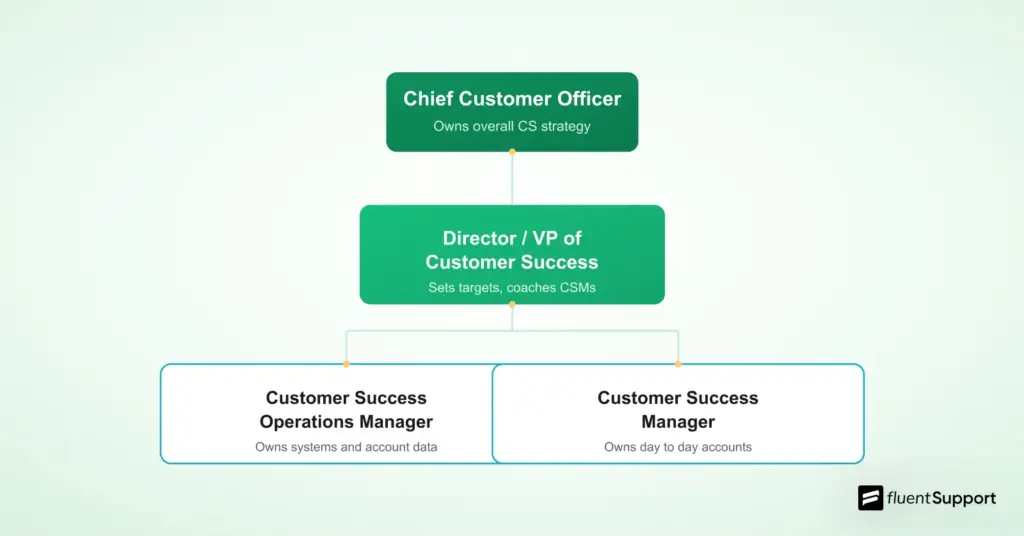
A customer success team usually spans four roles, each covering a different layer of the customer relationship. Smaller companies often combine two or three of these into one hire before splitting them out as the customer base grows.
Customer Success Manager
The CSM owns the day to day relationship with a set of accounts. They run onboarding sessions, watch usage patterns, and check in before a renewal date arrives. When an account shows signs of disengagement, the CSM is usually the first person to notice. The metric a CSM is judged on is almost always gross retention inside their own book of accounts, not activity like calls logged.
At smaller companies, one CSM might cover onboarding, training, and light support work across every account. As customer facing roles expand, this job narrows to focus on retention and expansion inside an assigned book of business. Back at Brightpath, the CSM who eventually took over the Redline account set a rule for herself: any customer with a 30 percent drop in weekly logins gets a check-in email within 48 hours, no exceptions.
Customer Success Operations Manager
CS Ops builds the systems everyone else runs on. This role manages the CRM or CS platform, tracks account health data, and standardizes the playbooks CSMs follow for onboarding, renewals, and escalation. CS Ops is judged on data accuracy and forecast reliability, not on individual customer relationships.
Without CS Ops, every CSM ends up tracking accounts in a personal spreadsheet, and reporting turns into guesswork. This role usually appears once a company has more than a handful of CSMs and needs consistent data across the team. Brightpath added its first CS Ops hire once it had four CSMs and three different versions of the same account list floating around.
Director or VP of Customer Success
This leader translates company goals into a working CS strategy. They hire and coach CSMs, set targets for retention and expansion, and work with product and sales teams to close feedback loops. Directors and VPs typically carry net revenue retention as their headline number, since it captures both what the team saved and what it grew.
Directors and VPs also decide how the team is structured, which accounts get high touch attention, and which segments run on a lighter, automated model. Their decisions shape how the entire customer lifecycle gets handled from onboarding through renewal.
Chief Customer Officer
At larger companies, a Chief Customer Officer sits on the executive team and owns every post-sale function, sometimes including support and renewals. The CCO sets the overall customer strategy and reports retention and expansion numbers directly to the CEO.
Not every company needs this role early on. It tends to appear once customer revenue grows large enough that retention decisions carry weight at the leadership level, usually once the company runs several CS pods across segments and needs one person aligning all of them to the same targets.
Customer Success Team Responsibilities
Day to day work varies by role, but most teams share the same core set of duties.
- Onboarding customers: This step gets new accounts through setup and to a first result quickly.
- Monitoring usage: This tracks product data to catch drop off before it becomes churn.
- Running renewals: This prepares the account and the conversation well before a contract ends.
- Surfacing feedback: This passes customer input to product and marketing teams.
- Identifying growth: This flags accounts ready for an upgrade or additional seats.
How to Structure a Customer Success Team
There is no single right structure. Most companies pick one of three models and adjust it as the customer base grows.
| Model | Best For | Main Advantage | Main Risk |
|---|---|---|---|
| By segment | Companies with a wide spread in account size | High value accounts get proportional attention | Small accounts can feel neglected |
| By lifecycle stage | Products with a long or complex onboarding | Clear ownership at each phase of the journey | Handoffs between stages can drop context |
| By engagement model | Companies scaling past their first 500 accounts | Coverage grows without a matching CSM headcount | Tech touch accounts can feel impersonal |
By Customer Segment
Grouping the team by account size lets each segment get the right amount of attention.
- Enterprise accounts: One CSM manages a small number of accounts with regular calls and strategic reviews.
- Mid market accounts: A CSM splits attention across a larger book and mixes calls with automated check-ins.
- Small business accounts: Coverage runs mostly on tech touch and relies on email sequences and in-app guidance instead of one on one time.
By Lifecycle Stage
Grouping by stage assigns ownership to specific points in the customer journey instead of specific accounts.
- Onboarding: A specialist gets the customer live and using core features quickly.
- Adoption: A CSM drives feature usage and confirms the customer sees value.
- Renewal and expansion: A CSM or account manager handles the contract conversation and looks for upsell room.
By Engagement Model
This model organizes the team around how customers are reached, not who they are.
- High touch: One CSM works closely with a small number of complex accounts.
- Tech touch: Automated emails and in-app content cover a large volume of smaller accounts.
- Hybrid: Automation handles routine touchpoints while a CSM steps in for anything that needs a human.
Account load varies widely by model. High touch teams tend to keep CSM books under 100 accounts so each relationship stays personal, while tech touch teams can push several hundred accounts per CSM without losing responsiveness, since automation handles the routine touchpoints.
Steps to Build a Customer Success Team From Scratch
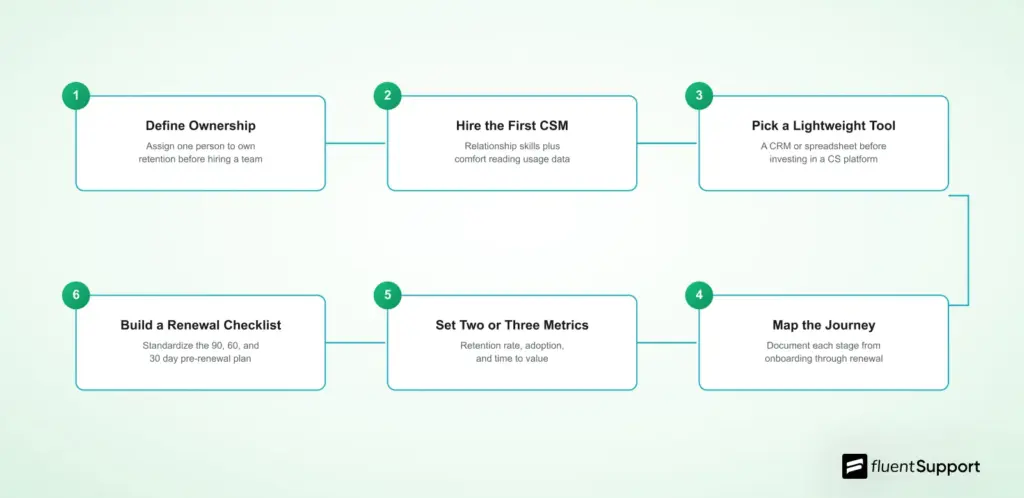
Building a CS team from nothing does not require a full org chart on day one. A handful of deliberate steps gets the function running before headcount catches up.
- Define ownership: Assign one person to own retention before hiring a full team, even if that person already handles support duties too.
- Hire the first CSM: Look for someone comfortable with both relationship building and reading usage data, not just a people person.
- Pick a lightweight tool: Start with a CRM or spreadsheet to track account health before investing in a dedicated CS platform.
- Map the customer journey: Document each stage from onboarding to renewal so the CSM knows what a healthy account looks like at every point.
- Set two or three metrics: Track retention rate, product adoption, and time to value before adding anything more complex.
- Build a renewal checklist: Standardize what happens 90, 60, and 30 days before a contract ends.
Spread across a rough timeline, this usually looks like defining ownership and picking a tool in the first two weeks, hiring the first CSM within the first month or two, and mapping the customer journey alongside that hire rather than before it. Metrics and a renewal checklist tend to follow in month two or three, once there is enough account data to make them meaningful instead of guesswork.
Metrics a Customer Success Team Should Track
Activity metrics like calls made or emails sent feel productive but say nothing about whether customers are sticking around. These five outcome metrics are what most CS leaders report on instead.
- Net revenue retention: This measures whether existing customers are expanding or shrinking their total spend.
- Gross retention rate: This shows how much revenue would remain without any expansion or upsells.
- Time to value: This tracks how quickly a new customer reaches their first meaningful outcome.
- Account health score: This combines usage, support history, and engagement into one risk indicator.
- CSAT or NPS: This captures how customers feel about the relationship, not just whether they renew.
Net revenue retention is worth walking through with real numbers, since it is the metric most CS leaders get judged on.
Say a company starts the year with 500,000 dollars in recurring revenue from its existing customers. Over the year it loses 40,000 dollars to cancellations and downgrades, but gains 60,000 dollars from upsells and added seats within that same customer base.
The company ends the year at 520,000 dollars, which works out to 104 percent net revenue retention. That sits close to the 103 percent median SaaS Capital found among bootstrapped B2B SaaS companies with 3 million to 20 million dollars in annual recurring revenue, and above 100 percent means the CS team is growing the existing base faster than it is losing it.
Common Challenges When Building a Customer Success Team
Most of the early pain in building a CS team comes from the same four issues, and each one has a straightforward fix once it is named.
- Unclear ownership: Sales, support, and CS all assume someone else owns the renewal conversation. Follow up slips as a result. The fix is a written rule stating who owns the account at each stage, signed off by all three teams.
- Scattered data: Account information lives across five different tools. That spread makes it hard to see the full picture of a customer. The fix is picking one system of record for account status, even if it starts as a shared spreadsheet.
- Overloaded CSMs: One CSM covering too many accounts turns proactive check-ins into reactive firefighting. The fix is capping the book size and moving lower value accounts to a tech touch track instead of adding them to a CSM’s plate.
- Missing metrics: Teams track activity like calls made instead of outcomes like retention or expansion. The fix is reporting on one outcome metric in every team meeting until it becomes the default way of talking about performance.
Tools a Customer Success Team Relies On
Most CS teams run on a mix of a CRM, a dedicated customer success platform for health scoring, and a support tool for ticket history. A CSM usually needs to see tickets, usage data, and contract details in one place before a renewal call, since scattered information leads to missed risk signals.
Smaller teams can start with a CRM and a spreadsheet. They can add a dedicated CS platform once account volume outgrows manual tracking.
Wrapping Up
A customer success team is what stands between a product that works and a customer who renews it. The moment nobody watches usage, accounts drift, and that drift ends in a cancellation nobody saw coming, the way it did for Brightpath before it hired its first CSM.
Start small. One CSM, a few clear metrics, and a defined picture of what a healthy account looks like will catch more churn than waiting until the team is fully staffed.
Start off with a powerful ticketing system that delivers smooth collaboration right out of the box.
FAQ
A customer success team helps customers reach their goals with a product through onboarding, adoption support, and renewal management. Its role is to catch risk early and turn product usage into a lasting relationship.
Frameworks vary, but the pillars generally cover onboarding, adoption, advocacy, expansion, retention, product feedback, and cross-functional alignment across sales, product, and support.
A shorter version of the framework usually narrows to onboarding, adoption, retention, expansion, and advocacy. These are treated as the core stages every customer moves through.
CS team is shorthand for customer success team, the group responsible for helping customers get value from a product after the sale closes.
It depends on the product’s complexity and price point. High touch enterprise CSMs often manage under 50 accounts, while tech touch CSMs on self-serve products can cover several hundred. As a rough guide, CSM headcount tends to track annual recurring revenue more closely than raw account count once a company scales past its first hire, since a handful of large accounts and a hundred small ones can carry the same workload for very different reasons.
Cost scales mostly with headcount rather than tooling, since most teams start with a CRM or a spreadsheet before buying a dedicated CS platform. A single CSM typically costs less than the revenue lost from a handful of preventable cancellations, which is why the first hire tends to pay for itself within a quarter or two.
Related Articles
Fluent Support 2.4.7: Ticket Filters, 5x Faster Tickets and Smart Customer Search
Fluent Support 2.4.7 brings a Ticket Filters sidebar…Customer Success Best Practices for Small Teams
In this blog, we’ve discussed customer success in…






Add your first comment to this post