
What Is Customer Profiling and Why Does It Matter More Than You Think

By Md. Sajid Sadman
March 26, 2026
Last Modified: March 17, 2026


Most businesses collect customer data. Very few actually know their customers.
There is a meaningful difference between having a spreadsheet of buyer information and genuinely understanding who your customers are, what drives their decisions, and what they expect from you at every touchpoint.
Customer profiling is what bridges that gap. This guide covers what it is, how to build it properly, where most businesses go wrong, and why it matters beyond just marketing.
TL;DR
What is customer profiling?
Customer profiling is the process of collecting and analyzing customer data to build detailed profiles that represent your ideal customers. These profiles are built around demographic, psychographic, behavioral, and geographic characteristics, and help businesses understand who their customers are and how to serve them better.
How is it different from customer segmentation?
Segmentation groups customers broadly based on shared characteristics. Profiling goes deeper by layering multiple data points to create a richer, more specific picture of each group. Segmentation gives you the map. Profiling gives you the directions.
What are the types of customer profiles?
The main types are demographic, psychographic, behavioral, geographic, and firmographic for B2B. Each one adds a different dimension to the overall picture of who your customer is and what drives their decisions.
Why does customer profiling matter beyond marketing?
Customer profiling improves support quality, product development, and retention, not just marketing. When support agents have profile data before handling a ticket, resolution is faster and satisfaction is higher. When product teams use profiles, they build for real needs rather than assumptions.
How do you build a customer profile?
Start by consolidating and cleaning your existing customer data. Enrich it with external sources. Identify behavioral and demographic patterns across your customer base. Build a profile document for each distinct group. Embed those profiles into your CRM, support tools, and team workflows. Review and update them regularly.
Where do most businesses go wrong?
The most common failure is building profiles and never using them operationally. The second is treating profiles as static documents rather than living ones. The third is keeping profiling siloed inside the marketing team instead of sharing it across support, product, and sales.
How does AI change customer profiling?
AI enables continuous, real-time profile updates based on live customer behavior across every touchpoint. Instead of a document reviewed quarterly, profiles become a dynamic data layer that every customer-facing team can read from at any time. The core principle stays the same. AI just makes it faster and more accurate at scale.
What Is Customer Profiling?
Customer profiling is the process of collecting and analyzing customer data to build detailed profiles that represent your ideal customers. These profiles are built around demographic, psychographic, behavioral, and geographic characteristics. Businesses use customer profiles to understand who their customers are, what drives their decisions, and how to serve them more effectively across marketing, sales, and support.
A customer profile is not a vague description of your target audience. It is a structured, data-backed portrait of a real type of customer, built from actual behavior and verified characteristics.
The practical output is this: when a business knows its customer profiles well, it stops guessing. Decisions about messaging, product development, channel strategy, and support workflows all become more grounded in reality.
Customer profiling is not a one-time exercise. The most useful profiles are updated continuously as customer behavior, preferences, and circumstances change over time.
Customer Profiling vs. Customer Segmentation
These two terms are often used interchangeably. They are related but not the same thing, and the distinction is worth understanding.
Customer segmentation is the act of grouping customers based on shared characteristics in a broad sense. It is the foundation. Customer profiling goes a level deeper by layering multiple data points together to create a richer, more nuanced picture of each group.
Think of it this way: segmentation tells you there is a group of customers aged 30 to 45 who buy online. Customer profiling tells you that this group prefers self-service, values fast resolution, responds well to email communication, and tends to churn when they feel ignored after a purchase.
| Customer Profiling | Customer Segmentation |
| Detailed, multi-layered portrait of a customer type | Broad grouping based on shared characteristics |
| Combines multiple data sources | Often based on one or two variables |
| Used for personalization at depth | Used for targeting and campaign planning |
| More granular and specific | More general and scalable |
| Informs support, sales, and product decisions | Primarily used in marketing strategy |
Neither is better than the other. Segmentation gives you the map. Profiling gives you the directions.
Types of Customer Profiles
Customer profiles are built from several distinct data categories. Let’s discuss each one.
Demographic Profiles
Demographics cover the basic factual attributes of a customer: age, gender, income level, education, occupation, and family status. This is the starting point for most profiling work.
Demographics answer the question of who the customer is on paper. They are useful but limited on their own. Two customers can share identical demographics and behave completely differently.
Psychographic Profiles
Psychographics go deeper. They capture how a customer thinks, what they value, what motivates them, and what concerns them. This includes personality traits, lifestyle choices, attitudes, and goals.
This is where profiling starts to get genuinely useful. Knowing that a customer values transparency and gets frustrated by jargon tells you how to communicate with them. Demographics alone cannot do that.
Behavioral Profiles
Behavioral data is drawn from what customers actually do rather than what they say. Purchase history, browsing patterns, engagement rates, support ticket frequency, response to campaigns, and product usage all fall into this category.
Behavioral profiles are often the most reliable because they are based on observed action rather than self-reported preference. They also change over time, which is why keeping profiles updated matters.
Geographic Profiles
Geographic profiling groups customers by location. This goes beyond just country or city. Regional purchasing patterns, local economic conditions, cultural norms, and even climate can influence how customers behave and what they need.
For businesses operating across multiple markets, geographic profiles are essential for adapting messaging, pricing, and support approaches to local contexts.
Firmographic Profiles (For B2B)
Firmographics apply to business customers rather than individual consumers. They cover company size, industry, revenue, structure, and decision-making processes.
A B2B business selling to a 10-person startup and a 500-person enterprise needs very different approaches. Firmographic profiling makes sure those differences are reflected in how the business communicates and sells.
Why Customer Profiling Matters Beyond Marketing
Most content on customer profiling frames it as a marketing tool. And it is. But limiting it to marketing means leaving most of its value on the table.
It Makes Marketing More Precise
This is the obvious one. When you know who you are talking to, you stop sending the same message to everyone. Campaigns become more targeted, budgets go further, and conversion rates improve because the right message is reaching the right person at the right time.
It Directly Improves Customer Support Quality
This is the part most businesses miss entirely. Customer profiling is just as valuable for support teams as it is for marketing teams, arguably more so.
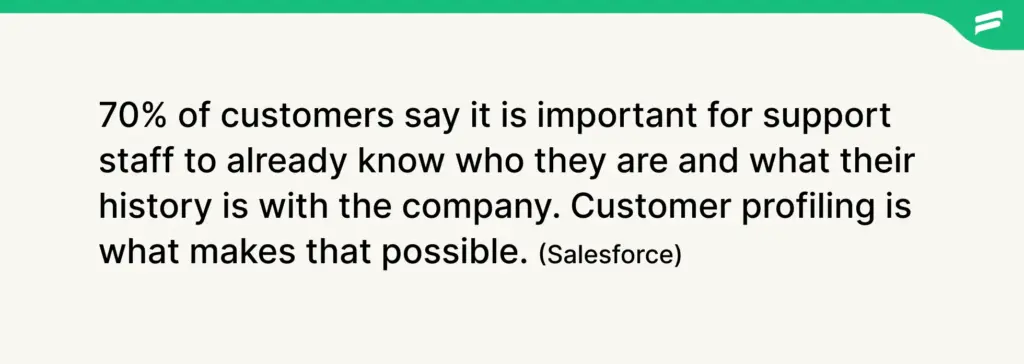
When a support agent knows a customer’s history, their communication preference, their typical issue patterns, and their level of technical familiarity before picking up a ticket, the interaction changes completely. Resolution is faster. The customer does not have to over-explain. The agent does not have to ask unnecessary questions.
Teams that embed customer profile data into their support workflows report measurably shorter handle times and higher satisfaction scores. The profile does the context-setting before the conversation even starts.
It Strengthens Product Development
Understanding your customer profiles means you build for real people rather than assumptions. Feature prioritization, pricing decisions, onboarding design, and product positioning all become more grounded when they are informed by detailed customer profiles rather than internal guesswork.
It Improves Customer Retention
Customers stay when they feel understood. Profiling enables businesses to anticipate needs, flag at-risk customers early, and intervene before churn happens. A customer who suddenly stops engaging after years of activity is telling you something. If you have a behavioral profile, you can hear it.
How to Build a Customer Profile
Building a customer profile is not a complicated process. But it does require discipline. Let’s discuss each step.
Step 1: Consolidate Your Existing Customer Data
Start with what you already have. CRM records, purchase history, support ticket data, email engagement, website analytics, and any survey responses are all valid starting points.
Before doing anything else, clean this data. Remove duplicates, fill obvious gaps, and make sure you are working from a reliable foundation. A profile built on dirty data is worse than no profile at all.
Step 2: Enrich with External Data Sources
Internal data tells you what your customers do with you. External data tells you who they are beyond your business. Third-party data sources can add demographic, behavioral, and geographic context that you could not collect on your own.
This step is where profiles start to feel fully dimensional rather than transactional.
Step 3: Identify Patterns and Group by Shared Characteristics
Look for clusters in your data. Which customers share similar purchasing behavior? Who contacts support most often and about what? Which segments have the highest lifetime value? Which ones churn fastest?
These patterns form the basis of your profiles. You are not inventing fictional personas at this stage. You are finding real groups that already exist in your customer base.
Step 4: Build the Profile Document
For each customer group, document the key characteristics across demographic, psychographic, behavioral, and geographic dimensions. Add context about their goals, pain points, communication preferences, and relationship with your product or service.
Keep the profile practical. The goal is something an agent, a marketer, or a product manager can read and immediately act on. Not a 40-page research report that sits in a shared drive untouched.
Step 5: Embed Profiles into Operational Workflows
This is the step most businesses skip, and it is the most important one. A customer profile that lives in a document and never influences day-to-day decisions has no value.
Connect profiles to your CRM so agents see relevant context when handling tickets. Use profiles to inform campaign segmentation. Feed profile data into your product roadmap discussions. The profile only delivers value when it is actively used.
Step 6: Review and Update Regularly
Customer behavior changes. A profile that was accurate eighteen months ago may not reflect your customer base today. Schedule quarterly reviews at minimum, and update profiles whenever significant behavioral shifts show up in your data.
Where Most Businesses Go Wrong with Customer Profiling
Getting customer profiling right is straightforward in theory. In practice, most businesses stumble at the same predictable points.
Building Profiles and Never Using Them
This is the most common failure by a significant margin. A team invests time in building detailed customer profiles, presents them in a workshop, saves the document somewhere, and never opens it again. Profiles are only valuable when they are embedded in how the business operates daily, not stored as a completed deliverable.
Treating Profiles as Static Documents
A customer profile is not a finished product. It is a working document. Businesses that build profiles once and treat them as permanent tend to find that decisions based on those profiles become increasingly disconnected from reality. The profile needs to evolve as the customer evolves.
Relying Only on Demographic Data
Demographics give you a starting point. They do not give you a customer. Businesses that build profiles based almost entirely on age, location, and income end up with groups that look similar on paper but behave very differently in practice. Psychographic and behavioral data are what make a profile genuinely useful.
Building Profiles for Marketing Alone
Customer profiling is treated as a marketing responsibility in most organizations. As a result, the support team, the product team, and the sales team never see the profiles or use them. The value stays siloed in one function instead of flowing across the business.
Customer Profiling in 2026: The AI Shift
The way customer profiles are built and maintained is changing. What used to be a periodic, manual process is becoming continuous and automated.
AI systems can now analyze customer behavior across every touchpoint in real time and update profiles automatically as new data comes in. A customer who changes their purchasing pattern, starts contacting support more frequently, or shifts their engagement behavior triggers a profile update without anyone having to run a report.
This shift from static to dynamic profiling has significant implications. Support teams can see a customer’s current behavioral state, not just their historical average. Marketing teams can respond to emerging signals rather than lagging data. Product teams can spot emerging needs before they become explicit requests.
The future of customer profiling is not a document you update quarterly. It is a live data layer that every customer-facing team reads from in real time. Businesses building toward that model now will have a meaningful advantage as AI tools become standard infrastructure.
The core principle stays the same. Know your customer well enough to serve them well. AI just makes it possible to do that at a scale and speed that was not realistic before.
Frequently Asked Questions
Customer profiling is the process of building a detailed picture of your ideal customers using data about who they are, how they behave, and what they care about. It helps businesses make better decisions about how to market to, sell to, and support their customers.
A buyer persona is a fictional character built to represent a target customer, often used in content marketing and campaign planning. Customer profiling is data-driven and represents real groups within your existing customer base. Personas are often aspirational. Profiles are observational.
The four core types are demographic, psychographic, behavioral, and geographic. For B2B businesses, firmographic profiling is a fifth important category that covers company-level characteristics like industry, size, and revenue.
At minimum, customer profiles should be reviewed and updated quarterly. For businesses with high transaction volumes or fast-moving customer behavior, monthly updates are more appropriate. AI-powered systems can maintain continuous updates automatically.
Yes, significantly. When support agents have access to a customer’s profile before handling a ticket, they already understand the customer’s history, communication preferences, and typical issues. This reduces handle time, improves resolution quality, and increases customer satisfaction.
Wrapping Up
Customer profiling is not a marketing exercise. It is a business discipline.
The businesses that do it well are not just running better campaigns. They are delivering better support, building more relevant products, and retaining customers who feel understood rather than processed.
The starting point is straightforward: consolidate your data, find the real patterns in your customer base, build profiles that reflect those patterns, and then actually use them across every team that touches the customer.
The businesses that treat profiling as a living practice rather than a completed project are the ones that keep getting better at knowing their customers. And in the long run, that is one of the more durable advantages a business can build.
Start off with a powerful ticketing system that delivers smooth collaboration right out of the box.
Related Articles
Is “AI Brain Fry” Burning Out Your Support Team?
AI brain fry is a new form of…10 Startups Leading The Way In Customer Service
Here are 10 genuine startups that are leading…





Leave a Reply