


8 Customer Service Skills That Build Better Teams

By Md. Sajid Sadman
May 21, 2026
Last Modified: June 24, 2026


Let me tell you what actually happens when a support interaction goes wrong. The customer does not send an angry email. They do not ask for a manager. They just close the tab, screenshot the conversation to share with a friend, and never come back.
And your team never knows it happened.
That is the real cost of weak customer service skills. The damage happens silently, in the conversations you never get a chance to fix. This blog breaks down the skills your team needs, how to build them, and how to measure whether they are working.
TL;DR
What are customer service skills?
Customer service skills are the observable behaviors and learned abilities that help support agents communicate clearly, solve problems efficiently, and create consistent experiences across every customer interaction.
Why do customer service skills matter for your team?
Because every support interaction either builds or erodes customer trust. When agents lack the right skills, they escalate unnecessarily, give unclear answers, and leave customers feeling worse than when they reached out. Teams that invest in skill development see higher CSAT scores and better retention.
What are the core customer service skills every team needs?
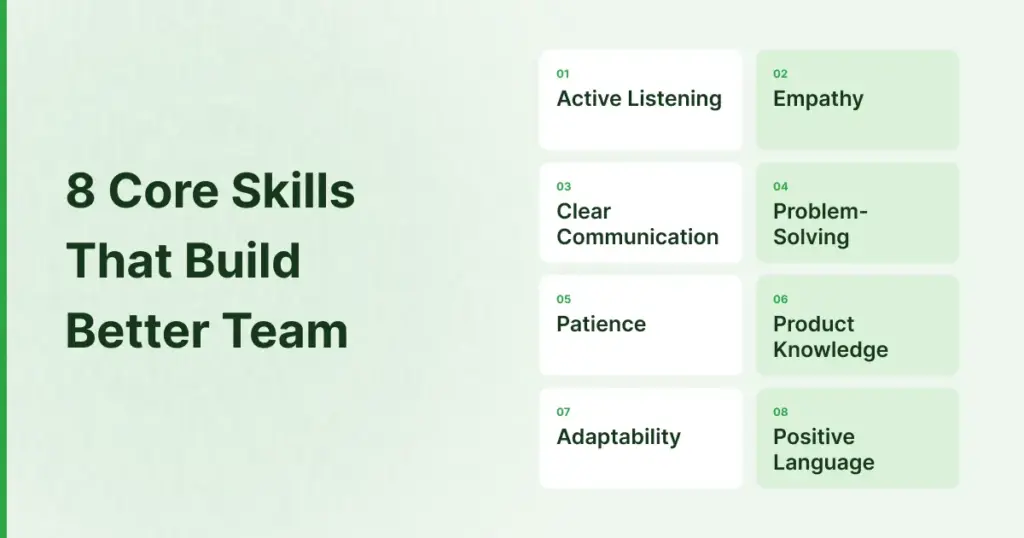
Active listening, empathy, clear communication, problem-solving, patience, product knowledge, adaptability, and positive language. These eight skills cover both the emotional and technical quality of every support interaction.
What is the difference between soft and hard skills in customer service?
Soft skills shape how an agent interacts, things like empathy, patience, and active listening. Hard skills cover what an agent knows and can do, like product knowledge, using helpdesk software, and following escalation processes. Both are necessary.
How do you develop customer service skills across a team?
Through regular ticket reviews, peer shadowing, and targeted coaching rather than one-off training sessions. The most effective development happens when managers review real interactions with agents and give specific, immediate feedback.
How do you measure whether your team’s skills are working?
Track CSAT scores, first contact resolution rates, and first response time at the individual agent level, not just the team average. These metrics are direct proxies for skill level. Team averages hide individual gaps that need targeted coaching.
How do customer service skills connect to customer satisfaction?
Directly. Every skill either adds to or subtracts from the customer’s experience. Clear communication reduces confusion. Empathy reduces frustration. Fast problem-solving reduces effort. The sum of those micro-experiences determines whether a customer feels satisfied or let down.
What Are Customer Service Skills?
Customer service skills are the observable behaviors and learned abilities that help support agents communicate clearly, solve problems efficiently, and create consistent experiences across every customer interaction.
Most people think of customer service skills as personality traits. But that framing causes problems. Personality is hard to change. Skills are not. And when you treat them as trainable behaviors rather than fixed traits, you can actually build them across your team.
Here is the thing: a single great agent cannot carry a team. The goal is consistent skill across every person handling tickets, chats, and calls.
The core customer service skills every team needs:
- Active listening
- Empathy
- Clear communication
- Problem-solving
- Patience
- Product knowledge
- Adaptability
- Positive language
Why Customer Service Skills Matter for Your Team
Most businesses invest in tools, headcount, and processes. But when support interactions keep going wrong, the issue is usually not the tool. It is the skills behind it.
Customer support statistics landing page by Fluent Support says, 67% of customer churn could be prevented if the issue was resolved in the first interaction. That is a skill problem, not a product problem. When agents lack the right skills, they escalate unnecessarily, give unclear answers, and leave customers feeling worse than when they reached out.
The reverse is also true. Teams that invest in skill development see higher CSAT scores, fewer repeat contacts, and better agent retention. People who feel competent at their jobs tend to stay in them.
The Core Customer Service Skills Every Team Needs
Your team handles dozens of interactions every day. And every single one of those interactions runs on these skills. Let’s go through each one.
1. Active Listening
Active listening means understanding what the customer is actually saying, not just waiting for your turn to respond.
In practice, it looks like this: an agent paraphrases the customer’s issue back to them before jumping to a solution. That one step alone reduces misunderstandings and makes the customer feel heard. From real support environments, most repeat contacts happen because the first agent solved the wrong problem.
Active listening also means paying attention to what customers do not say. Frustration, confusion, and hesitation all show up in how someone explains a problem. Agents who pick up on those signals respond more effectively.
2. Empathy
Here is the thing about empathy: customers can tell the difference between an agent who genuinely gets it and one who is reading from a script. “I understand your frustration” means nothing if the rest of the reply proves otherwise.
Real empathy means recognizing where the customer is in their experience and responding to that reality. A customer locked out of their account the night before a big presentation needs a different response than someone casually browsing the knowledge base. The situation shapes the tone.
You can coach empathy. Start by having agents review their own closed tickets and identify moments where the tone missed the mark. That kind of self-review builds awareness faster than any training module.
3. Clear Communication
Clear communication reduces the need for follow-up contacts. Every time a customer has to write back because the first reply was confusing, your team just doubled the work for that ticket.
Written communication and verbal communication need different skills. In email and chat support, agents cannot rely on tone of voice. Word choice carries everything. Short sentences, plain language, and a direct answer before the explanation are the three rules that make written support easier to read.
On calls, clarity means checking in. A quick “Does that make sense?” or “Would you like me to walk through that again?” keeps the conversation on track and signals that the agent is present.
4. Problem-Solving
Think about what actually happens when a customer contacts support. They rarely say “here is the exact problem.” They describe a symptom. Problem-solving is the skill that moves from that symptom to the actual root cause, and then to a fix.
Agents who struggle here usually do so for one of two reasons. Either they do not have enough product knowledge to diagnose the issue, or they have not been given clear escalation paths so they know when to hand off. Both are fixable at the team level.
Good problem-solving also means knowing what a solution actually looks like from the customer’s perspective. Fixing the technical issue is not always the same as resolving the customer’s experience of the issue.
5. Patience
Patience is the skill that holds everything else together under pressure. And it is the first one to degrade when ticket volume spikes.
Teams typically struggle here not because agents lack patience as individuals, but because the environment does not support it. When agents are rushing through tickets to hit a resolution count, they take shortcuts. They skip the paraphrase. They paste the canned response without reading the full context. They close the ticket before the customer confirms the issue is resolved.
This is a systems problem as much as a skill problem. Effective customer support strategies always account for the environment agents work in, not just the traits they bring to it.
6. Product Knowledge
This is one skill that support teams consistently underestimate, and the gap always shows up at the worst possible moment. When a customer asks a specific question and the agent cannot answer it confidently, trust erodes fast.
The cost shows up directly in escalation rates. When frontline agents cannot diagnose an issue on their own, they escalate to senior agents or specialists. That slows resolution times and frustrates customers who expected a direct answer from the first person they contacted.
The fix is not longer onboarding. It is a structured process for keeping agents current. Regular product updates in team meetings, a maintained internal knowledge base, and short refresher sessions after major releases all close the gap faster than hoping agents keep up on their own.
7. Adaptability
No two customer interactions are exactly alike. Adaptability is the ability to shift approach based on context without losing effectiveness.
A customer who sends a short, frustrated one-line message needs a different response than a customer who writes three paragraphs explaining their situation in detail. The skill is reading the context and adjusting, not applying the same formula to every interaction.Adaptability also matters across channels. Agents who handle multiple types of customer service channels need to shift their communication style between email, live chat, and phone. Each channel has its own rhythm and expectations.
8. Positive Language
Positive language is not about being artificially cheerful. It is about framing responses in a way that moves the conversation toward a solution rather than creating friction.
The difference is small but consistent. “I cannot process that refund until Monday” creates a wall. “Your refund will be processed first thing Monday” delivers the same information but lands differently. Word choice shapes how customers experience the interaction.
From real support environments, agents who default to positive framing handle difficult conversations more smoothly. Customers stay calmer. Resolutions happen faster. It is one of the highest-leverage micro-skills in customer service.
Just a heads up: even the most skilled support team will struggle if the system behind them is chaotic. Scattered tickets, no visibility into agent performance, conversations falling through the cracks. That is where a proper helpdesk makes the difference. Fluent Support is a WordPress helpdesk plugin built specifically for support teams who want to fix that.
Hard Skills vs Soft Skills in Customer Service
Not all customer service skills work the same way. Some shape how an agent interacts. Others determine what an agent can actually do. Understanding the difference helps you hire smarter and coach more precisely.
Soft skills govern the emotional quality of the interaction. Hard skills govern the technical quality of the resolution. You need both. When you hire for customer service roles, the goal is finding people with the soft skill foundation who can then develop the hard skills through structured training.
| Soft Skills | Hard Skills | |
|---|---|---|
| What it covers | How an agent interacts and makes customers feel | What an agent knows and can do technically |
| Examples | 1. Active listening 2. Empathy 3. Patience 4. Positive language 5. Adaptability 6. Clear communication | 1. Product knowledge 2. Using helpdesk software 3. Following escalation processes 4. Reading customer data 5. Writing clear documentation 6. Multi-channel support |
| What it shapes | The emotional experience of the interaction | The technical quality of the resolution |
| Best developed by | Coaching, feedback, and real interaction reviews | Training, documentation, and hands-on practice |
| Hiring priority | Hire for these. Harder to teach from scratch. | Train for these. Can be built after hiring. |
How to Develop Customer Service Skills in Your Team
Most teams run training sessions and call it skill development. But training delivers information. Coaching changes behavior. You need both, and most teams get the balance wrong.
The most effective skill development happens through regular ticket reviews. When managers sit with agents and walk through real interactions, pointing out what worked and what did not, agents improve faster than through any formal course. The feedback is specific, relevant, and immediate.
Use your customer support data and analytics to identify where skill gaps are showing up. High escalation rates in a specific agent’s queue point to a product knowledge or problem-solving gap. Low CSAT from a particular agent often points to a communication or empathy issue. The data tells you where to focus the coaching.
A few practical approaches that work well in real support environments:
How to Measure Whether Your Team’s Skills Are Working
So how do you actually know if the skills are improving? You look at the numbers that skills directly produce.
CSAT scores reflect the emotional quality of the interaction. Low scores consistently point to empathy, communication, or patience gaps. First response time reflects how well agents manage their workload and prioritize. First contact resolution rate is the clearest indicator of problem-solving and product knowledge combined.
Track these metrics at the individual agent level, not just the team level. Team averages hide individual gaps. An agent with consistently low first contact resolution needs targeted coaching on problem-solving and product knowledge, not a team-wide training session.
Beyond the numbers, qualitative signals matter too.
The metrics give you the where. The ticket reviews give you the why. Use both together when coaching your team toward excellent customer service.
Wrapping Up
The gap between a support team that customers trust and one that frustrates them usually comes down to skills, not headcount or tools. Most support failures are skill failures in disguise.
The practical takeaway is straightforward. Treat customer service skills as trainable behaviors. Measure the outputs that reflect those skills. Build a coaching habit into your team’s weekly rhythm. That combination compounds over time in ways that one-off training events never do.
Skills built consistently, at the team level, are what turn support from a cost center into a competitive advantage.
Start off with a powerful ticketing system that delivers smooth collaboration right out of the box.
FAQ
Active listening, empathy, clear communication, problem-solving, and product knowledge are the foundation. But the most important skill in any given interaction is whichever one the situation calls for most. Teams that develop all of them give agents the flexibility to meet customers where they are.
Yes. Most customer service skills are learned behaviors, not fixed personality traits. Empathy, communication clarity, and even patience can all be developed through consistent coaching, deliberate practice, and honest feedback. The key is treating skill development as an ongoing process, not a one-time training event.
Skills are behaviors, how an agent listens, communicates, and responds under pressure. Knowledge is information, what the agent knows about the product, policies, and processes. Both are necessary. Strong skills without knowledge leads to warm but unhelpful interactions. Knowledge without skills leads to technically correct but emotionally cold ones.
The most reliable approach is to use scenario-based questions and short practical exercises. Ask candidates to walk through how they would handle a specific difficult customer situation. Look for active listening signals, structured thinking, and whether they default to positive or negative framing. Hiring for customer service roles is as much about observing behavior in the moment as it is about reviewing past experience.
Beyond the core skills every agent needs, a customer service manager needs to coach, identify skill gaps in their team, read performance data, and set clear expectations. The shift from agent to manager is a shift from practicing skills personally to building them in others.
Directly. Every customer service skill either adds to or subtracts from the customer’s experience of the interaction. Clear communication reduces confusion. Empathy reduces frustration. Fast problem-solving reduces effort. The sum of those micro-experiences shapes whether a customer feels satisfied, neutral, or let down. That is why understanding what is customer service at a deeper level always starts with the skills behind each interaction.
Related Articles
26 Best Ticketing System Software in 2026
The best ticketing system software in 2026 includes…Fluent Support 2.4.5: Remote Portal, New Workflow Triggers and more
Fluent Support 2.4.5 lets you run the customer…



Add your first comment to this post