
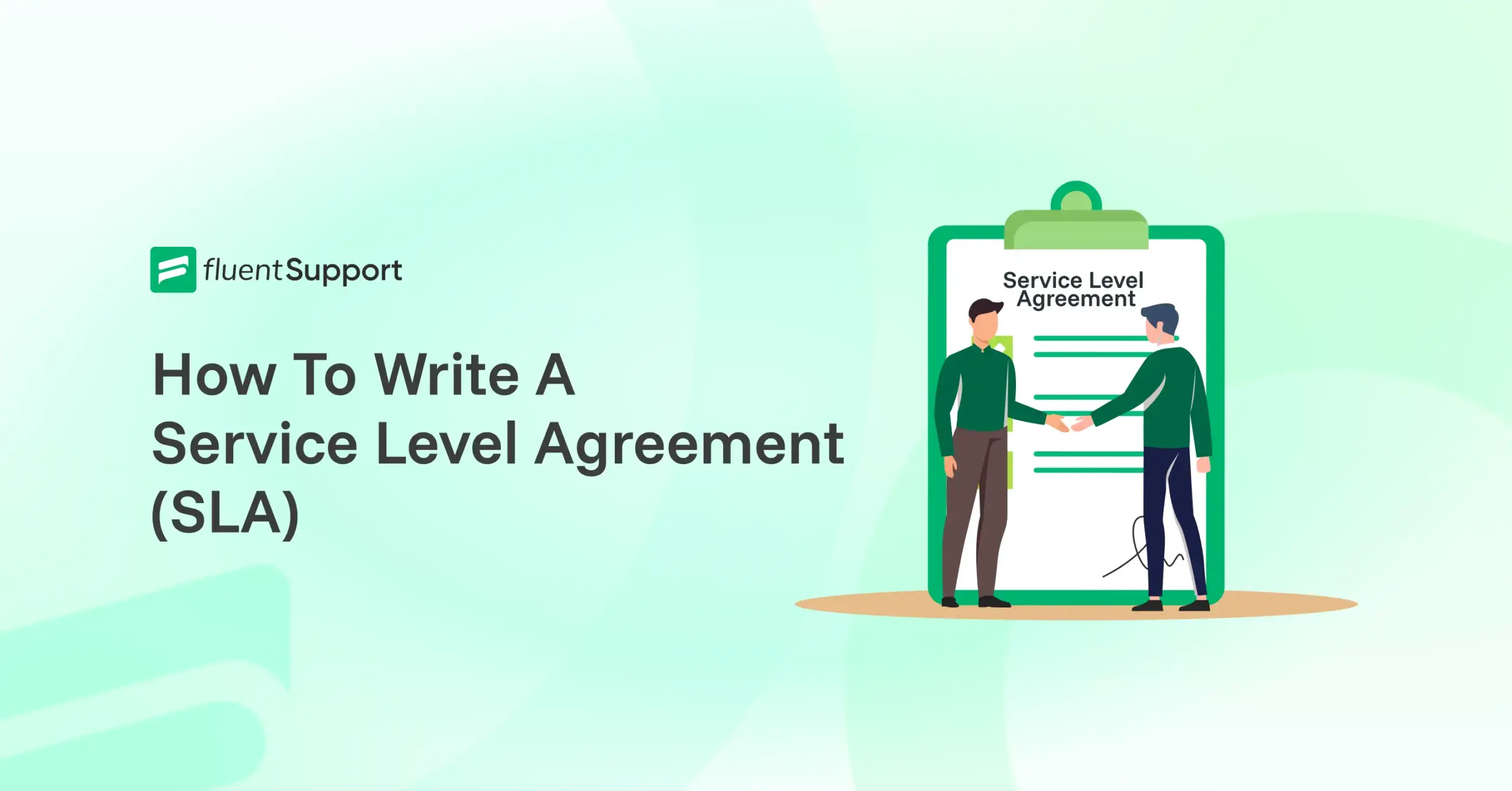
How to Write a Service Level Agreement (SLA) with Template & Examples

By Prosanjit Dhar
January 9, 2026
Last Modified: January 14, 2026


Service Level Agreements (SLAs) are the backbone of reliable customer service. They help service providers manage customer expectations, define service boundaries, and clearly state when the provider is not responsible for outages or performance issues.
In simple words, an SLA prevents confusion before problems happen.
That’s why delivering a clear and practical Service Level Agreement is essential for maintaining trust and delivering consistent value.
What is a Service Level Agreement (SLA)?
A Service Level Agreement (SLA) is a formal agreement between a service provider and a customer that defines the services to be delivered and the expected levels of performance, availability, quality, and responsibilities.
It’s a kind of rulebook that clearly explains:
- What service will be provided
- How well the service should perform
- Who is responsible for what
- How quickly will support respond
- What happens if service levels are not met
Ultimately, it helps customers to avoid poor or unclear service as well as providers from unrealistic expectations. Keeping this in mind, SLAs come in different types depending on the use case.
Types of Service Level Agreements (SLAs)
There are three main types of SLAs:
- Customer Service Level Agreement
- Internal Service Level Agreement
- Multilevel Service Level Agreement
Beginners should always identify which one they need before writing anything. Choosing the wrong type creates confusion and makes the SLA ineffective.
Customer Service Level Agreement (External)
A Customer Service Level Agreement defines the service commitments between a business and its paying customers. It is typically embedded in the commercial contract and sets clear expectations on availability, responsiveness, and accountability.
Common use cases:
- SaaS: Defines application availability, support response times, and data protection standards.
- Hosting & Cloud: Guarantees uptime, incident response, and support coverage.
- Agencies: Specifies delivery timelines, revision cycles, and communication cadence.
- Support Services: Sets response and resolution targets across defined support channels.
In practice, customer-level SLAs translate service promises into measurable obligations by aligning expectations, enabling enforcement, and protecting trust.
Internal Service Level Agreement
An internal Service Level Agreement defines service commitments between teams within the same organization or company. But it’s not visible to customers. Its primary purpose is to reduce friction, clarify ownership, and enforce accountability across departments.
Common use cases:
- Marketing delivers 200 qualified leads per month: Leads must meet agreed criteria (e.g., industry, budget, company size) before being passed to sales.
- Sales follow-up within 24 hours: Every qualified lead is contacted within one business day to prevent revenue leakage from delayed response.
Multilevel Service Level Agreement
This involves more than two teams or services. A multilevel SLA creates a chain of commitments where each team depends on others to meet their obligations. If one team fails, the entire chain breaks, so accountability is distributed across multiple parties.
Common use cases:
- Sales closes deals: The sales team commits to closing a certain number of contracts per month and properly documenting customer requirements during the sales process.
- Support handles onboarding: Once a deal closes, the support team commits to onboarding the new customer within a specific timeframe, setting up their account, and training them on the product.
- Engineering fixes bugs: When customers report issues during onboarding or normal use, the engineering team commits to investigating and resolving bugs within defined timeframes based on severity.
Each team has defined responsibilities.
If sales close deals but provide poor documentation, support cannot onboard customers properly. Alternatively, if support onboards customers poorly, those customers will likely report more issues and place a greater burden on engineering.
Each team’s performance affects the others, so the multilevel SLA defines interconnected commitments.
As you already understand, various types of SLAs. Now, let’s learn to create a suitable one for your own business.
How to create a Service Level Agreement (Beginner-friendly)
There’s no single SLA template that works for everyone. Some SLAs are one page. Others are more detailed. What matters is that both sides clearly understand what’s included, what’s not, and how success is measured.
1. Define services covered
Describe the services included in this agreement. Be specific about what is covered and what is not covered. Include service tiers if you offer multiple levels.
Example:
This SLA covers technical support, system monitoring, and bug fixes for the [Product Name] software. This SLA does not cover custom development, third-party integrations, or user training beyond initial onboarding.
2. Commit factual service hours
State when services are available and when support staff are working. An SLA should reflect reality. Don’t promise 100% uptime and instant resolution. As complex issues take time to diagnose and fix.
You can use historical data and list only the services you actually provide.
Example:
Technical support is available Monday through Friday, 9:00 AM to 6:00 PM Eastern Time, excluding public holidays. System monitoring operates 24/7/365. Emergency issues reported outside business hours will receive a response by the start of the next business day.
3. Keep priority levels simple
Define what qualifies as each priority level. Usually, four priority levels are enough for most businesses.
|
Priority |
Response Time |
Resolution Time |
|
[Critical/High/Medium/Low] |
[Time] |
[Time] |
- Critical: Full outages, security breaches, data loss.
- High: Major functionality issues affecting many users.
- Medium: Partial issues with workarounds available.
- Low: Cosmetic issues, questions, or feature requests.
Fewer levels keep teams focused on solving problems.
4. Clarify customer responsibilities
List what customers must do for the SLA to remain valid.
Example:
- Report issues promptly using the support ticket system at [URL]
- Provide complete information, including error messages and steps to reproduce issues
- Maintain current contact information
- Pay invoices within stated terms
- Keep login credentials secure
5. Service credits (Important)
Define compensation when SLA is breached.
Example:
If we fail to meet response time commitments more than [number] times in a calendar month, you will receive a [percentage]% credit on that month’s invoice. If monthly uptime falls below [percentage]%, you will receive a prorated credit based on actual downtime.
6. Set exceptions and boundaries
Include specific circumstances when SLA commitments do not apply. So, your team and your customers don’t get horrified surprises.
Example:
This SLA does not apply during:
Also, define scope limits. If you offer bug fixes, say feature development isn’t included. If support is only available via email, state that clearly. Boundaries prevent scope creep and keep delivery sustainable.
7. Escalation process (customer support sectors)
Explain how unresolved issues move up the support hierarchy.
Example:
- Level 1: Support tickets are initially handled by our support team
- Level 2: Issues unresolved after [time period] or requiring specialized expertise are escalated to senior technical staff
- Level 3: Issues still unresolved or requiring policy decisions are escalated to management
8. Define SLA review time
Specify how often the SLA will be reviewed and updated.
Example:
This SLA will be reviewed quarterly. Either party may request modifications with 30 days written notice. Changes require mutual written agreement except for minor clarifications, which may be made with 14 days’ notice.
Now, look at how all these steps will look together.
Basic SLA template and structure
You can copy this and fill in your specific information.
Service Level Agreement (SLA)
Effective Date: January 1, 2026
Between: [Your Company Name] (“Service Provider”)
And: [Customer Name] (“Customer”)
This Service Level Agreement (“SLA”) defines the services provided, service availability, performance standards, and responsibilities of both parties.
1. Services Covered
This SLA covers the following services for [Product Name]:
1.1. Included services
(a) Technical support for product-related issues
(b) Bug fixes for existing features
(c) System monitoring and incident alerts
1.2. Excluded services
(a) Custom development or feature requests
(b) Third-party integrations are not officially supported
(c) User training beyond initial onboarding
(d) Issues caused by customer-side misconfiguration
If a service is not explicitly listed above, it is not included under this SLA.
2. Service Hours & Availability
We commit only to what we can reliably deliver and avoid inflated promises.
2.1. Support Hours:
Support is provided during the following hours:
Monday–Friday, 9:00 AM–6:00 PM (Eastern Time), excluding public holidays.
2.2. System Monitoring:
The system is monitored on an automated basis twenty-four (24) hours per day, seven (7) days per week, three hundred sixty-five (365) days per year.
2.3. After-Hours Issues:
Emergency issues reported outside business hours will receive an initial response by the start of the next business day.
3. Priority Levels & Response Targets
To ensure clarity and timely handling, issues are categorized according to the following priority levels.
|
Priority |
Description |
Response Time |
|
Critical |
Full system outage, security breach, data loss |
1 hour |
|
High |
Major feature failure affecting multiple users |
4 hours |
|
Medium |
Partial issues with available workarounds |
1 business day |
|
Low |
Minor issues, UI bugs, or general questions |
2 business days |
Response and resolution times are targets, not guarantees, and depend on issue complexity and customer cooperation.
4. Customer Responsibilities
This SLA applies only if the customer fulfills the following responsibilities:
4.1 Issue Reporting
(a) Issues must be reported through the official support ticket system
(b) Complete and accurate details must be provided, including error messages, screenshots, and steps to reproduce
4.2 Account and Payment Obligations
(a) Customer contact information must be kept current
(b) Invoices must be paid within agreed payment terms
(c) Login credentials must be kept secure
Delays caused by missing, inaccurate, or incomplete information shall pause applicable SLA timelines.
5. Service Credits
Service credits are the sole and exclusive remedy for SLA breaches.
5.1 Response Time Breaches
If response time commitments are missed more than three (3) times in a calendar month, the Customer is eligible to receive a five percent (5%) credit applied to that month’s invoice.
5.2 Uptime Breaches
If monthly system uptime falls below 99.5%, a prorated service credit will be applied based on actual downtime.
5.3 Credit Limitations
(a) Credits must be requested within thirty (30) days of the applicable incident
(b) Total service credits shall not exceed twenty percent (20%) of the applicable monthly fee
6. Exceptions & Scope Boundaries
6.1 SLA Exceptions
This SLA does not apply during the following circumstances:
(a) Scheduled maintenance announced at least forty-eight (48) hours in advance
(b) Public holidays, as listed on the Service Provider’s website
(c) Internet backbone, infrastructure, or hosting provider failures beyond the Service Provider’s control
(d) Force majeure events, including natural disasters, war, or government actions
6.2 Scope Boundaries
The following items fall outside the scope of this SLA:
(a) Bug fixes do not include feature enhancements
(b) Support is provided via ticketing and email only
(c) Phone or live chat support is excluded unless expressly stated otherwise
Clear scope boundaries protect both parties from unintended scope expansion.
7. Escalation Process
If an issue remains unresolved, it may be escalated as follows:
7.1 Escalation Levels
(a) Level 1 – Frontline support team
(b) Level 2 – Senior technical staff, after twenty-four (24) hours or where specialized expertise is required
(c) Level 3 – Management review for policy or contractual matters
Escalation requests must be submitted through the support ticket system.
8. SLA Review & Changes
8.1 Review Cycle
This SLA is reviewed every quarter.
8.2 Amendments
(a) Either party may request changes with thirty (30) days’ written notice
(b) All changes require mutual written agreement
(c) Minor clarifications may be implemented with fourteen (14) days’ prior notice
Signatures
Service Provider: _______________________
Customer: _______________________
Date: _______________________
This template provides all essential elements while remaining simple enough for beginners to understand and implement. Fill in the bracketed sections with your specific details, and adjust the structure as needed for your particular service type.
Final thoughts
A Service Level Agreement is a legal document that clarifies the relationship between customers and employees. That’s why using complex legal language, technical jargon, and vague commitments makes your SLA suspicious.
If they cannot understand what you are promising, they assume you are hiding unfavorable terms or leaving yourself too many loopholes. Simple, clear language builds trust by demonstrating transparency.
Start off with a powerful ticketing system that delivers smooth collaboration right out of the box.
Related Articles
Omnichannel Customer Support: The Guide for Support Teams
Omnichannel customer support means every channel, agent, and…Help Desk Software Wiki [Explained]
Learn what a help desk software wiki is,…

Leave a Reply