

Klarna News: AI Just Got Demoted, Here’s What We Learned

By Md. Ariful Basher
July 9, 2026
Last Modified: July 9, 2026


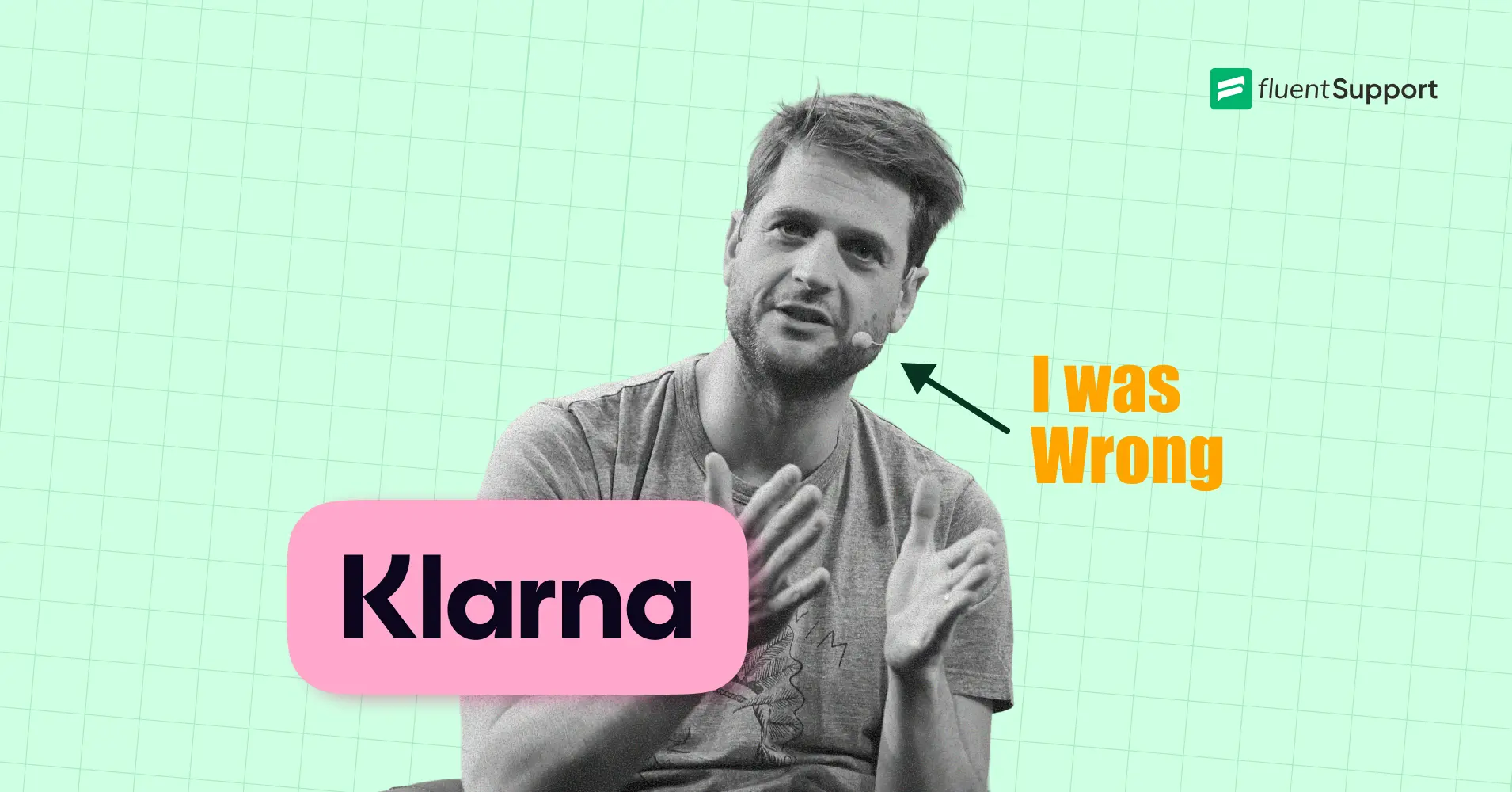
In 2024, Klarna’s CEO told the world his AI chatbot was doing the work of 700 full-time customer service agents. Eighteen months later, Klarna is redeploying engineers and marketers into support roles and hiring gig workers to answer tickets a bot used to handle. That reversal is the real klarna news story right now, and it says more about customer support than it does about Klarna.
If you’ve ever sat in a leadership meeting where someone floated “let’s just automate support,” you already know the feeling this gives you.
Key Takeaways
- Klarna’s AI chatbot once handled two-thirds of customer service chats and claimed to do the work of 700 agents.
- CEO Sebastian Siemiatkowski later admitted the cost-cutting push “went too far.”
- Klarna started rehiring human agents in 2025 through a flexible, gig-style remote model.
- Engineers and marketers were reassigned into customer support as the pivot deepened.
- Klarna stock has fallen roughly 52% since its September 2025 IPO at $40 a share, trading around $19 as of July 8, 2026.
- Klarna wasn’t alone. Amazon, Salesforce, Meta, and Cloudflare cut jobs citing AI too, and 55% of leaders who did this now say it was the wrong call, per Orgvue.
- The lesson isn’t that AI failed. It’s that AI without human judgment isn’t customer support.
- The winning model pairs AI speed with human empathy, not one instead of the other.
What Actually Happened Inside Klarna’s AI Experiment
Here’s what’s actually happening, stripped of the LinkedIn drama.
Klarna, the Swedish buy now pay later giant, partnered with OpenAI in 2023 to build a support chatbot. Within a month it had handled 2.3 million conversations across more than 35 languages. Siemiatkowski said publicly that the assistant was doing work equivalent to 700 full-time agents, and the company froze hiring for almost a year while leaning on the bot.
The chatbot itself wasn’t a gimmick. It genuinely resolved routine cases: refunds, return status, simple payment questions. That’s the part every headline got right.
Then came the part most headlines skipped.
Then Every Other CEO Caught the Same Fever
Klarna wasn’t an outlier. It was the trailer for a movie every boardroom decided to remake.
Once “AI can do all our jobs” became a quotable line, CEOs lined up to say a version of it. Amazon cut 14,000 corporate roles in October 2025, then another 16,000 in January 2026, with Andy Jassy telling staff plainly that generative AI would reduce the total corporate workforce as the company captured efficiency gains. Salesforce’s Marc Benioff shrank his own support org from roughly 9,000 to 5,000 people, saying the company simply needed “less heads.” Cloudflare and Meta cut jobs in the same window, both citing AI as the driver.
By mid-2026, tech alone had shed well over 120,000 jobs with AI named as the leading reason, according to Challenger, Gray & Christmas data reported by Forbes. Even Nvidia’s CEO, Jensen Huang, the man selling the chips powering all of it, called this out, describing CEOs who blame AI for layoffs as “lazy” and saying the framing doesn’t add up from a plain business standpoint. When the guy supplying the hardware thinks the excuse is thin, that’s worth sitting with. A May 2026 Gartner study of 350 firms found the companies cutting headcount hardest showed no better returns than the ones who didn’t, and some of the cautious ones actually outperformed.
But here’s what none of them planned for. Customers don’t want a beautifully engineered simulation of a person. They want a person. And no matter how fluent the model gets, that gap hasn’t closed nearly as fast as the memos promised.
Why the Chatbot Couldn’t Hold the Line
Fast, cheap, and correct on paper. That was the pitch.
But early users reported the bot often acted more like a gateway to human support than a full solution, and satisfaction scores slid as the automation went too far. This is where things break. A chatbot can answer “where’s my refund” all day. It cannot read the tone of a frustrated customer who’s three months behind on a payment plan and needs a human who won’t just recite policy at them.
Empathy isn’t a feature you bolt onto a language model. It’s a judgment call, made in real time, by someone who’s had a hard week themselves and still shows up patient. Klarna found that out the expensive way.
By mid-2025, the company reversed course. Siemiatkowski told Bloomberg that cost had become too dominant a factor in how the support team was organized, and the result was lower quality. That’s a striking thing to hear from the same executive who spent a year telling investors AI would shrink his workforce.
The Rehiring Reversal: Klarna Brings Humans Back
Klarna didn’t just quietly walk it back. It restructured around the mistake.
The company began recruiting remote, gig-style support agents, specifically targeting students, people in rural areas, and loyal Klarna users who already understood the product. By September 2025, Business Insider reported Klarna was reassigning engineers, marketers, and analysts into customer support through an internal “talent pool,” after Siemiatkowski said the company had reached an “epiphany: in a world of AI nothing will be as valuable as humans.”
Most businesses don’t figure this out until the complaints pile up and the churn numbers start moving the wrong way. Klarna figured it out in public, in front of investors, right before an IPO.
What This Means for Klarna Stock
Here’s where the klarna stock story connects back to the support desk.
Klarna listed on the NYSE on September 10, 2025, priced at $40 a share, valuing the company at roughly $15 billion. It popped 15% on debut. As of July 8, 2026, it closed around $19, down roughly 52% from that IPO price, though it’s ticked up recently after a $1.97 billion antitrust win against Google in its PriceRunner case.
None of that price movement traces directly to the chatbot. But the pattern is worth sitting with. A company can’t cost-cut its way to the customer trust that actually protects a valuation. Analysts covering KLAR keep flagging the same underlying question long-term investors ask about any consumer lender: can this company keep customers loyal enough, long enough, to justify the multiple. Support quality is part of that answer, whether or not it shows up in a quarterly filing.
The Bigger Pattern: Klarna Isn’t Alone
Klarna didn’t get the technology wrong. It got the sequencing wrong, and it’s far from the only one.
According to a report from Orgvue reported by CNBC in July 2026, 55% of business leaders who made staff redundant due to AI now admit the decision was wrong, and separate Robert Half data shows 32% of U.S. hiring managers who eliminated a role because of AI have already rehired for the same or a similar position. Ford brought back hundreds of senior engineers after AI-driven quality checks missed defects behind a record number of recalls, and Commonwealth Bank of Australia reversed layoffs after its AI voice system couldn’t handle real customer calls. Same pattern every time: cut the humans first, discover what they actually did second.
What the Public Forum Is Saying
This story didn’t just live in press releases. It got picked apart on Reddit too.
A founder on r/SaaS laid out the timeline in detail: the chatbot’s headline numbers, the quiet rehiring, and the CEO admitting the cost-cutting had gone too far. The post credits cognitive scientist Gary Marcus with naming the pattern the “Klarna Effect”, meaning a loud early win followed by a quiet reversal once reality catches up. One commenter put the underlying problem simply: customer service looks like an easy AI win on paper until someone shows up with a complex issue that actually needs human judgment.
That’s the part every AI-replaces-support pitch conveniently leaves out.
AI Isn’t the Villain. It’s the Wrong Job Title
We’re not here to tell you AI is bad at support. That would be dishonest, and honestly, a little lazy.
AI is genuinely good at the first chunk of most support workloads: triaging tickets, drafting first responses, summarizing a customer’s history before an agent even opens the thread, flagging sentiment before a conversation goes sideways. Used well, this is what customer service collaboration between agents and AI is supposed to look like. It makes the agent faster, sharper, and less burned out by 4pm.
Here’s the part most vendors won’t say out loud. AI will keep getting better at this. It will probably never get all the way to “excellent,” and that’s not really a knock on the technology.
This is how technology has behaved for centuries. Calculators got fast, and accountants didn’t disappear. They moved up to the work a calculator can’t touch. Search engines got smart, and researchers didn’t vanish either, the bar for “good enough” just moved with them. Every time a tool closes the gap on human expectation, that expectation quietly resets a notch higher. A customer who once tolerated a scripted chatbot now expects it to already know their order history and their tone. AI keeps climbing. Demand climbs right alongside it, permanently a step ahead.
That’s why the math on support headcount is backwards from what most CEOs assumed. Nearly a third of companies that cut staff citing AI have already reopened those exact roles, which tells you the original plan was never really about capability. It was about a quarterly slide deck.
Future of AI Integration In Support Team
Here’s the actual future, and it’s less dramatic than “AI takes your job.” Support teams don’t get smaller. They get bigger, just differently shaped. When one agent can competently handle two or three times the ticket volume because AI is clearing the repetitive noise out of the way, a company doesn’t need fewer agents. It can finally afford to promise priority support to far more customers than it used to. The ceiling on what a single agent can deliver goes up, so the team grows to meet the demand that ceiling unlocks.
If you’re running support on WordPress, something like Fluent Support just handles this for you already, drafting AI responses agents can edit before sending rather than auto-firing replies at a frustrated customer.
What This Means If You’re Building Support Right Now
If you’re a founder or support lead reading this klarna news story and wondering what to actually do differently, it comes down to sequencing, not ideology.
Start by mapping which tickets are genuinely repetitive versus which ones require a judgment call. Automate the first bucket. Staff the second one properly, and don’t understaff it to hit a cost target before your competitors notice the difference in reviews.
- Audit before you cut. Know which tasks AI actually replaces versus which ones it only assists.
- Keep a human escalation path visible. Customers forgive a bot. They don’t forgive being trapped by one.
- Measure satisfaction, not just resolution time. Klarna’s resolution numbers looked great right up until the reviews didn’t.
Younger customers in particular expect speed without losing the option of a real person, a tension worth understanding if your support strategy is shifting.
Closing Thought
The klarna news headline everyone remembers is “AI replaces 700 jobs.” The one that actually matters is quieter: the company that bet hardest on full automation is the same one now paying to bring humans back. That’s the real demotion here. AI didn’t get fired. It got moved down the org chart, from the agent everyone promised would run the desk, to the assistant sitting next to the human who actually can. Businesses that build support around that distinction now will save themselves an expensive correction later.
Start off with a powerful ticketing system that delivers smooth collaboration right out of the box.
Related Articles
Fluent Support 2.4.7: Ticket Filters, 5x Faster Tickets and Smart Customer Search
Fluent Support 2.4.7 brings a Ticket Filters sidebar…Customer Success Best Practices for Small Teams
In this blog, we’ve discussed customer success in…




Add your first comment to this post