


What the 2026 World Cup Reveals About Customer Experience at Scale

By Md. Sajid Sadman
June 17, 2026
Last Modified: June 19, 2026


Customer experience has never been tested on a bigger stage than it is this month. FIFA projects that around six billion people will engage with the 2026 World Cup, which turns the tournament into the largest live customer experience experiment ever run.
For 39 days across 16 cities, billions of fans are buying tickets, choosing how to watch, traveling to stadiums, and deciding how they feel about the brands around them. Every one of those moments is a customer experience in miniature. The same rules that decide whether your customers stay or leave are deciding all of them.
Some organizations are using the moment to deepen trust and loyalty, and others are quietly teaching fans to walk away. The gap between the two is the clearest customer experience lesson you will see all year.
Here is what this World Cup reveals about customer experience, drawn from real decisions happening right now, with the principle behind each one made plain so you can apply it long after the final.
Key Takeaways
- The World Cup is a customer experience test at full scale. Billions of people judge brands across ticketing, broadcasts, travel, and sponsorship at the same time.
- Transparency is the foundation of trust. PwC found that 32% of customers leave a brand they love after one bad experience, and the ticketing backlash showed how fast hidden pricing burns goodwill.
- Effortless access beats a captive audience. Meeting fans on every screen, including a free option, is what set the broadcast records.
- Customer experience is the whole journey. The travel, the wait, and the information around an event shape how people feel as much as the event itself.
- Customers reward genuine value and punish hollow attention. Brands that added something real earned loyalty, while a visible AI shortcut drew instant backlash.
- Customer effort decides loyalty. Lowering effort wins trust and compounds into retention and lifetime value.
- Effort is the part you control. Honest pricing, easy access, fast responses, and a smooth journey win at any scale.
What Customer Experience Really Means, and Why the World Cup Proves It
Customer experience is the total impression a person forms across every interaction with you, from the first advertisement to the final follow-up. It is never a single moment, but the sum of all of them, and it lives in how easy, honest, and human each step feels. The World Cup compresses that idea into 39 days and multiplies it by billions, which is why fan reactions this month mirror the wider shifts in customer experience expectation everywhere.
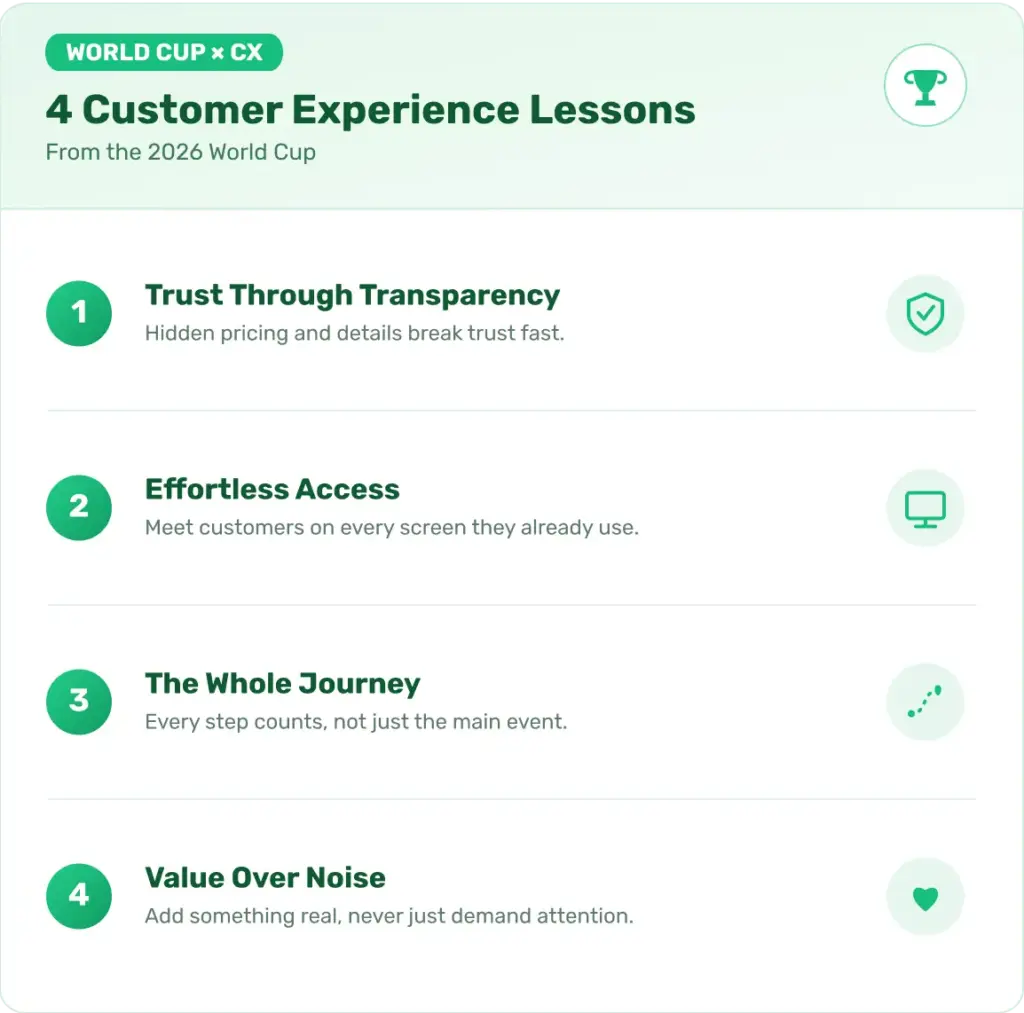
The tournament is testing four customer experience fundamentals at once, and each reveals a principle that applies far beyond football:
- Trust and transparency: ticketing shows what happens when pricing feels unfair and unclear.
- Effortless access: broadcasting shows the pull of meeting customers on their own terms.
- The end-to-end journey: host cities show that experience covers every step, not just the main event.
- Value over noise: sponsors show that customers reward brands that give rather than take.
None of these are unique to football. They are the everyday levers of customer experience, scaled up to a global audience and put on display for everyone to judge. That visibility is exactly what makes the tournament such a useful teacher.
Lesson 1: Trust Is Built on Transparency, Not Captive Demand
Trust is the foundation of customer experience, and it is built or broken the moment a customer decides whether they were treated fairly. People accept a high price far more easily than they accept feeling deceived about it.
FIFA tested that line and crossed it. Using dynamic pricing for the first time at a World Cup, it let the most expensive final tickets climb from around $6,730 to $10,990, with prices rising on 90 of the 104 matches.
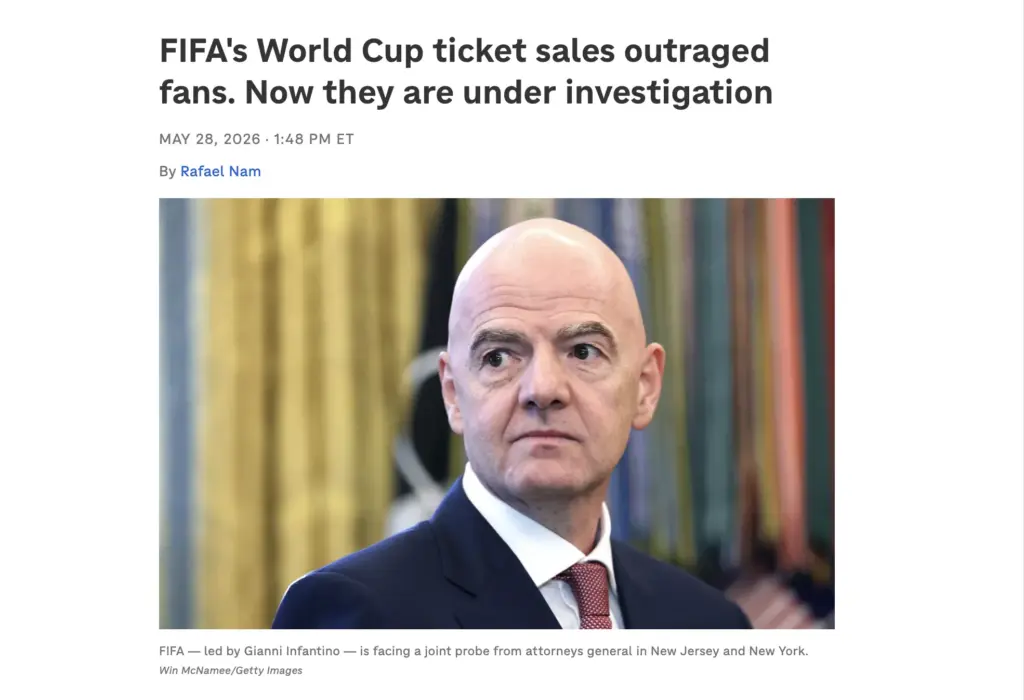
Many fans waited hours in online queues with no clear idea of the price or the seat, and the sense of being misled triggered an investigation by two state attorneys general and a European complaint over bait advertising and hidden seat and refund details.
The customer experience lesson is the expensive one. When pricing, policies, or wait times are hidden, every interaction afterward starts from suspicion instead of goodwill. PwC found that 32% of customers would stop doing business with a brand they love after one bad experience, and a broken sense of fairness is the fastest route to that exit.
For a support or experience team, the takeaway is practical. Set expectations clearly, state your policies in plain language, and never make a customer guess what they are paying or waiting for. Transparent, proactive communication is one of the cheapest customer retention strategies a business can run.
Lesson 2: Effortless Access Beats a Captive Audience
The best customer experiences remove effort. Customers should not have to work to give you their attention, their money, or their loyalty, and the easier you make it, the more of all three you earn.
Broadcasting proved the point. Fox and Telemundo met fans on every screen, across broadcast television, the Fox One and Peacock apps, and the free Tubi service, so cost and device were never a barrier. The result was the USA versus Paraguay match drawing nearly 25 million viewers, with English-language viewership up 106% from the comparable 2022 match and the two networks projected to earn around $850 million in advertising.
This is the customer experience case for being easy to reach. PwC reports that nearly 80% of consumers rank speed, convenience, knowledgeable help, and friendly service as the most important parts of a positive experience. Meeting people on the channel they already use, without extra steps, delivers exactly that.
For support teams, the lesson is to be present on the channels customers prefer and to make moving between them feel seamless. A free, low-effort path to help widens the group of customers who trust you, the same way free streaming widened the broadcast audience. Even small friction, like the criticism Fox drew for cutting to ads during live play, is worth removing before it adds up.
Lesson 3: Customer Experience Is the Whole Journey
Experience is not the headline event. It is every step surrounding it, including the steps you may not think you own. Customers do not separate your product from the path they take to reach it.
Resolving Offline Friction
The host cities made that vivid. In Arlington, Texas, there is no direct public transit to the stadium, so fans face long connecting trips in summer heat between 95 and 105 degrees, and that slog colors the whole day. The cities that thought beyond the 90 minutes of football planned for the entire journey, running free FIFA Fan Festivals in all 16 host cities and, in Seattle’s case, extending the celebration across nine surrounding towns.
The Support Parallel
The customer experience parallel is direct. A confusing checkout, a clumsy onboarding, or a long hold can sink an otherwise excellent product, exactly as a brutal commute can sour a brilliant match. Map every stage the way a customer support funnel lays out each touchpoint, and you find the friction before your customers do.
Proactive information is part of that journey too. Cities that told fans where to go, what to bring, and which fan zones needed advance registration turned hard logistics into manageable ones. The same holds when you give customers self-service answers and status updates before they have to ask for them.
Lesson 4: Customers Reward Value, Not Noise
A strong customer experience adds something to a person’s life. Attention you take is quickly forgotten. Value you give tends to stick, and it is what turns a passive audience into a loyal one.
Sponsors are learning this in public. Strategists note that the brands that win focus on enhancing the experience rather than attaching themselves to it, and fans clearly notice the difference. YouGov data shows that 40% of US World Cup followers actively notice sponsors, and 21% have tried a brand for the first time because of it. Coca-Cola leaned into shared emotion with its travelling Trophy Tour, while Visa focused on being the smooth payment layer behind ticket access.
This is the core of customer-centric experience. PwC found that consumers will pay up to 16% more for great experience, which means experience is a value exchange and not a cost to minimize. Brands that ease a moment, answer a question, or make someone feel understood earn loyalty that advertising cannot buy.
Every customer interaction is a chance to contribute or to interrupt. A genuinely helpful reply, a proactive fix, or an honest answer adds value, while a scripted deflection or a shortcut the customer can sense does the opposite. Fans punished Coca-Cola for an AI shortcut they could feel, and customers respond to support the same way.
Make Your Support Effortless
Every lesson here comes down to one thing, lowering the effort it takes to be your customer. Fluent Support is built to do exactly that, keeping your tickets, conversations, and whole team in one WordPress dashboard so help feels fast and easy on every request.
The Throughline: Customer Effort Decides Loyalty
Step back from the four lessons and one idea runs through all of them, which is customer effort. Every winning example lowered the effort of being a customer, and every failing one raised it.
Confusing prices, hidden seats, and endless queues made being a fan harder, while free streaming, free fan zones, and helpful sponsors made it easier. Customers always remember which way you pushed them. Effort is a stronger predictor of loyalty than delight, because people rarely leave over a missed chance to be amazed and they routinely leave over friction.
The encouraging part is that effort is the part of experience you control. Honest pricing, easy access, fast and helpful responses, and a smooth path from start to finish are within reach at any scale. They are the same customer service skills that turn a first-time buyer into a customer who stays.
Lower effort also pays you back twice. A customer who finds you easy to deal with stays longer, spends more over time, and tells other people why. That is how a strong experience quietly compounds into retention and lifetime value, long after the interaction itself is forgotten.
Wrapping Up
The World Cup will crown one champion on July 19, but the real winners are decided in millions of small interactions off the pitch. They are the organizers and brands that made the experience feel effortless, honest, and worth returning to.
Your business runs the same test every day, only on a smaller stage. Treat customer experience as the sum of every touchpoint rather than a single moment, and you build loyalty that price cuts and ad spend can never replace. The customer support toolkit is a practical starting point, and so is learning to build a support team that protects the experience when demand peaks.
Start off with a powerful ticketing system that delivers smooth collaboration right out of the box.
Frequently Asked Questions
Because billions of people pass through ticketing, broadcasts, travel, and sponsorship at the same time, the tournament shows the same experience principles that decide loyalty in any business, only at a massive scale.
Reduce customer effort. The parts of the World Cup that lowered cost and friction earned trust, and the parts that raised them lost it quickly.
It builds trust. When pricing, policies, and wait times are clear, customers feel respected, and when they are hidden, customers feel exploited and are far more likely to leave.
Yes. Transparent communication, easy access across channels, and a smooth end-to-end journey work at any scale, and together they form the foundation of customer loyalty.
Related Articles
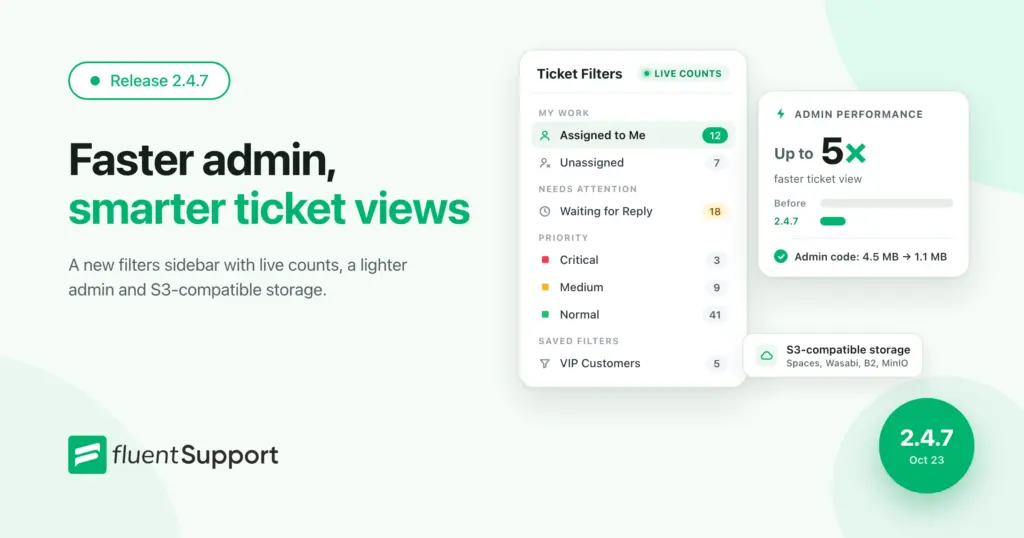
Fluent Support 2.4.7: Ticket Filters, 5x Faster Tickets and Smart Customer Search
Fluent Support 2.4.7 brings a Ticket Filters sidebar…Customer Success Best Practices for Small Teams
In this blog, we’ve discussed customer success in…






Add your first comment to this post