


How to Reduce Customer Churn Rate: A Complete Guide

By Prosanjit Dhar
March 30, 2026
Last Modified: March 30, 2026


You’re spending more than ever to acquire customers. But your growth still feels slower than it should.
That’s because customer churn quietly cancels out everything you’re building.
Globally, businesses lose over $1.6 trillion each year to customer churn. And in SaaS, even a small churn rate can undo years of progress in just a few quarters.
This guide breaks down what churn really is, why it’s more dangerous than it looks, and how to reduce it with strategies that actually work.
What is customer churn rate?
Customer churn (or customer attrition) rate is the percentage of customers or subscribers who stop doing business with a company over a specific time period.
It is calculated by dividing the number of customers lost during that period by the total number of customers at the start, then multiplying by 100.
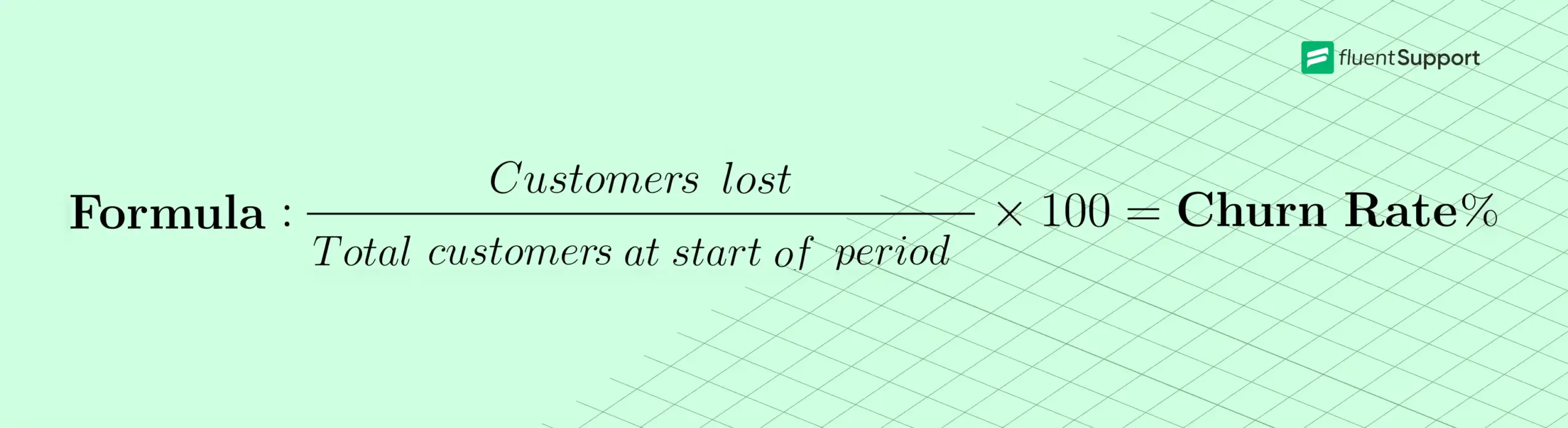
Customer churn is the inverse of customer retention and one of the most revealing metrics of your business’s long-term sustainability.
It doesn’t just show how many customers you’re losing. It shows how well your product, experience, and value proposition are holding up over time.
How to Calculate Customer Churn Rate
Calculating customer churn rate is simple.
Divide the number of customers lost during a specific period by the number of customers at the start of that period, then multiply by 100.
Customer churn rate formula:
Customer churn Rate = (Customers Lost During Period ÷ Customers at Start of Period) × 100
Example:
- Start of quarter: 2,000 customers
- End of quarter: 1,750 customers
- Customers lost: 250
Churn Rate = (250 ÷ 2,000) × 100 = 12.5%
That means you lost 1 in every 8 customers in just one quarter. Over time, even a small churn rate can quietly erode what should have been compounding business growth.
Types of churn: Interpretation matters more than calculation
The formula is straightforward. But what you do with it is where the real value lies.
Monthly vs. quarterly churn
Monthly churn measures customer loss over 30 days. It provides immediate feedback for your business.
On the other hand, quarterly churn covers 90 days, smoothing out short-term volatility for strategic planning.
Monthly is better for acting on high-volume or quick-churn environments (3–5% is typical). While quarterly suits larger, enterprise-level clients with fewer and longer-term cancellations.
However, a 3% monthly churn rate might seem manageable. But over a year, that translates to roughly 31% of your customers leaving.
Customer churn vs. revenue Churn
Customer churn and revenue churn measure different dimensions of the same problem.
- Customer churn tracks how many customer accounts you lose.
- Revenue churn measures the financial value lost due to cancellations or downgrades.
And they don’t always tell the same story.
If you lose multiple small customers but retain your largest accounts, your customer churn may look high while revenue churn remains low. On the flip side, losing a single high-value customer can severely impact revenue. Even if your customer churn appears minimal.
Voluntary vs. involuntary churn
Voluntary churn occurs when customers actively cancel subscriptions due to dissatisfaction or lack of value.
But involuntary (or passive) churn happens unintentionally. Usually caused by payment failures, expired cards, or technical errors.
Many businesses focus entirely on voluntary churn while ignoring the involuntary variety, which can account for 20–40% of total churn in subscription businesses.
Why customer churn Rate matters
Most businesses know churn is bad, but few realize how much it affects growth. Acquiring a new customer usually costs far more than retaining an existing one.
So every churned customer means you have to spend again just to replace lost revenue. Over time, that creates a costly cycle where growth feels like progress but never truly compounds.
Churn also weakens customer lifetime value. The longer customers stay, the more revenue you generate and become profitable. That is why even a small improvement in retention can have a major impact on profitability.
In other words, churn isn’t just a support issue; it’s a growth issue.
What actually causes customer churn?
What’s interesting is that customer churn rarely happens suddenly.
By the time a customer cancels, they’ve usually been disengaging for a while. Understanding the common causes helps you to prevent them.
1. Poor market fit or customer profiling
If marketing or sales attract customers outside the ideal profile, those users are more likely to churn. The product simply wasn’t built for their needs.
2. Weak onboarding
Customers who never reach the product’s “aha moment” at the opening might often leave early. Confusing onboarding or slow time-to-value prevents users from fully adopting the product.
3. Poor customer experience
That’s the most important thing in customer churn. Your support delays, unclear documentation, or frustrating interfaces gradually erode trust. Even small issues can accumulate into churn.
4. Misaligned pricing and value proposition
When customers say a product is “too expensive,” it usually means they don’t see enough value. Clear ROI and strong positioning are the key.
5. Low engagement
Declining product usage is one of the earliest churn signals. Customers who rarely log in or interact are far more likely to cancel.
6. Lack of customer relationship
Customers who feel no connection to the brand will switch easily when a cheaper or newer option appears. Strong brands create loyalty beyond features or price. They create long-term customer relationships.
How to reduce customer churn rate?
Reducing churn isn’t about one tactic. It’s about fixing the points where customers lose value, trust, or momentum.
Here are the highest-impact strategies:
1. Start with the right customers (ICP-first acquisition)
Retention begins before the sale. If you’re consistently acquiring customers who are a poor fit, no amount of post-sale effort will compensate.
Define your Ideal Customer Profile (ICP) with precision.
- Which customer segments have the highest retention rates?
- Which ones churn fastest?
Use that data to align your marketing and sales motion. Attracting the right customers from the start is the single highest-leverage churn reduction strategy.
Prioritize customers who are buying for long-term value. Not the ones who are drawn in purely by discounts or “free trial” offers. These customers tend to have the shortest tenures and the lowest LTVs.
2. Treat customer support as a retention engine
The goal is to make every support interaction feel like it’s handled by someone who genuinely cares about the outcome.
That means:
- Reducing response and resolution times.
- Training agents with empathy, not just scripts.
- Empowering your team to solve problems without unnecessary escalation.
- Following up after issues are resolved.
A well-equipped support team using the right helpdesk tools can transform support from a reactive cost center into a proactive retention engine.
Tools like Fluent Support are built specifically to help teams deliver fast, organized, and human support at scale without the bloat of enterprise-priced platforms.
3. Use data to predict and prevent churn
Don’t wait for customers to cancel. By then, it’s too late. The goal is to identify churn risk before it becomes churn reality.
Start by analyzing patterns in your churned customers:
- When did they stop engaging?
- What support issues did they raise?
- What features did they never adopt?
- When in the customer lifecycle did they leave?
From this data, build a churn risk framework, even a simple one. Customers who haven’t logged in for 14 days, haven’t completed onboarding, or have submitted multiple unresolved tickets are all showing early warning signals.
Flag them, reach out proactively, and address the friction before it becomes a farewell.
4. Invest seriously in onboarding and customer education
Time-to-value is everything. The faster a customer experiences a meaningful outcome with your product, the more likely they are to stick around.
Build onboarding flows that:
- Guide users to their first “aha moment” as quickly as possible.
- Eliminate unnecessary steps and confusion.
- Set honest, clear expectations (no surprise charges, no bait-and-switch free trials).
- Offer in-product tooltips, walkthroughs, and milestone celebrations.
Beyond initial onboarding, an ongoing content ecosystem (tutorials, guides, webinars, documentation) keeps customers growing with your product rather than outgrowing it.
5. Offer incentives with strategic timing
A discount offered to every customer at the 90-day mark is a blunt instrument. But an offer extended proactively to a high-value customer who just submitted their second support ticket this week?
That’s precision retention.
Effective incentive strategies include:
- Extended trials or paused billing for customers going through genuine hardship.
- Early renewal discounts for customers approaching the end of their contract.
- Loyalty rewards or account upgrades for long-tenured customers.
- Dedicated account managers for high-value accounts who need human touchpoints.
The goal isn’t to bribe customers into staying. It’s to remove friction and reinforce value at the moments when they’re most likely to reassess the relationship.
6. Build a community around your brand
When customers feel like they belong to something larger (a community of peers, practitioners, or advocates), leaving isn’t just a business decision. It’s a social one. That friction works in your favor.
Build spaces (Slack communities, forums, customer events, Facebook groups) where your most engaged users can connect, share, and help each other.
Use your team to show up, answer questions, share insights, and make the community feel alive. Community-generated content, referrals, and organic advocacy are among the most cost-effective retention and acquisition tools in existence.
7. Create a lifecycle marketing and engagement strategy
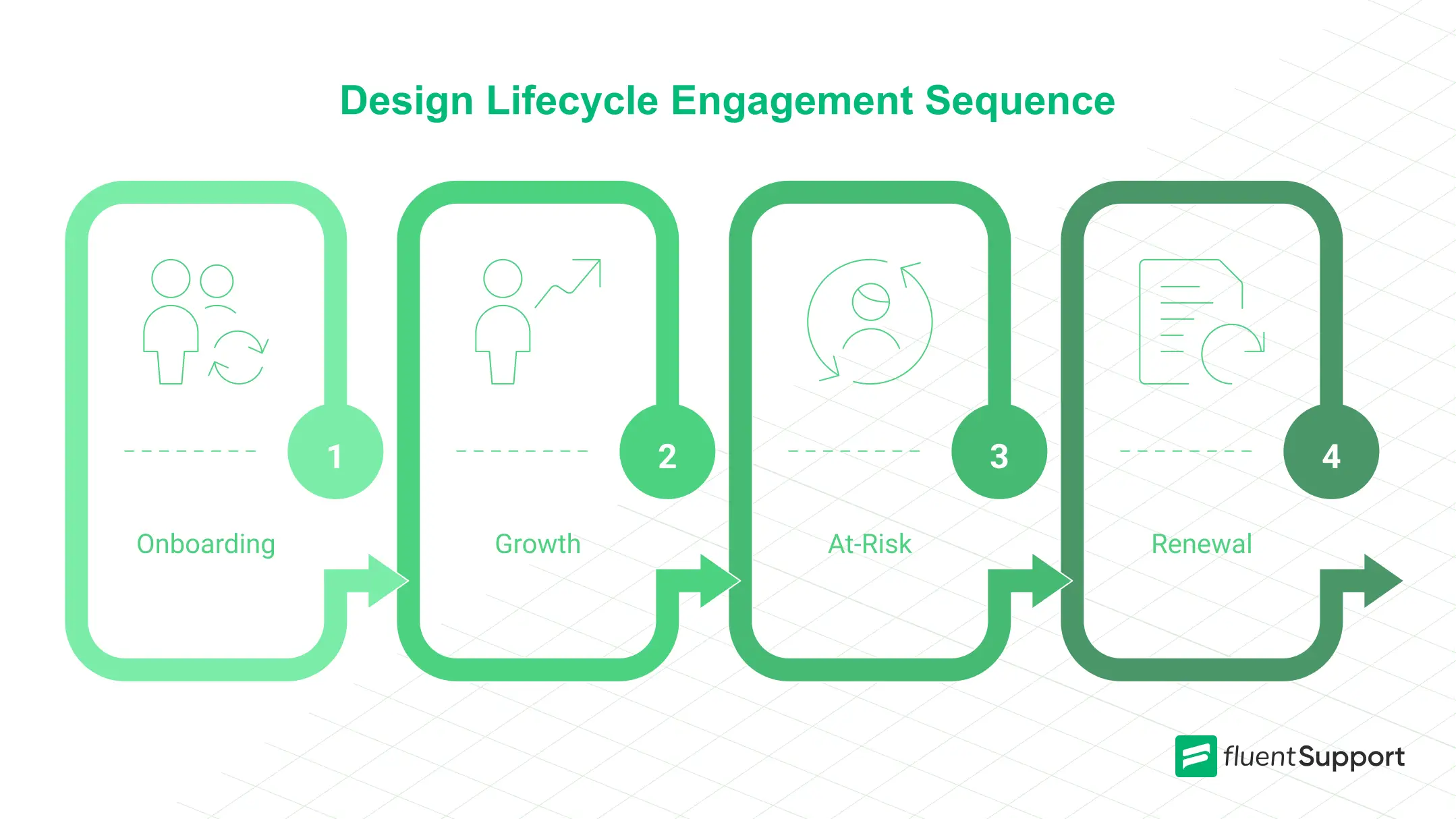
Map your customer lifecycle and design intentional communication at each stage:
- Onboarding phase: Welcome series, quick-start tutorials, milestone check-ins
- Growth phase: Feature education, advanced use cases, peer success stories
- At-risk phase: Re-engagement campaigns, support offers, exclusive value
- Renewal phase: ROI summaries, renewal incentives, relationship reviews
Segment your audience so that each communication feels personally relevant.
Use behavioral triggers (not just time-based sequences) to send the right message at the right moment. Customers who feel understood and valued don’t need to be convinced to stay.
Advanced insights: playing offense against churn
If the strategies above are foundational, these concepts represent the next level where businesses with serious retention programs operate.
Predictive churn analysis
Using historical customer data, you can build machine learning models (or use built-in tools in modern CRMs and analytics platforms) that assign each customer a churn probability score.
These models factor in login frequency, feature adoption, support ticket volume, NPS scores, and more to predict which customers are most likely to leave in the next 30, 60, or 90 days.
This allows your customer success team to prioritize outreach in a scalable and data-driven way.
Early warning signals to monitor
Even without sophisticated models, certain behavioral signals consistently precede churn:
- Declining login or product usage frequency
- Unanswered or unresolved support tickets
- Skipped renewal conversations
- Low NPS scores (typically 0–6, “detractors”)
- Feature adoption stalls after onboarding
Set up internal alerts for these signals so your team can respond before the customer mentally checks out.
Retention metrics worth tracking
Beyond churn rate itself, build a retention dashboard that includes:
- Net Revenue Retention (NRR): Revenue retained from existing customers, including expansion. An NRR above 100% means growth from your existing base alone.
- Customer Lifetime Value (LTV): The projected total revenue from a customer over their entire relationship with you. Churn directly compresses customer LTV.
- Net Promoter Score (NPS): A proxy for customer sentiment. Low NPS is one of the earliest leading indicators of future churn.
- CSAT (Customer Satisfaction Score): Measures customer satisfaction with specific interactions, like support. Consistently low CSAT correlates strongly with eventual churn.
Tracking these together gives you a richer, more predictive picture than churn rate alone.
Wrapping up
Reducing your customer churn rate isn’t about plugging a leak. It’s about building a business that’s genuinely worth staying in.
And that starts with honest measurement. It grows through better onboarding, smarter support, and more strategic engagement. And it compounds, year after year, into the kind of retention-driven growth that acquisition alone can never produce.
Start with one metric. Improve one touchpoint, then another. The businesses that win at retention are the ones that took it seriously first.
Start off with a powerful ticketing system that delivers smooth collaboration right out of the box.
Related Articles
26 Best Ticketing System Software in 2026
The best ticketing system software in 2026 includes…Fluent Support 2.4.5: Remote Portal, New Workflow Triggers and more
Fluent Support 2.4.5 lets you run the customer…

Add your first comment to this post