

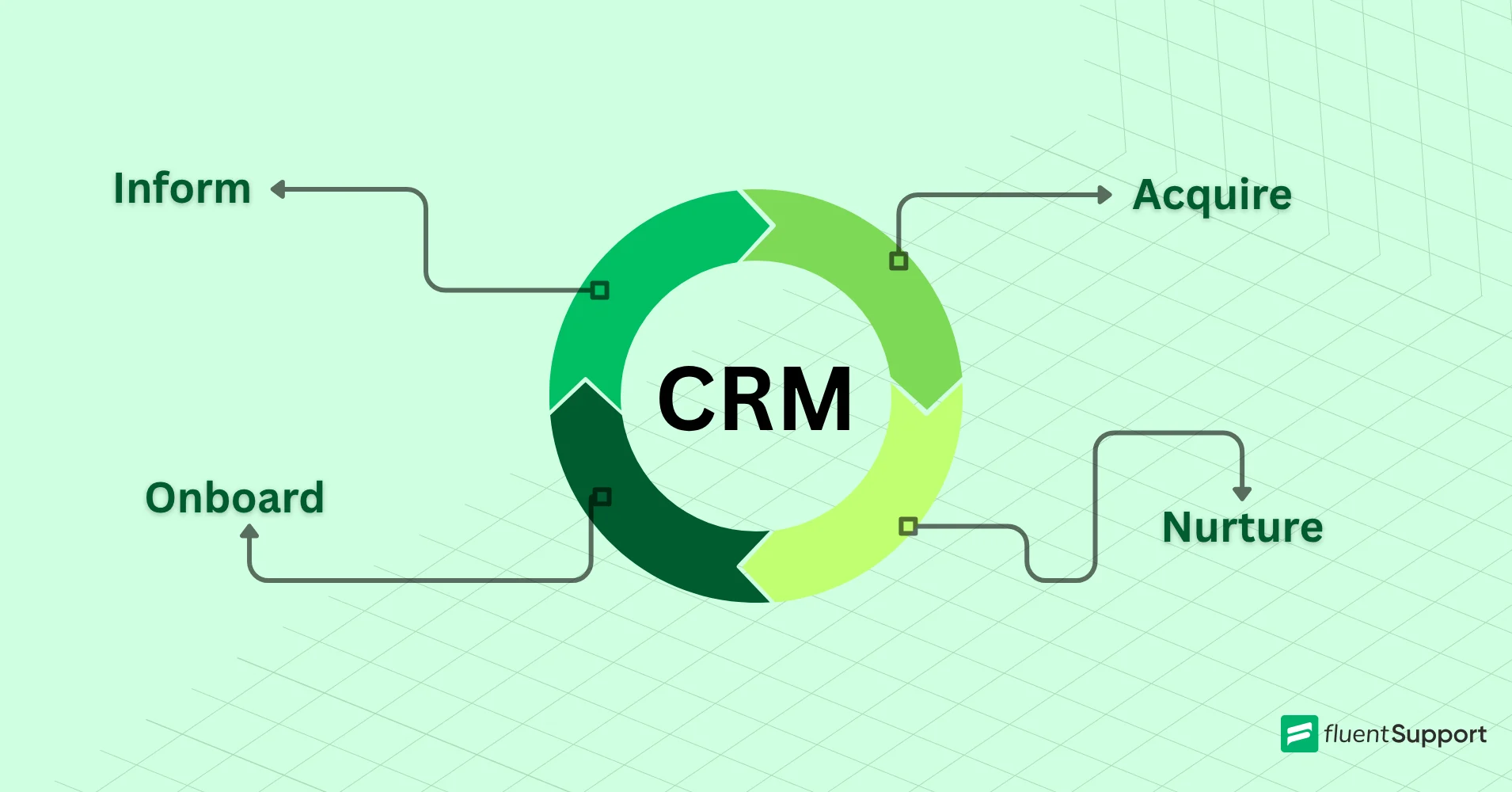
How to Build a Modern CRM Process + [AI Tips]

By Rasel Siddiqe
May 13, 2026
Last Modified: May 13, 2026


You bought a CRM. You moved your contacts in. Six months later, your sales team still tracks deals in spreadsheets, your support team hunts customer history across three open tabs, and nobody is sure who owns what. The software is fine. The CRM process behind it is the problem.
This post walks through what a working CRM process looks like for a modern business: the five stages, the tools that handle each one, the common pitfalls, and where AI fits in. By the end, you will know what to build, what to fix, and what to stop doing.
We will lean on the customer service side throughout, because that is where most growing teams quietly lose revenue. If your support work is the leaky end of the funnel, Fluent Support is the WordPress-native helpdesk we will use as the example throughout this guide.
TL;DR
- A CRM process is the agreement between marketing, sales, and support on how every customer interaction is captured, handled, and improved.
- Most growing businesses fail at retention, not acquisition. Fix the back half of the CRM process first.
- The five stages are acquisition, engagement, conversion, retention, and advocacy.
- AI now helps in every stage, but only in narrow, well-defined tasks like summaries, scoring, and tone adjustment.
- A working CRM process is built on clean data, defined ownership, and the right tool at each stage.
What is a CRM process?
A CRM process is the structured set of steps a business follows to manage every interaction with a current or potential customer, from the first contact through long-term loyalty. It covers how you capture leads, nurture them, close sales, retain customers, and turn them into advocates. The software is the tool. The CRM process is the playbook that runs on top of it.
When the software is doing the work but the process is informal, results stay random. A defined CRM process gives every team, from marketing to sales to support, the same picture of who the customer is and what happens next.
What is the primary objective of the CRM process?
The primary objective of the CRM process is to build and maintain profitable customer relationships across the full customer lifecycle. It does this by capturing reliable customer data, acting on it consistently, and increasing customer lifetime value over time. Everything else, including faster replies, sharper marketing, and higher conversion, is a downstream effect of getting that core right.
A working CRM process is not a feature list. It is a system that turns customer interactions into reliable data, and reliable data into better decisions.
The 5 stages of the CRM process
A healthy CRM process has five stages. Each stage has its own goal, its own metric, and its own set of tools. Skipping a stage is one of the fastest ways to lose customers without noticing.
1. Awareness and customer acquisition
Awareness is where you identify potential customers and capture their information into your CRM. The goal is volume of qualified leads, not just traffic. Common acquisition channels include organic search, paid ads, content, events, referral programs, and direct outreach.
Your CRM is the receiving end. It should auto-collect leads from forms, landing pages, social channels, and your sales team’s manual entry, then store them in one place with consistent fields.
Where AI helps in acquisition: AI tools cluster leads by intent, score them against past converters, and help write better ad and landing-page copy. Tools your team can try include ChatGPT and Claude for ad copy variants, HubSpot’s lead scoring, and Apollo or Clay for enriched outbound lists.
2. Engagement and lead nurturing
Engagement is where you build trust before you ask for the sale. The CRM process uses behavioral data, email sequences, and content recommendations to keep leads moving without overwhelming them. The goal is qualified pipeline, not blast volume.
WordPress-native email marketing platforms like FluentCRM handle the engagement layer without sending data to a third-party SaaS tool, which fits well with a self-hosted CRM process.
Where AI helps in engagement: AI is most useful in segmenting audiences, personalizing subject lines, and predicting send times. Mailchimp’s content optimizer, FluentCRM’s automation rules, and copy helpers like Jasper handle most of this work. Keep humans on the actual messaging.
3. Sales conversion
Conversion is where engaged leads turn into paying customers. The CRM process at this stage tracks deal stages, follow-up reminders, proposal status, and reasons for win or loss. A clean pipeline view tells your team where to spend time today.
Most CRMs lose the plot here because reps stop updating fields. Fix it with shorter pipelines, mandatory fields per stage, and automatic stage transitions wherever possible.
Where AI helps in conversion: AI deal-coach tools like HubSpot Sales Hub, Gong, and Salesforce Einstein summarize calls, suggest the next step, and predict close probability based on past patterns. Use them as a second opinion, not a replacement for sales judgment.
4. Customer retention
Retention is where most of your future revenue lives, and where most growing teams quietly lose it. The CRM process at this stage covers digital customer onboarding, ongoing support, renewal tracking, and proactive check-ins. This is also where helpdesk software starts to matter more than marketing software.
A WordPress-native helpdesk like Fluent Support keeps every ticket, customer note, and reply attached to the customer record, so the support team sees the same history the sales team built. The setup covers unlimited tickets, internal notes, customer activity views, and reporting, without per-agent pricing.
Where AI helps in retention: AI-assisted helpdesk features such as ticket summaries, generative replies, and sentiment analysis cut first-response time and let small teams handle bigger inboxes. The AI-assisted support features inside Fluent Support cover these directly inside WordPress. Similar features exist in Zendesk AI and Freshdesk’s Freddy outside WordPress.
5. Loyalty and advocacy
Advocacy is the final stage of the CRM process and the cheapest growth lever you have. Loyal customers refer others, leave reviews, expand their spend, and forgive mistakes. Your CRM process should track NPS, review activity, referrals, and repeat purchase rate.
Set up automations to ask happy customers for reviews, pull advocates out of satisfaction surveys, and route promoter feedback to marketing for case studies. A practical place to start is learning how to turn customers into a referral source before you build more complex loyalty mechanics.
Where AI helps in advocacy: AI tools like Delighted, AskNicely, and built-in CRM analytics spot promoter patterns, summarize open-ended NPS feedback, and draft thank-you messages or follow-up offers. Stay involved with the wording, because this is where the human voice matters most.
The four building blocks of a working CRM stack
A working CRM process needs four building blocks, no matter which software you pick.
Contact management
A single source of truth for every contact, with full interaction history, custom fields, and segment membership. Bad contact management is the most common cause of a broken CRM process: duplicates, missing fields, and stale records that nobody trusts.
Sales management
Pipeline view, deal stages, activity tracking, forecasting, and rep dashboards. The point is to make the next step obvious for every deal, every day.
Marketing automation
Email sequences, behavioral triggers, segmentation, and campaign tracking. This is the engine that runs the engagement and retention stages while your team sleeps. WordPress businesses can run this on the same server as the rest of the site using FluentCRM.
Customer service
Ticketing, knowledge base, internal notes, SLAs, and automated routing. The CRM process is only as good as your slowest reply. Helpdesks like Fluent Support cover most of this without per-agent fees.
Common problems that break the CRM process
Even good teams hit the same walls.
Bad data
The CRM process collapses when records are wrong. Set up validation on entry, schedule a quarterly cleanup, and pick one team to own data quality. Tools like Validity DemandTools, Dedupely, and HubSpot’s data quality command center help with cleanup at scale.
Low user adoption
If your sales team updates the CRM only on the day before pipeline review, the data is useless. Cut required fields to the minimum, build short training sessions per role, and reward adoption with public wins.
Integration gaps
Your CRM has to talk to email, helpdesk, billing, and analytics. Otherwise you are back to spreadsheets within months. WordPress setups can connect through the Fluent Support integrations list, Zapier, or Make. Map every tool before you pick a CRM.
Goal misalignment
A CRM process built around what the software can do, instead of what the business needs, will always underperform. Start with the metric you want to move, such as lower CAC, higher LTV, or faster response time, then build the CRM process backward from that metric.
How to measure if your CRM process is working

A CRM process without metrics is a spreadsheet with extra steps. Pick a small set of indicators across the lifecycle.
- Sales: conversion rate, average deal size, sales cycle length, win rate by source.
- Marketing: cost per qualified lead, email engagement, content-to-lead ratio, attributed revenue.
- Support: first response time, resolution time, ticket reopen rate, CSAT and NPS.
- Customer: lifetime value, churn rate, repeat purchase rate, referral rate.
Review these on a fixed cadence. The CRM process is a system, and systems only improve when somebody is watching them.
Build a CRM process that lasts
A CRM process is not the same thing as buying CRM software. The software is one tool. The CRM process is the agreement between marketing, sales, and support on how every customer interaction gets handled, recorded, and improved.
If you run a WordPress business, you can build most of this stack inside WordPress without paying per agent or per contact. Fluent Support handles the helpdesk side, FluentCRM handles email and marketing automation, and your customer data stays on your own server.
Pick the one stage of the CRM process that is weakest today. Fix the tool, fix the ownership, and fix the data hygiene for that stage. Then move to the next one. The teams that win at CRM are not the ones with the most features. They are the ones who actually follow the process.
Related Articles
Customer Service Checklist: A Practical Guide for Support Teams
A practical customer service checklist covering readiness, communication,…Personalized Customer Experience: What It Is and How to Build It
A personalized customer experience is when a business…



Leave a Reply