


Customer Communication Management: Stop Losing Customers

By Md. Sajid Sadman
May 26, 2026
Last Modified: May 23, 2026


Your customer just filed a complaint through email. Two hours later, they get a promotional SMS about your new product launch.
That disconnect is not a one-time mistake. It is what happens when teams communicate in silos. Customer communication management fixes that by creating one consistent strategy across every channel, every message, and every stage of the customer journey.
This blog breaks down what CCM actually is, why it matters more than most teams realize, and how to build a strategy that works.
TL;DR
What is customer communication management (CCM)?
CCM is the practice of managing how a business creates, delivers, and tracks all communication with customers across every channel. It combines strategy, process, and tools to ensure every message is consistent, relevant, and timely.
Why does customer communication management matter?
Without a CCM strategy, teams communicate in silos and customers receive fragmented, inconsistent experiences. When support, marketing, and sales operate separately, customers get promotional emails on the same day they file complaints.
What are the core elements of a CCM strategy?
The five core elements are channel coverage across email, phone, chat, and social platforms, consistent messaging through shared templates and brand voice guidelines, personalization using customer data and history, automation for high-volume routine communications like confirmations and updates, and a feedback loop for tracking metrics like response time and satisfaction scores.
What is the difference between reactive and proactive communication?
Reactive communication responds after the customer reaches out with a problem. Proactive communication reaches out before the customer needs to ask, informing them about shipping delays, known issues, upcoming renewals, or plan changes. Both are necessary for a mature CCM strategy.
What does omnichannel mean in customer communication management?
Omnichannel CCM means every channel shares customer context so conversations continue seamlessly. A customer who emailed yesterday should not feel like a stranger when they call today. This requires a unified view where all interactions across all channels are accessible from one place.
What breaks without CCM?
Three main failures occur without CCM. First, fragmented customer data across different tools means customers repeat themselves and agents give conflicting answers. Second, inconsistent tone develops when agents write without shared guidelines. Third, teams miss the feedback loop and keep repeating broken communication patterns without knowing they are failing.
How do you build a CCM strategy?
Start by auditing every customer communication touchpoint to find gaps and duplications. Define your brand voice explicitly with examples for every agent. Segment customers by needs so new users get onboarding while long-term customers get retention messaging. Identify high-volume, low-complexity touchpoints for automation. Build a measurement framework tracking response rates, CSAT scores, and resolution speed. Create a regular review process to gather agent input and customer feedback monthly.
How is CCM different from CRM?
A CRM stores customer data like purchase history and account details. CCM sits on top of that data layer and uses it to drive actual communication. CRM is the foundation that makes personalization possible. CCM is the execution layer that delivers messages. You need both, but they serve different functions.
What Is Customer Communication Management (CCM)?
Customer communication management (CCM) is the practice of creating, organizing, delivering, and tracking every outbound and inbound interaction a business has with its customers across all channels. It covers everything from a support reply sent via email to an automated order confirmation sent by SMS.
A well-run CCM strategy typically includes:
- A defined process for how messages are created and approved
- Channel management that covers email, chat, phone, and social
- Personalization based on customer data and history
- Automation for routine and high-volume communications
- A feedback loop for measuring communication quality
- Documentation and archiving of past interactions
The goal is not to send more messages. The goal is to send the right message, to the right customer, through the right channel, at the right time.
Why CCM Matters More Than Most Teams Realize
Here is a pattern teams typically run into: support handles customer queries, marketing sends campaigns, and sales manages onboarding messages. Each team is doing their job, but none of them are talking to each other.
The customer ends up receiving a promotional email the same day they filed a complaint. That kind of disconnect damages trust fast.
CCM matters because customers do not separate your departments. To them, every message they receive is from you, the company. A slow reply, a mismatched tone, or a generic response after a premium purchase all register as failures.
Here is why getting CCM right changes everything:
Retention becomes predictable. Research from Aberdeen Group found that companies with strong omnichannel communication strategies retain 89% of their customers. Companies without them retain closer to 33%. CCM is one of the most direct levers you have on that number.
Every touchpoint reinforces your brand. When your communication is consistent across channels, customers develop confidence in your business. They know what to expect. That consistency builds trust faster than any single great interaction ever could.
Agents work faster with full context. When every channel shares customer history, agents stop wasting time hunting for context. They see the last three interactions, the open issues, and the customer’s preferences in one view. That means faster resolutions and less frustration for everyone involved.
Customer lifetime value increases. Personalized, timely communication keeps customers engaged beyond the first purchase. They are more likely to renew, upgrade, and refer others when they feel like you actually know who they are and what they need.
You spot problems before they compound. A unified communication strategy gives you visibility into what is working and what is breaking. You see patterns. You catch tone drift. You notice when response times slip on a specific channel before churn numbers reflect it.
The Core Elements of a CCM Strategy
A CCM strategy is not a single process. It is a set of connected decisions about how your business communicates, and how those decisions get enforced consistently across every team and channel.
Channel Coverage
You cannot manage what you have not mapped. So the first step in any CCM strategy is knowing every channel your customers use to reach you, and every channel you use to reach them.
That includes email, phone, live chat, and social platforms. Most teams underestimate how many channels they actually operate across.
When you map them all out, you also start to see where context is getting lost. A customer who moves from chat to email should not have to re-explain their issue.
Consistent Messaging
Consistency does not mean robotic. It means your customers get the same quality of information and the same tone whether they talk to a junior agent on Monday or a senior agent on Friday.
That requires shared templates, clear brand voice guidelines, and a review process that catches drift before it reaches the customer. Teams that rely on individual agent judgment alone tend to produce inconsistent outcomes.
Personalization at Scale
Think of personalization in CCM as using what you already know about a customer to make every communication feel relevant. Their name, their history, their last issue, their preferred channel.
The data your team already captures through a helpdesk ticketing system gives you most of what you need. Ticket history, response preferences, and resolution patterns are all signals.
Automation for Routine Communication
Not every message needs a human. Ticket confirmations, status updates, follow-ups, and satisfaction surveys can all be automated without losing quality.
In fact, automating these frees your agents to focus on complex issues that actually require judgment and empathy. The key is knowing where automation helps and where it harms.
Customer service automation works well for high-volume, low-complexity touchpoints. It works poorly when a customer is frustrated and needs a real conversation.
Just a heads up: Fluent Support’s workflow automation uses triggers, conditions, and actions to handle routine tasks. When a ticket is created, when a customer responds, or when a ticket closes, you can fire automated workflows based on conditions you set. Build the workflow once, and it runs automatically.
Feedback and Measurement
A CCM strategy without measurement is guesswork. You need to know whether your communications are landing.
Are customers reading your updates? Are they responding to follow-ups? Are resolution rates improving after you changed your response templates?
Tracking metrics like first response time and customer satisfaction scores at the communication level tells you what is working. It also helps you spot agents or channels that are underperforming before the problem compounds.
Reactive vs. Proactive Communication
Most teams default to reactive communication. A customer reaches out, you respond, issue gets resolved.
That cycle is necessary, but it is not sufficient. Customers who only ever hear from you when something goes wrong associate your brand with problems, not solutions.
Proactive communication is the other half of a mature CCM strategy. That means reaching out before the customer needs to ask.
Shipping delays, known product issues, upcoming renewals, changes to their plan. Customers who are informed in advance are far more forgiving than customers who discover problems on their own.
Teams typically struggle to build proactive communication habits because it requires internal coordination. Support has to know what product, sales, and operations are doing.
Customer Communication Management and the Omnichannel Reality
The channel a customer chooses tells you something about their urgency and expectation. Someone who calls wants speed.
Someone who emails is often willing to wait a bit longer for detail. Someone who messages on social media wants a quick acknowledgment.
But here is where most teams fall short: they treat each channel as a separate silo. A customer who emailed yesterday should not feel like a stranger when they call today.
Omnichannel customer support means every channel shares context. The conversation continues, it does not restart.
Achieving that requires a unified view of the customer. All interactions, across all channels, accessible from one place.
What Happens When You Skip CCM
What actually happens when teams do not have a clear CCM strategy in place?
When communication is not managed as a unified strategy, the cracks show up fast. Customers get mixed messages. Agents waste time hunting for context. Trust erodes quietly because no one is measuring whether the communication is even working.
Common failures without CCM:
Purely reactive communication: Teams only reach out when something is wrong. Customers associate your brand with problems, not solutions.
Fragmented data: Support, sales, and marketing use separate tools. No one has the full customer picture. Customers repeat themselves. Agents contradict each other.
Inconsistent tone: Every agent writes in their own voice. One sounds warm, another sounds robotic. Fine for small teams. A trust problem at scale.
No feedback loop: Teams send messages and assume they landed. No tracking means broken patterns repeat.
Lost context at handoffs: A customer emails, then calls. The agent has no idea what was already discussed. Every channel switch forces the customer to start over.
How to Build Your CCM Strategy Step by Step
Building a CCM strategy does not require starting from scratch. Most teams already have the raw materials.
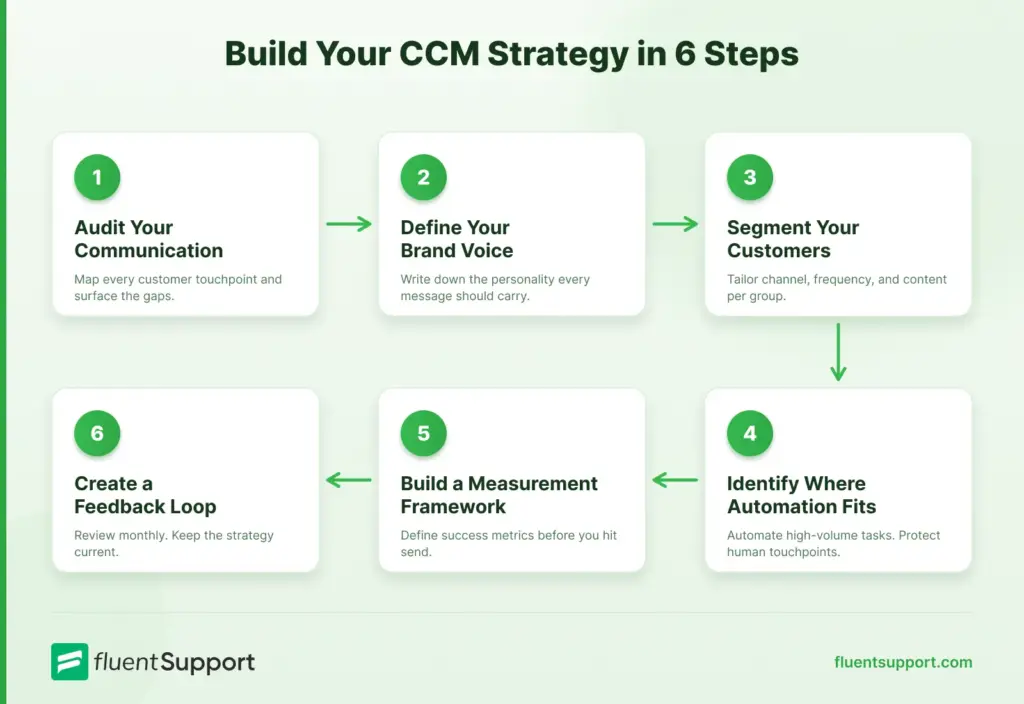
Step 1: Audit Your Current Communication
Start by mapping every touchpoint where your business communicates with customers. Outbound emails, ticket replies, automated messages, social responses, phone scripts.
List them all.
This audit will reveal gaps, duplications, and inconsistencies you probably did not know existed.
Step 2: Define Your Brand Voice
Your brand voice is the non-negotiable personality that should come through in every message, regardless of who sends it. Direct but warm. Clear without being cold.
Whatever it is, write it down explicitly and give every agent access to examples. Vague instructions like “be professional” do not translate to consistent execution.
Step 3: Segment Your Customers
Not every customer needs the same type of communication. New users need onboarding messages.
Long-term customers need check-ins and retention signals. High-value accounts need proactive updates.
Segmenting your customers allows you to tailor the frequency, channel, and content of your communications to fit what each group actually needs.
This is especially important for B2B customer service, where communication expectations are higher and the stakes of a missed message are greater.
Step 4: Identify Where Automation Fits
Go through your communication touchpoints and identify which ones are high volume and low complexity. Those are your automation candidates.
Set up workflows for ticket confirmations, follow-ups, survey requests, and status updates.
Then protect your human touchpoints. Complex complaints, escalated tickets, and high-value customers should always have a real person behind the response.
Step 5: Build a Measurement Framework
Define what success looks like for your communications before you send them.
Response rate, open rate, CSAT score, repeat customer rate, and resolution speed are all relevant signals.
Review them regularly and tie them back to specific communication changes so you know what is actually driving outcomes.
Step 6: Create a Feedback Loop
A CCM strategy is never finished. Customer expectations shift, channels evolve, and your team learns what works and what does not. Build a regular review process.
Check your customer service statistics monthly. Gather agent input on what templates are falling flat. Survey customers about their communication preferences.
Use all of that to keep the strategy current.
CCM vs. CRM: What Is the Difference?
This distinction comes up often, and it is worth clarifying.
A CRM (customer relationship management) system stores data about your customers: who they are, what they have bought, how long they have been a customer, their support history, and their interactions with your business. It is a data layer.
CCM (Customer Communication Management) sits on top of that data layer and uses it to drive communication. CCM is the strategy and the execution. It takes the information stored in your CRM and turns it into actual messages that reach customers at the right time, through the right channel, with the right tone.
You need both, but they serve different functions.
| Aspect | CRM | CCM |
|---|---|---|
| Purpose | Stores and manages customer data | Creates and delivers customer communication |
| Focus | Data collection and organization | Message strategy and execution |
| Primary Use | Track customer relationships, sales pipeline, support history | Personalize and automate outbound and inbound messages |
| What It Manages | Contact details, purchase history, interaction logs | Email campaigns, ticket replies, notifications, surveys |
| Output | Customer profiles and insights | Actual messages sent to customers |
| Who Uses It | Sales, support, and marketing teams | Support, marketing, and operations teams |
| Example Tools | Salesforce, HubSpot, Zoho CRM | Helpdesk systems, email automation, notification platforms |
The mistake teams make is treating their CRM as a communication tool when it was designed to be a data tool. That gap is where CCM lives.
A customer engagement center often bridges the two: it brings CRM data into the communication workflow so agents have the full customer context right inside the tool they use to respond.
Wrapping Up
You just walked through the full framework. Channel coverage, consistent messaging, personalization, automation, feedback loops, and the step-by-step build. That is more than most teams ever sit down and map out.
Now you have a clear path. Audit your touchpoints, define your voice, segment your customers, automate the repetitive stuff, and measure what actually moves the needle. That is your CCM strategy.
The teams that execute on this do not just communicate better. They keep customers longer.
Start off with a powerful ticketing system that delivers smooth collaboration right out of the box.
Customer communication management is the strategy a business uses to control how it communicates with customers across every channel. It covers what gets said, how it gets said, who sends it, and how the outcome gets measured.
A CRM stores customer data. CCM uses that data to create and deliver communication. CRM is the foundation. CCM is how you act on it.
Consistency builds trust. When customers receive the same quality of response regardless of which channel they use or which agent they speak with, they develop confidence in the brand. Inconsistency, even when unintentional, erodes that trust over time.
Automation handles high-volume, low-complexity communication like confirmations, updates, and follow-ups. It frees agents for more nuanced interactions. The key is identifying which touchpoints benefit from automation and which ones still require a human response.
It should cover every channel your customers actually use. That typically includes email, phone, live chat, social media, and SMS. The types of customer service your business offers will determine which channels matter most.
Track metrics like first response time, customer satisfaction score, resolution rate, and repeat contact rate. Review these regularly and tie changes in performance back to specific changes in your communication process. The customer experience statistics your team tracks should always connect back to real communication decisions.
Without CCM, teams communicate in silos, customers receive inconsistent messages, and there is no way to measure or improve what is being sent. The result is a fragmented customer experience that damages retention over time.
Not at all. Small and growing businesses benefit from CCM just as much, if not more, because they have fewer resources to recover from poor communication. A simple CCM framework gives small teams structure and helps them look and feel more professional as they scale.
Related Articles
Fluent Support 2.4.7: Ticket Filters, 5x Faster Tickets and Smart Customer Search
Fluent Support 2.4.7 brings a Ticket Filters sidebar…Customer Success Best Practices for Small Teams
In this blog, we’ve discussed customer success in…



Add your first comment to this post