


Customer Service Myths That Lead Teams Astray

By Md. Sajid Sadman
May 18, 2026
Last Modified: May 18, 2026


What if the way you are running customer service is based on things that were never actually true?
Not edge cases. The core stuff. The customer is always right. No complaints means happy customers. Speed is everything. These ideas feel like common sense because everyone repeats them. But repeating something does not make it right.
Here are eight customer service myths that most teams still operate on, and what actually works instead.
TL;DR
Q: What are customer service myths?
Customer service myths are widely believed ideas about how support should work that feel logical but fall apart when tested against data. They survive because they sound like common sense, not because they produce better outcomes for teams or customers.
Q: Does no complaints mean customers are happy?
No. Most dissatisfied customers never complain. They leave without saying a word. Silence is a sign of disengagement, not satisfaction. Teams that rely on complaint volume to measure customer health are missing the majority of the problem.
Q: Is the customer always right?
No. The phrase was coined in early retail to signal trustworthiness, not to instruct staff to comply with every demand. Acting on it literally damages agent morale and leads to poor decisions. Customers deserve empathy and fair resolution, not unconditional agreement.
Q: Is response speed the most important support metric?
Speed matters, but it is not the whole picture. A fast reply that misses the point creates more frustration than a slower, accurate one. Resolution quality, customer effort score, and follow-up contact rate all tell you more about support effectiveness than response time alone.
Q: Does a high CSAT score mean customers will stay?
Not necessarily. CSAT measures how a customer felt about one interaction. It does not predict whether they will renew, return, or recommend. Loyalty is built across many touchpoints over time, not in a single ticket.
Q: Is customer service a cost centre?
No. Harvard Business Review found that acquiring a new customer costs five to 25 times more than retaining an existing one. Service directly influences retention, repeat revenue, and lifetime value. Treating it as overhead leads to underinvestment with real revenue consequences.
Q: Does more channels mean better service?
No. Adding channels without the staffing to support them creates inconsistency. Customers do not want more options. They want reliable help on the channels they already use. A well-run two-channel operation serves customers better than a stretched five-channel one.
Q: Are satisfied customers automatically loyal?
No. Satisfaction and loyalty are different things. A customer can leave a five-star rating and still churn. Loyalty comes from consistency, feeling valued over time, and positive experiences across the full relationship, not just the last interaction.
Q: Will AI replace customer support teams?
No. AI handles high-volume, repetitive queries well. But complex, emotional, and context-heavy problems still require human judgment. The practical outcome in most support environments is a hybrid model where AI reduces agent load and humans handle what AI cannot.
What Are Customer Service Myths?
Customer service myths are widely accepted beliefs about support operations that feel logical but are not supported by evidence. They spread because they are simple, repeatable, and easy to apply without much analysis.
The risk is not that they sound wrong. The risk is that they sound right. And when teams make operational decisions based on flawed assumptions, the damage shows up in churn data, agent morale, and customer retention numbers long before anyone connects the dots.
Here are the eight myths this blog covers:
- 1. No complaints means customers are happy
- 2. The customer is always right
- 3. Speed is the most important metric
- 4. High CSAT means customers will stay
- 5. Customer service is a cost centre
- 6. More channels means better service
- 7. Satisfied customers are loyal customers
- 8. AI will replace your support team
Myth 1: No Complaints Means Customers Are Happy
Silence is not satisfaction. It is one of the most misleading signals a support team can rely on.
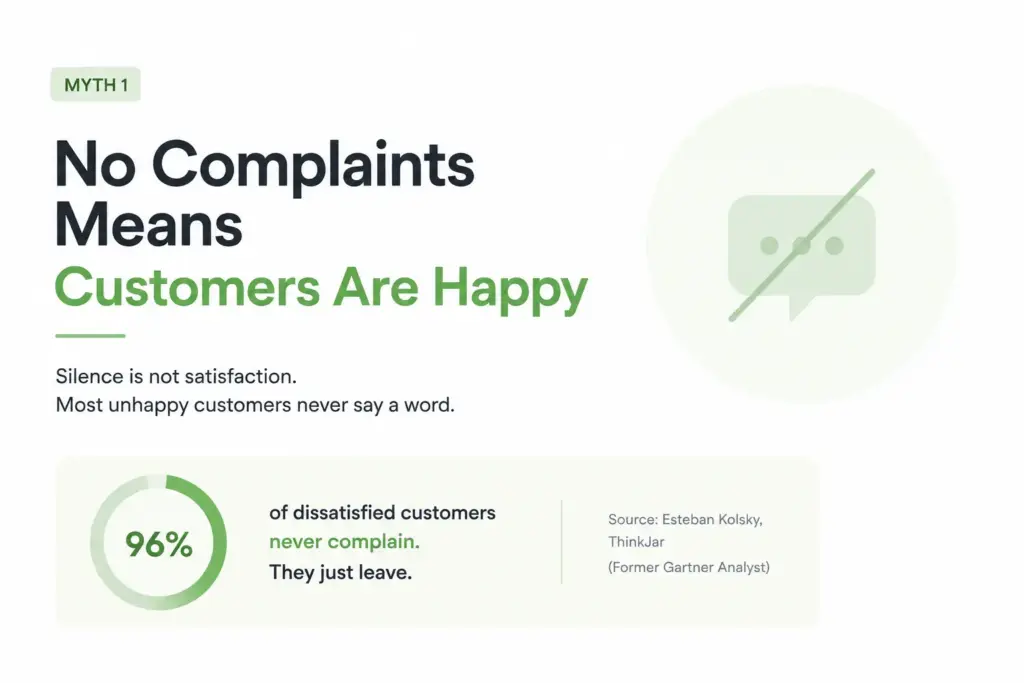
Research by Esteban Kolsky, former Gartner analyst and founder of ThinkJar, found that fewer than 4% of dissatisfied customers ever raise a complaint directly with a business.
The other 96% do not say a word. They close the tab, cancel the subscription, or switch to a competitor. Teams that measure success by a quiet inbox are, in practice, measuring how many unhappy customers could not be bothered to tell them.
This comes up frequently in support professional communities. On Quora discussions about customer service misconceptions, practitioners consistently flag silent churn as the thing their managers misread most. The absence of feedback gets treated as positive feedback, and that gap is where customers slip away unnoticed.
The operational fix is straightforward. Build proactive customer support into your process. Send post-interaction surveys. Track channel drop-offs. Reach out before customers have to. Waiting for complaints to arrive is not a support strategy.
What to do instead: Ask for feedback at every meaningful touchpoint rather than waiting for customers to volunteer it. Treat low complaint volume as a signal to investigate, not a reason to celebrate.
Myth 2: The Customer Is Always Right
This phrase has been in circulation for over a century. Wikipedia traces it to retailers like Marshall Field and Harry Gordon Selfridge around 1905, at a time when shops routinely misled buyers and the principle of caveat emptor (let the buyer beware) was common practice. The idea was to signal trustworthiness, not to endorse every claim a customer made.
Snopes has confirmed that the popular social media version, which adds “in matters of taste” to make the phrase less absolute, has no verified source. The original phrase was never meant literally, even in its own era. Selfridge’s own store published an editorial in 1936 acknowledging that the unreasonable customer does exist.
The myth causes two concrete problems in real support environments. First, it pressures agents to agree with demands that are factually wrong, policy-violating, or unreasonable, which erodes the team’s credibility and morale. Second, it signals to agents that their own judgment does not matter, which leads to disengagement over time.
The more useful framing is this: customers’ needs are always worth understanding, but their stated position is not always correct. Good complaint handling involves listening carefully, validating the frustration, and resolving the underlying issue without surrendering to every demand.
What to do instead: Train agents to lead with empathy, investigate thoroughly, and then resolve based on what is fair and accurate. Supporting your agents when customers are unreasonable is not optional. It is how you retain good people.
Myth 3: Speed Is the Most Important Metric
Speed matters. Nobody is arguing otherwise. But making it the primary measure of support quality leads teams to optimise for the wrong thing.
When speed becomes the dominant goal, agents are incentivised to close tickets fast rather than close them well. First response time gets tracked obsessively, while resolution quality gets less attention. The result is customers who receive a quick reply but still have an unsolved problem. Learn more about how first response time fits into the bigger picture before treating it as your headline metric.
Community discussions on this point are clear. Support professionals regularly note that customers with complex problems do not want a fast answer. They want the right answer. A reply within two minutes that misses the point is more frustrating than a considered response that takes fifteen. Speed and resolution quality are both important, but they serve different functions, and building your customer experience KPIs around speed alone leaves gaps that show up in CSAT and churn data.
The practical tension is real. Being fast and being thorough can conflict, especially in a high-volume queue. The answer is not to abandon speed targets, but to balance them against resolution rate, customer effort score, and follow-up contact rate.
What to do instead: Track first response time alongside resolution quality and customer effort score. A team that resolves problems completely on first contact, even if slightly slower, outperforms one that replies fast and creates follow-up tickets.
Myth 4: High CSAT Scores Mean Customers Will Stay
CSAT is a useful signal. It is not a loyalty guarantee.
The metric captures how a customer felt at the end of a single interaction. It does not measure what they will do next week, whether they are actively comparing alternatives, or how they feel about the broader relationship with the brand. Teams that use CSAT as a proxy for retention are, in effect, measuring the wrong thing. Customer satisfaction and customer loyalty are related but they are not the same.
The distinction matters operationally. A customer can rate a support interaction five stars and still churn because the product disappointed them, a competitor offered better pricing, or the onboarding experience weeks earlier left a bad impression. That five-star rating tells you the agent did their job well in that moment. It tells you nothing about the overall customer experience that determines whether they stay.
From real support environments, this pattern appears most visibly in subscription businesses. High post-ticket CSAT sits alongside churning cohorts. When teams dig into the data, the individual interaction scores look fine. The cumulative experience tells a different story.
What to do instead: Pair CSAT with Net Promoter Score, customer effort score, and repeat customer rate to get a more complete picture of how customers feel about the relationship, not just the last interaction.
Myth 5: Customer Service Is a Cost Centre
This belief persists in boardrooms and budget discussions because support costs are easy to see and the revenue contribution is harder to quantify directly.
The data tells a different story. Harvard Business Review research puts the cost of acquiring a new customer at five to 25 times more than retaining an existing one, depending on the industry. And a 5% increase in retention rates can lift profits by 25 to 95%. Customer retention strategies built on strong service consistently outperform acquisition-first approaches in long-term revenue. Resolved complaints handled well regularly produce more loyalty than problem-free interactions. Upsell and cross-sell opportunities emerge most naturally when a customer has just had a positive support experience.
The Verde Group’s CX research puts it plainly: service is not a cost, it is a growth driver. Teams that resolve experience friction to the customer’s complete satisfaction see measurable reductions in churn and increases in repeat purchasing. This connection between service quality and revenue is well-documented in customer service statisticsthat teams can use to make the case internally.
The framing matters because it determines how support teams are staffed, resourced, and measured. A team treated as overhead operates differently from a team treated as a retention function. And the outcomes reflect exactly that difference.
Just a heads up: most helpdesk tools charge you more as you grow. Fluent Support does not. Unlimited agents, unlimited tickets, full workflow automation, and detailed reporting, all inside your WordPress dashboard for a flat annual price.
What to do instead: Track the revenue impact of service explicitly. Measure churn reduction tied to support interventions, upsell conversion rates during support interactions, and the lifetime value difference between customers who have had a great support experience and those who have not.
Myth 6: More Channels Means Better Service
Adding channels feels like progress. It rarely is, unless the team is resourced to staff them properly.
The reality is that a customer on an understaffed channel has a worse experience than a customer on a single well-managed one. Spreading a support team across six platforms without adjusting headcount or tooling means every channel degrades. Customer experience statistics show that customers do not want infinite options. They want fast, reliable help on the channels they already use.
This myth shows up in job descriptions too. Listings for customer service roles increasingly feature a list of ten platforms as a requirement, without specifying the workflows that connect them. Support professionals in community forums regularly note that multichannel fragmentation creates inconsistency, not coverage. A customer who gets a great answer via email but waits two days on live chat has not had an omnichannel experience. They have had two different experiences, one of which disappointed them. The types of customer service a team offers should match what they can actually deliver well.
The question is not how many channels you offer. It is whether the channels you offer are consistently staffed, connected to each other, and actually used by your customers.
What to do instead: Start with the channels your customers already contact you on. Add new ones only when you can resource them properly. A well-run two-channel support operation serves customers better than an understaffed five-channel one.
Myth 7: Satisfied Customers Are Loyal Customers
Satisfaction is a moment. Loyalty is a pattern. They are not the same thing, and building your retention strategy around satisfaction scores alone misses the distinction.
A customer can leave a five-star review and never return. They may have had a fine experience but felt no particular reason to stay. Loyalty is built on something deeper: consistency over time, a sense that the relationship is worth maintaining, and enough positive interactions to make switching feel like a loss.
Customer relations research consistently shows that satisfied customers become loyal customers when they feel heard, remembered, and valued across multiple touchpoints, not just the most recent one.
This is one of the most discussed points in support communities and CX forums. The consensus is that satisfaction is a floor, not a ceiling. Meeting expectations produces satisfaction. Consistently exceeding them, or recovering exceptionally well when things go wrong, is what produces the kind of loyalty that shows up in repeat customer rates and referrals.
Teams that conflate the two tend to stop investing in the relationship once a ticket is resolved. They close the loop on the interaction but not on the relationship. Proactive follow-up after resolution, even a short check-in, consistently improves both retention and second-purchase behaviour in observed support environments.
What to do instead: Invest in post-resolution follow-up and build loyalty touchpoints into the customer journey beyond support interactions. Track customer health scores alongside satisfaction to monitor the relationship, not just the last ticket.
Myth 8: AI Will Replace Your Support Team
This one generates more anxiety than almost any other belief in support communities, and it is worth addressing directly.
AI handles repetitive, structured queries well. It processes high volumes, responds instantly, and maintains consistency across identical question types. These are real and significant advantages. But the scenarios where AI struggles are equally significant: emotionally charged conversations, ambiguous context, escalating situations, and cases where the customer needs to feel genuinely heard. These are not edge cases in most support queues. They are a substantial portion of the work. AI in customer serviceworks best as a layer that supports agents, not one that replaces them.
The more accurate picture, backed by observed deployment patterns, is a hybrid model. AI handles the high-frequency, low-complexity queries. Agents handle the complex, relationship-critical ones. The agent experience improves because the repetitive load is reduced. The customer experience improves because complex problems reach skilled humans faster.
What Quora threads and industry forums actually surface is a different concern: that AI is used to cut teams before the tooling is mature enough to cover the gap. That is the real risk. The threat to support quality is not AI itself. It is the assumption that AI readiness means human support is optional.
What to do instead: Invest in post-resolution follow-up and build loyalty touchpoints into the customer journey beyond support interactions. Track customer health scores alongside satisfaction to monitor the relationship, not just the last ticket.
Wrapping Up
Customer service myths are persistent because they are built on real intuitions that got oversimplified along the way. Caring about complaints, prioritising speed, and using satisfaction scores are not bad instincts. The problem is treating each one as a complete answer rather than part of a larger picture.
The practical takeaway is this: audit your team’s operating assumptions the same way you audit your processes. Ask which beliefs are driving your decisions and whether the data actually supports them. Good customer service is built on clear thinking, not received wisdom.
The teams that outperform are the ones willing to question what they thought they knew.
Start off with a powerful ticketing system that delivers smooth collaboration right out of the box.
FAQ
The most common ones are that silence means satisfaction, that the customer is always right, that speed is everything, and that satisfied customers are automatically loyal. All of these feel intuitive but fall apart when tested against real retention and churn data.
The phrase was coined in the early 1900s by retailers like Marshall Field and Harry Gordon Selfridge to signal trustworthiness at a time when shopping was largely unregulated. It was never intended to mean that every customer demand should be honoured. Mental Floss’s review of the phrase’s history confirms it has always been applied more selectively than the slogan suggests.
Look at what metrics drive your team’s daily decisions. If speed is the primary measure without balancing resolution quality, or if low complaint volume is treated as a success signal, those are signs that operational decisions are based on myths rather than data.
CSAT is reliable for measuring how a customer felt about a specific interaction. It is not reliable as a predictor of loyalty or retention. Teams that want to measure loyalty need to combine it with NPS, customer effort score, and repeat purchase behaviour over time.
Directly and measurably. Retained customers cost less to serve, buy more over time, and refer others at higher rates than newly acquired customers. The belief that service is purely a cost ignores the revenue impact of churn prevention and upsell conversion that happen through support interactions.
Only if you can resource them properly. More channels with insufficient staffing creates inconsistency, which is worse than fewer channels that work reliably. Add channels based on where your customers actually need help, not to expand coverage on paper.
The evidence points toward a hybrid model rather than replacement. AI handles volume and consistency well. Human agents handle complexity, emotion, and relationship-building in ways AI does not replicate reliably. The most effective support operations use both, with each covering what it does best.
Related Articles
Fluent Support 2.4.7: Ticket Filters, 5x Faster Tickets and Smart Customer Search
Fluent Support 2.4.7 brings a Ticket Filters sidebar…Customer Success Best Practices for Small Teams
In this blog, we’ve discussed customer success in…




Add your first comment to this post