

Customer Service Philosophy: Examples & Downloadable Template

By Prosanjit Dhar
April 2, 2026
Last Modified: April 8, 2026


Exceptional customer service requires a documented set of guiding principles. Which we addressed as the philosophy of customer service.
Without this, your support teams have to rely on individual judgment. Ultimately, leading brands provide inconsistent experiences for customers and higher agent burnout.
This guide defines a customer service philosophy, provides a step-by-step process to create your own, and lists 10 real-world examples from established companies.
What is a customer service philosophy?
A customer service philosophy is a documented set of guiding principles and core values that dictate how a company interacts with its customers.
It serves as a framework to empower employees to make customer-centric decisions without needing constant managerial oversight.
A complete customer service philosophy consists of three parts:
- The Vision: The overarching goal for the customer experience.
- The Values: The 3-5 non-negotiable principles your team operates on.
- The Behavioral Guidelines: How those values translate into specific daily actions.
Without all three layers, you have a slogan. With all three, you have a system.
Why company need a customer service philosophy
A defined customer service philosophy directly impacts your company’s retention and revenue. According to research cited in a Forbes Communications Council article, increasing customer retention rates by just 5% can lead to a 25% to 95% increase in profits.
It also:
- Gives agents a clear purpose and standard to follow.
- Shortens onboarding by providing new hires with a measurable benchmark from day one.
- Enables frontline autonomy so agents can resolve issues without escalating every decision.
According to Zendesk’s CX Trends Report, 73% of consumers say they would leave a company after just one bad experience. A philosophy gives every agent a consistent decision-making framework so that “bad experiences” stop being the product of guesswork.
How to write your own customer service philosophy
Creating a philosophy requires more than picking words that sound right in a meeting.
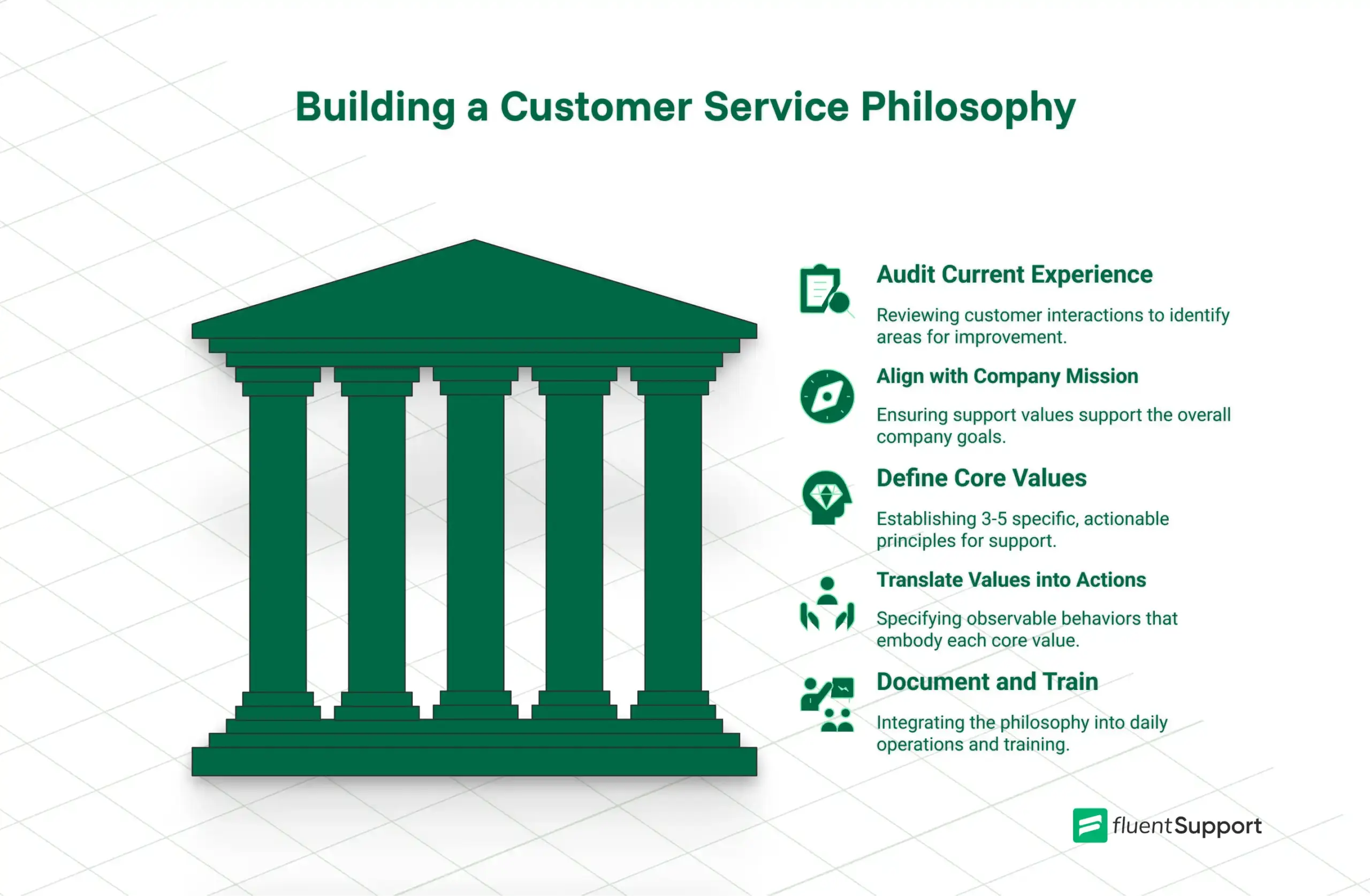
Follow this framework:
- Audit your current customer experience: Review recent support tickets, chat logs, and CSAT scores. Also, speak directly with frontline agents to pinpoint breakdowns and strengths.
- Align with your overarching company mission: Your support philosophy must support the broader company mission. For example, if the mission emphasizes simplicity, the philosophy must prioritize clear, jargon-free resolutions.
- Define your core support values. Choose 3–5 specific, actionable principles. Replace vague terms like “nice” with concrete ones such as “Radical Transparency” or “Frictionless Resolutions.”
- Translate values into daily actions. For each value, specify observable behaviors. Example: If “Empathy” is a core value, state that agents must use the customer’s name and acknowledge frustration before providing a solution.
- Document, share, and train. Integrate the philosophy into daily operations, performance reviews, and team communications. Share real examples of it in action each week.
10+ customer service philosophy examples
Study these documented philosophies from leading companies:
1. The Ritz-Carlton
Core Philosophy: “We are Ladies and Gentlemen serving Ladies and Gentlemen.”
Why it works:
This line, attributed to co-founder Horst Schulze, does three things simultaneously.
- It elevates the agent’s professional identity.
- It sets a behavioral standard of mutual respect.
- And it applies equally to a housekeeper and a concierge.
The Ritz-Carlton also gives every employee a $2,000 discretionary budget per guest, per incident, to resolve problems without manager approval. The philosophy is funded and structural, not aspirational.
2. Zappos
Core Philosophy: “Deliver WOW through service.”
Why it works:
Zappos backs this up with a structural commitment: no call time limits. Agents are empowered to stay on the phone for as long as the customer needs, ship free replacement orders without approval, and find creative solutions that no script would ever cover.
The philosophy is not a motto; it is a policy architecture that removes the most common constraints agents face.
3. Apple
Core Philosophy: The A.P.P.L.E. Steps of Service.
- A Approach customers with a personalized, warm welcome.
- P Probe politely to understand all the customer’s needs.
- P Present a solution for the customer to take home today.
- L Listen for and resolve any issues or concerns.
- E End with a fond farewell and an invitation to return.
Why it works:
Apple converts a vague concept like “good service” into a specific, repeatable checklist that any employee at any store on any continent can follow. This ensures brand-consistent experiences at scale. The steps are observable behaviors, not attitudes, which makes them trainable and evaluable.
4. WPManageNinja
Core Philosophy: “Build tools that solve real problems of the small business.”
Why it works:
WPManageNinja started as a small team of WordPress developers frustrated by tools that over-promised and under-delivered. Rather than chasing feature bloat, they set a deliberate constraint: no overcomplications, no unnecessary features, just lean and efficient plugins that help small and medium businesses move faster.
That constraint is their philosophy in action. Their internal motto reinforces it directly: put yourself in your users’ shoes, address their pain points, and work with care, clarity, and purpose.
5. The Walt Disney Company
Core Philosophy: The Four Keys: Safety, Courtesy, Show, Efficiency (in strict priority order).
Why it works:
Disney forces prioritization. Safety is ranked above Courtesy. If a cast member has to choose between being polite and keeping a guest safe, the hierarchy tells them exactly what to do.
This removes ambiguity in high-pressure moments and protects both the guest and the employee. The deliberate ranking is what separates Disney’s philosophy from every generic “we value safety and service” statement.
6. Amazon
Core Philosophy: “Customer Obsession. Leaders start with the customer and work backwards.”
Why it works:
Amazon‘s internal product and service processes literally start with a mock press release written from the customer’s point of view before any development begins. “Working backwards” is a documented operational process, not a value statement.
By embedding the customer’s perspective into how decisions get made, Amazon ensures that support and product teams are solving the same problem.
7. Nordstrom
Core Philosophy: “Use good judgment in all situations. There are no additional rules.”
Why it works:
Nordstrom‘s employee handbook has historically been one page. This philosophy communicates radical trust in the employee and creates a culture where agents take bold ownership because they feel respected enough to make calls.
Psychological safety is baked into the founding document. When staff know their employer trusts them, they act in ways that earn that trust.
8. Southwest Airlines
Core Philosophy: “A warrior spirit, a servant’s heart, and a fun-LUVing attitude.”
Why it works:
Southwest defines a behavioral profile, not just a standard. Agents are not simply asked to be “helpful.” They are asked to embody a specific kind of professional character at work.
This clarity in identity makes hiring, onboarding, and peer accountability significantly more specific and actionable. According to Southwest’s own public reporting, this philosophy has contributed to employee turnover rates of 4 to 5%, in an industry where double that is standard.
9. HubSpot
Core Philosophy: “Solve for the customer, not for the metric.”
Why it works:
HubSpot’s philosophy directly addresses one of the most common failure modes in support operations: optimizing for Average Handle Time (AHT) at the expense of actual resolution quality.
By naming the metric-gaming trap explicitly, HubSpot permits agents to spend more time when the customer genuinely needs it, and gives managers a clear standard to coach against.
10. Chewy
Core Philosophy: “We wow every customer, every time.”
Why it works:
Chewy operationalizes this with handwritten birthday cards for pets, personal calls to customers who have lost a pet, and surprise gifts sent with no budget ceiling attached.
These are structural commitments that cost real money in the short term. Chewy’s willingness to absorb that cost consistently is what makes the philosophy credible rather than decorative.
11. Trader Joe’s
Core Philosophy: “Every product we buy must be something we’d be proud to sell to our family.”
Why it works:
While primarily a product philosophy, this principle cascades directly into how Trader Joe’s employees handle service. Crew members are trained to open any product for a customer to try before buying, help carry bags to the car without being asked, and answer questions about any item in the store without transferring the customer to someone else.
The philosophy creates generalist ownership at every level, which eliminates the “that is not my department” response that frustrates customers across retail.
Customer service philosophy template
Use the following template in a focused 90-minute workshop with your support lead, two senior agents, and your Head of CX. Work through each section in sequence.
Do not skip Step 4; it is the section most teams leave incomplete.
CUSTOMER SERVICE PHILOSOPHY TEMPLATE
Brand Name: [Your Company]
Section 1: Our Vision Complete this sentence: “Every customer who contacts us should leave feeling ___________________.”
Write 2 to 3 sentences that describe the ideal experience from your customer’s point of view.
Section 2: Our core values
| Value Name | In One Sentence, What This Means | What Violating This Looks Like |
| Value 1 | ||
| Value 2 | ||
| Value 3 | ||
| Value 4 (optional) | ||
| Value 5 (optional) |
Section 3: Behavioral Guidelines
For each value above, complete this table:
| Value | In a Live Chat, This Looks Like… | On a Phone Call, This Looks Like… | What We Never Do |
| Value 1 | |||
| Value 2 | |||
| Value 3 |
Section 4: Empowerment Boundaries
Answer these four questions to define what your agents can do autonomously:
- What can an agent offer a customer without manager approval? (Example: a refund up to $50, a free one-month extension, a complimentary upgrade)
- What requires a manager’s sign-off?
- What situations require immediate escalation?
- What is our standard response time commitment per channel? (Email: ___ hours. Live chat: ___ minutes. Phone: ___ rings.)
Section 5: How We Measure This
List the 3 metrics your team tracks to evaluate whether this philosophy is working in practice:
Identify how often you will review real interactions against this philosophy: ___________________
After the workshop, share the draft with your full support team and ask one question:
“Is there anything in here that would have helped you handle a difficult conversation this week?”
Their answers will tell you whether the document is operational or decorative.
Wrapping up
Your support team is making judgment calls right now, on every ticket, every chat, every call. The only question is whether those calls are guided by a documented system or by individual instinct.
Write the customer service philosophy and train it into your agents’ memories. Then watch your team handle situations you never anticipated, and handle them exactly the way your brand needs them to.
Start off with a powerful ticketing system that delivers smooth collaboration right out of the box.
Related Articles
What Is Sales Support? Why You Need It
Sales support keeps deals moving and customers happy…401 Error: What It Means and How to Fix It
A 401 error means the server rejected your…







Leave a Reply