


Customer Service Experience: Meaning, Skills, and Real Examples

By Uttam Kumar Dash
June 4, 2026
Last Modified: June 4, 2026


Most businesses assume their customers are satisfied until they aren’t. Then the churn comes fast, and it’s rarely because of the product.
The gap between what businesses think they’re delivering and what customers actually feel is exactly where customer service experience lives.
In this blog, we will cover what customer service experience means, why it matters more now than ever, the skills behind it, real examples that show it in action, how to measure it, and how to build it into your operations practically.
TL;DR
- Customer service experience is the total feeling a customer builds through every interaction with your support team, from first contact to post-purchase follow-up
- Poor service loses customers faster than poor products
- Active listening, empathy, speed, and personalization are the core skills
- Measurable with CSAT, NPS, CES, and first contact resolution rate
- Systems, training, and the right helpdesk tools make it scalable
- Every metric you track and every tool you use directly shapes how customers walk away feeling
What is customer service experience?
Customer service experience is the opinion a customer forms about a company based on every support interaction they have throughout their relationship with that company.
It covers the full arc: the ease of reaching out, the quality of the response, how quickly the issue was resolved, and whether the follow-up felt genuine or scripted.
A customer who searches your knowledge base at midnight, sends an email at 9 AM, then follows up on social media has had three distinct interactions. All three shape their experience.
The definition also extends beyond reactive support. The checkout experience, the onboarding emails, the self-service portal, and even how your team responds to a negative review on Reddit. All of it feeds into how customers feel about your service.
| Customer Service Experience | Customer Experience (CX) | |
| Focus | Support interactions | Entire customer journey |
| Includes | Tickets, chat, email, issue resolution | Product, website, marketing, support, brand |
| When | When customers need help | Every stage of the journey |
| Owned By | Support team | Entire company |
| Goal | Resolve issues efficiently | Build loyalty and positive perception |
Customer service experience vs. Customer experience: Not the same thing
People mix these two up constantly, including on Quora and Reddit where users repeatedly ask whether “customer experience” and “customer service experience” refer to the same thing.
They don’t, though they overlap heavily. Here’s a clear breakdown:
| Customer Service Experience | Customer Experience (CX) | |
| Scope | Support-specific interactions only | Entire customer journey end-to-end |
| Includes | Help requests, issue resolution, agent communication | Product quality, marketing, website, support, brand perception |
| When it happens | When a customer needs help | At every touchpoint, even without contact |
| Who owns it | Support and service teams | Every department across the business |
| How it’s measured | CSAT, CES, FRT, FCR | NPS, CLV, churn rate, overall satisfaction |
| Goal | Resolve issues well and fast | Shape positive perception across the full journey |
A customer can love your product and still give you a low NPS score because your support team made them feel like a ticket number. That is the gap customer service experience is designed to close.
The distinction matters for strategy too. Improving customer experience requires changes across marketing, product, and operations. Improving customer service experience is more focused. It targets your support systems, team skills, response times, and resolution quality. For a deeper look at how the two relate, see Fluent Support’s breakdown of service vs. experience.
Why customer service experience matters more
Here is a number worth sitting with: Salesforce research shows 88% of “customers say good customer service makes them more likely to buy from a company again.” That is retention and revenue sitting inside your support queue.
The cost of ignoring it is steep. According to a Bain study cited in Harvard Business Review, “a 5% increase in customer retention can raise profits by 25% to 95%.” Acquiring a new customer costs five to seven times more than keeping an existing one. Every poor support experience is a quiet leak in your revenue bucket.
As CX author and NYT bestselling author Shep Hyken put it: “Customer service is not a department, it is a philosophy.” (Shepard Presentations) When support quality lives only in one team and not in how your whole business operates, the experience breaks down the moment a customer touches a different department.
There is also an advocacy angle worth noting. Customers who have genuinely good service experiences do not stay quiet. On subreddits like r/CustomerService, threads about standout support regularly get hundreds of upvotes, with users naming the brands directly. That kind of organic promotion cannot be bought.
The 5 core skills behind great customer service experience
1. Active listening
Customers know when they’re being heard and when they’re being processed. Active listening means understanding the actual problem, not just waiting for enough information to close the ticket. It involves reading tone, reading context, and asking clarifying questions before jumping to solutions.
2. Empathy
Empathy in support means acknowledging how a situation feels before explaining how it will be fixed. A customer who had their shipment delayed and missed a birthday gift doesn’t just need a refund. They need to feel like the person helping them understands why that’s frustrating.
3. Problem-solving speed
Speed matters, but accuracy matters more. Fonolo research found that 82% of consumers say having their issue resolved quickly is the single most important factor in a great service experience. Being quick and wrong damages trust more than being slightly slower and right. The skill is knowing how to move fast without skipping understanding.
4. Clear, calm communication
Under pressure from a frustrated customer or a high ticket volume, the ability to communicate clearly and without jargon separates adequate support from memorable support. Short sentences, plain language, and no deflection.
5. Adaptability
Some customers want warmth and small talk. Others want the fastest possible fix with zero unnecessary words. Skilled agents read this immediately and adjust. The same script cannot work for both.
What a bad customer service experience looks like
Before building toward good, it helps to understand what failure looks like in practice.
Typical patterns that damage customer service experience:
- Long waits with no updates: Customers are not bothered by delays as much as they are bothered by silence. No status update is perceived as neglect.
- Repeated information requests: Asking a customer to re-explain their issue to a third agent signals a broken system, not a caring team.
- Canned responses that miss the point: A generic “Thank you for reaching out, we’ll get back to you” reply to an urgent billing error reads as dismissal.
- No follow-through: Promising a callback or resolution and not delivering is worse than saying nothing at all.
Fluent Support’s rundown of things customers hate covers these patterns in more detail. Short CTA
Customer service experience examples
BarkBox and the vet bill
When a customer’s dog got sick from chewing a BarkBox toy labeled for heavy chewers, BarkBox refunded the purchase, sent a replacement, and then went further. They asked for the veterinarian bill and reimbursed it directly. That post went viral on Facebook with over 78,000 shares.
The lesson: resolution is the floor, not the ceiling.
Source audio’s 20-minute response
A Reddit user posted about having both a hardware and software issue with a guitar pedal from Source Audio. They expected a two-to-three-day wait. The company replied within 20 minutes with an accurate fix and shipped a replacement part the same day. The post circulated across guitar communities for months.
Fast, accurate, and personal. Three things that are simple in theory and rare in practice.
The complaint as an opportunity
On Reddit’s r/jobs, users consistently note that the interactions they remember most are the ones where something went wrong and the company made it right. That pattern holds commercially too. A well-handled complaint can turn a critic into an advocate.
[Insert stat graphic: customers whose complaints are resolved effectively are more likely to become brand advocates than customers who never had a complaint at all]
How to measure customer service experience
Measurement is where most small and mid-size businesses fall short. Without data, you are running on impressions. With the right metrics, you can see exactly where experience breaks down.
Key metrics
- CSAT (Customer Satisfaction Score): Post-interaction survey. Direct. Simple. Measures how a customer felt immediately after contact.
- NPS (Net Promoter Score): Measures long-term loyalty by asking how likely customers are to recommend you. A high NPS means your service experience is turning customers into advocates.
- CES (Customer Effort Score): Measures how easy it was for the customer to get help. Effort is one of the strongest predictors of churn.
- First Contact Resolution (FCR): The percentage of issues resolved in one interaction. High FCR drives down costs and satisfaction simultaneously rises.
- First Response Time (FRT): How quickly a customer gets an initial reply.
Track these consistently. One metric in isolation tells only part of the story.
How to build a better customer service experience
Start with the feedback you already have
Every ticket is data. Patterns in complaints reveal systemic issues. Patterns in praise reveal what to protect. If your team handles 50 tickets a week and 30% mention the same problem, that is a product or process issue, not a one-off.
Structured feedback loops turn reactive support into proactive improvement.
Train for empathy, not just process
Process training produces consistent agents. Empathy training produces memorable ones. Building a culture where agents feel equipped and empowered, rather than just drilled on scripts, directly improves the quality of every interaction.
For the hiring and training side of this, the support team guide covers it well.
Reduce friction at every touchpoint
Blake Morgan, CX futurist and author of The 8 Laws of Customer-Focused Leadership, put it plainly: “Customer experience is the best marketing money can’t buy.” (blakemichellemorgan.com) Friction-free experiences drive loyalty because ease signals respect for the customer’s time.
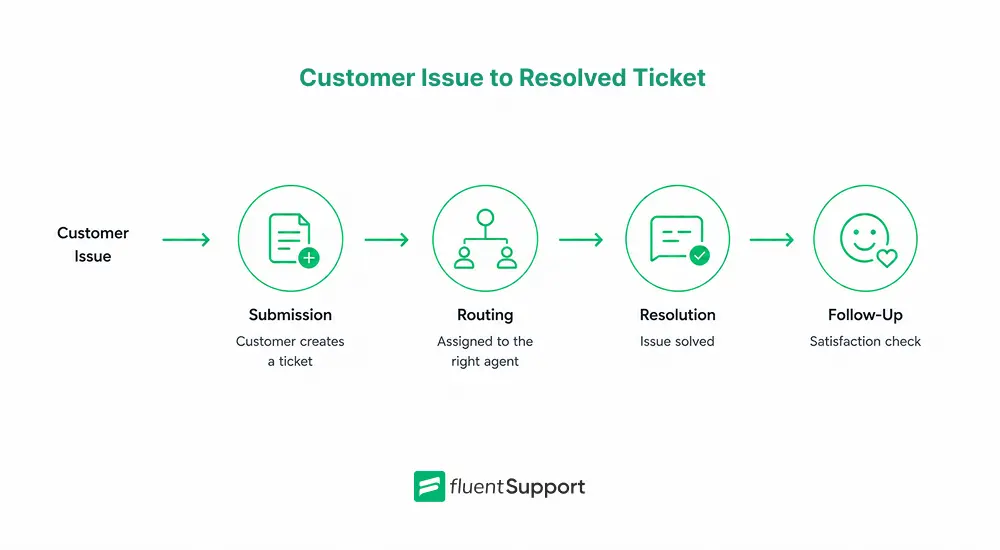
A well-organized knowledge base gives customers self-serve answers fast. Automated ticket routing sends issues to the right agent immediately. Clear SLAs set expectations upfront. These are the operational backbone of consistent service experience.
Use the right helpdesk infrastructure
At some scale, customer service experience cannot be sustained through spreadsheets and shared inboxes. A proper ticketing system organizes volume, tracks response times, records history, and makes sure nothing falls through.
Fluent Support is built for exactly this: a WordPress helpdesk plugin that handles multi-channel ticket management, automated workflows, and agent productivity tools without the bloated cost of enterprise platforms.
Customer service experience on a resume and in interviews
This section is for a different reader: job seekers and hiring managers. Worth addressing directly.
When hiring managers ask about customer service experience, they want behavioral evidence. Not a list of responsibilities. Actual examples of how you handled pressure, resolved conflict, or improved a process.
The STAR format works well here: Situation, Task, Action, Result.
Example answer for “Tell us about your customer service experience”: “In my previous role, I managed inbound email support for an e-commerce brand handling 80+ tickets daily. A customer contacted us upset about a delayed order ahead of a major event. I escalated internally, arranged a priority reshipment, and sent a personal note with a discount code for the inconvenience. They left a five-star review specifically about how the situation was handled.”
Concrete, specific, and outcome-focused. That is what strong customer service experience looks like in an interview.
The Role of AI in Customer Service Experience Today
AI is no longer a future consideration in customer service. It’s active infrastructure. AI-assisted triaging, response suggestions, sentiment analysis, and chatbots for first-line resolution are now standard tooling for teams that want to maintain quality at scale.
The risk is getting this wrong. AI that handles simple queries well and escalates complex ones correctly improves the experience. AI that deflects without resolving, or routes incorrectly, creates frustration that manual processes would have avoided.
The real leverage is AI in support, supplementing human empathy, not replacing it. When an agent has full context, suggested responses, and automatic ticket history pulled up before reading the first message, their ability to deliver a good experience scales.
Wrapping Up
Customer service experience is how customers remember you. Not your marketing. Not your product page. The moments where something went wrong and someone helped. Or didn’t.
Building a strong customer service experience is not one initiative. It’s a combination of trained people, clear processes, and the right infrastructure. The service metrics you track and the systems you use to manage volume directly shape what customers walk away feeling.
Want a system that makes ticket handling this smooth? Fluent Support brings structure and clarity to every request so your team always knows exactly what to do next. See how it works.
FAQs
How do I explain my customer service experience?
Use specific examples with measurable outcomes. Describe the situation, what you did, and the result, particularly in interviews. Avoid vague descriptors like “I’m a people person.” Concrete examples of resolved problems or improved satisfaction scores carry far more weight.
What counts as customer service experience on a resume?
Any role involving direct interaction with customers, users, clients, or internal stakeholders counts. Retail, food service, tech support, live chat, phone support, and even volunteer roles in community organizations all qualify. Highlight skills like conflict resolution, active listening, and ticket or case management.
What is the difference between customer experience and customer service experience?
Customer experience covers the entire customer journey across all touchpoints: product, brand, marketing, and support. Customer service experience specifically refers to the quality of support interactions. All customer service experience is part of customer experience, but customer experience extends well beyond support alone.
What are the 5 core customer service skills?
1. Active listening, 2. empathy, 3. problem-solving, 4. clear communication, and 5. adaptability. These apply across every channel and every type of customer issue.
Can one bad customer service interaction undo long-term loyalty?
It can significantly damage it. Research consistently shows that a large portion of customers who leave brands they previously trusted do so because of a single unresolved or poorly handled experience. A bad interaction handled well and quickly can actually rebuild trust stronger than if the issue never happened.
Related Articles
Fluent Support 2.4.7: Ticket Filters, 5x Faster Tickets and Smart Customer Search
Fluent Support 2.4.7 brings a Ticket Filters sidebar…Customer Success Best Practices for Small Teams
In this blog, we’ve discussed customer success in…





Add your first comment to this post