


What Is Customer Courtesy and How to Practice It

By Uttam Kumar Dash
May 31, 2026
Last Modified: June 2, 2026


Think about the last time a support interaction genuinely surprised you. Not because the issue resolved fast, but because the person helping you made you feel like a human being rather than a ticket number. That is customer courtesy in action, and it is quietly one of the most powerful forces in customer retention.
Most businesses pour resources into products, ads, and pricing optimization. Then they lose customers over something far simpler: how people are spoken to. A rushed agent, an indifferent tone, a canned reply that was clearly not read before it was sent. These small failures compound fast.
In this blog, we will break down exactly what customer courtesy means, why businesses that get it right consistently outperform those that do not, and what practical habits actually move the needle in real support interactions.
TL;DR
- Customer courtesy is every word, behavior, and action support teams use to make customers feel respected and genuinely valued
- It goes far beyond basic politeness and includes active listening, empathy, proactive communication, and dignified closings
- Poor courtesy damages retention more quietly than almost any other service failure
- Specific habits and the right support infrastructure help teams deliver it consistently at scale
What is customer courtesy?
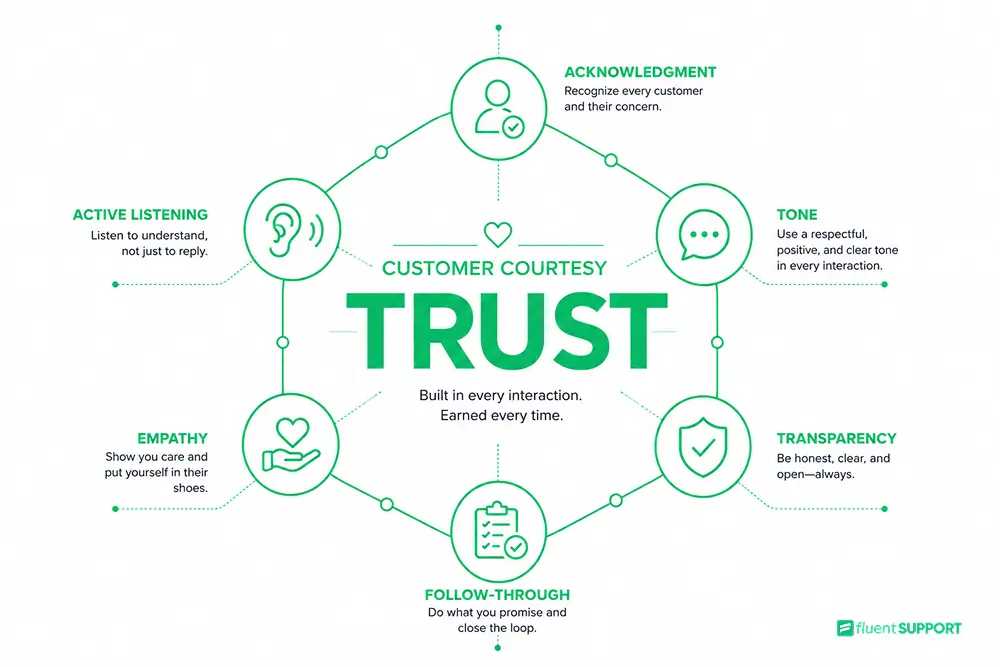
Customer courtesy is the deliberate effort to make customers feel respected, valued, and genuinely heard in every single interaction, across every channel, regardless of how complex or routine the issue is.
The word “deliberate” carries weight here. Courtesy does not happen automatically under pressure. It is a practiced behavior: choosing words carefully, adjusting tone to match the moment, listening without interrupting, and treating every incoming ticket or call as if this customer’s problem is worth solving fully.
CX expert Shep Hyken puts it directly: “Kindness and courtesy are the root of a positive customer experience.” That holds across decades and industries because it points to something basic. Customers remember how you made them feel, often more than what you actually did for them.
Courtesy encompasses tone of voice, word choice, speed of acknowledgment, empathy during frustration, follow-through on commitments, and how interactions close out. Get one of those wrong consistently, and customers notice. They may not complain. They just quietly leave.
Why customer courtesy directly affects business outcomes
The business case for customer courtesy is stronger than most companies realize. It shows up in retention numbers, referral rates, and revenue.
According to PwC’s “Experience Is Everything” research, based on 15,000 global respondents, “42% of consumers said they would pay more for a friendly and welcoming experience, and 73% reported that a positive experience was a key driver of their brand loyalty.” These are not marginal preferences. They reflect how the majority of your customer base makes purchasing decisions.
When courtesy breaks down, the consequences are swift and quiet. Customers who encounter poor service rarely complain formally. They leave. That silent churn is the most dangerous kind because there is no ticket to review, no feedback to act on.
On the other side, Medallia’s 2025 customer loyalty research with Ipsos, drawing from over 800 CX practitioners, found that “61% of consumers cite friendly employees as one of the top factors that influence their loyalty decisions.” Word of mouth remains one of the highest-converting acquisition channels, and courteous service is what activates it.
There is also an internal dimension worth considering. A 2024 study published in the National Institutes of Health’s behavioral sciences journal, drawing on data from 401 customer-contact employees in the South Korean hospitality industry, found that “when customers treated service staff courteously, those employees showed significantly higher levels of prosocial service behavior.”
The mediating factor was organization-based self-esteem. Simply put: courtesy flows both ways. Customers who are respectful get better service. Agents who feel valued give more of themselves.
What customer courtesy is not
There is a common misread that courtesy just means being polite: saying “sir” and “ma’am,” keeping the language soft, sounding pleasant. That is part of it, but treating it as the whole picture creates a real gap in quality.
Courtesy without competence frustrates customers. A warm agent who apologizes beautifully but never solves the problem leaves people more irritated than before they called. On the other side, a fast resolution delivered with cold, dismissive language also fails the test.
A Quora answer on why courtesy matters in customer service framed the relationship clearly: “Courtesy is a force multiplier. It prevents friction, builds trust, and transforms one-time transactions into lasting relationships.” The connection between courtesy and outcomes is not anecdotal.
There is also the matter of consistency. Being courteous with an easy, friendly customer takes no skill. The real measure is whether the same standard holds for the frustrated caller, the person who has contacted support four times about the same issue, or the customer who is factually wrong but still deserves dignity.
5 core components of customer courtesy
Active listening before responding
The most commonly cited failure in support interactions is agents who respond before the customer finishes explaining. Waiting until someone has clearly finished, then acknowledging what they said before moving toward a solution, signals that their words were actually heard.
In practice, verbal acknowledgments help. A simple “Got it, let me make sure I fully understand what you’re describing” goes further than silence followed by a template answer.
Empathy that feels real
Empathy in customer service is frequently reduced to a phrase list. “I understand your frustration” repeated across every interaction without variation is not empathy. Real empathy involves actually registering what this customer is dealing with. If someone has been waiting three days for a resolution, name that specifically. If the issue cost them time or money, acknowledge it directly. Validation is not agreement. It is recognition.
Language that personalizes instead of generalizes
The shift from “we” to “I” is small but meaningful. When an agent says “I am going to look into this right now,” they attach their identity to the resolution. It creates accountability. “We are looking into it” can feel like a hand-off with no clear owner.
Using the customer’s name, referencing their specific history when available, and avoiding generic phrasing all contribute to the feeling that this interaction is individual, not industrial.
Respecting time through transparency
- Speed alone is not enough: Responding fast matters, but not making customers repeat themselves matters just as much.
- Context before transfers: Agents who hand off a customer without sharing context force that customer to re-explain everything. It signals that their time is not valued.
- Progress updates during resolution: If you need time to investigate, say so and give a realistic timeline. Silence reads as indifference even when it is not.
Closing interactions thoughtfully
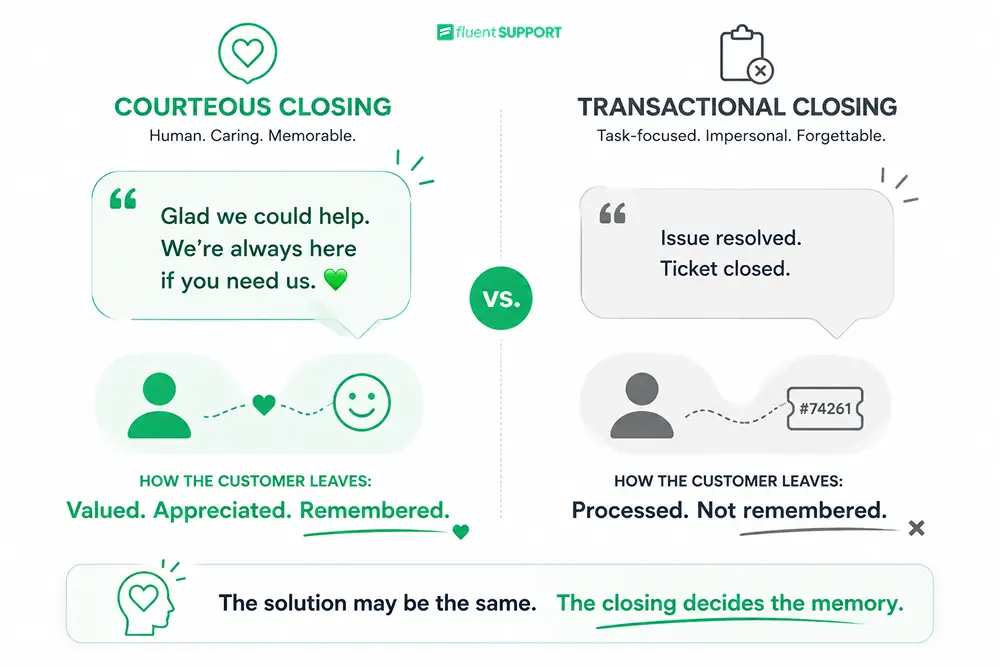
How an interaction ends shapes how the entire exchange is remembered. Checking whether anything else needs addressing before signing off, expressing real appreciation for patience.
And, not rushing to close the ticket are small decisions that accumulate into the customer’s lasting impression of your team’s customer service skills.
Customer courtesy examples worth studying
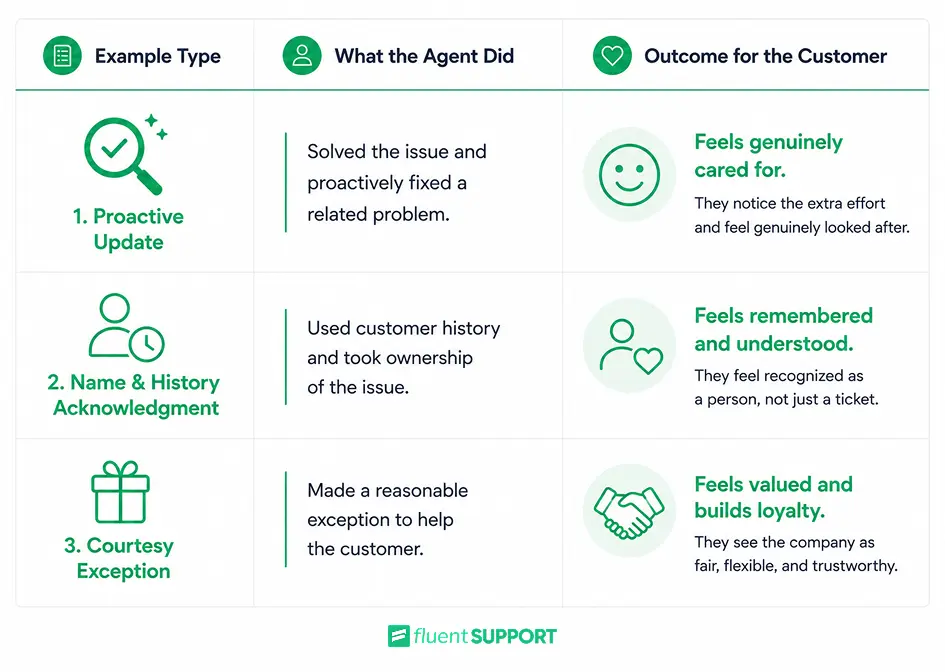
The proactive update
A customer raises a billing concern. The agent resolves it, then notices a related issue the customer never mentioned, addresses it separately, and explains what they found. The customer asked for one thing. They received two resolutions and a demonstration that someone was actually paying attention. That kind of service creates stories people share.
The name and history acknowledgment
An agent says: “I can see from your history that you contacted us about this last month. I want to make sure we actually get this fully resolved this time.” That one sentence contains an apology, accountability, and a commitment, without being dramatic or formulaic.
The one-time courtesy
In many businesses, a “one-time courtesy” refers to a single exception made in a customer’s favor: waiving a fee, extending a deadline, or honoring a price that technically expired. The value of the exception itself is often smaller than the signal it sends. It communicates that the agent has discretion and is choosing to use it on behalf of this customer. Even when modest, that gesture lands differently than a policy recitation.
The Ritz-Carlton’s approach is a well-known reference here. The brand allows employees to spend up to $2,000 per guest to resolve issues without needing managerial sign-off. The specific amount is less important than the philosophy: give frontline staff the authority to act courteously without bureaucratic friction slowing them down.
The honest answer
A customer asks whether a feature exists. The honest answer is no, not yet. A courteous response acknowledges that clearly, explains what alternatives exist right now, and if relevant, gives context about what is coming. Courtesy includes honesty delivered with care, not warmth wrapped around avoidance.
What breaks customer courtesy at scale
Individual agents can be courteous. Sustaining it consistently across a team, especially as volume grows, is where the challenge actually lives.
1. Ticket overload and processing mode
When agents are overwhelmed by backlogs, they shift from problem-solving to processing. Responses get shorter and more mechanical. Reducing support ticket backlog is not just an operational priority. It is directly connected to how courteous customers experience each interaction.
2. No access to customer history
When agents lack context about a customer’s previous interactions and purchase history, they ask redundant questions or give generic answers. Both feel discourteous to the customer even if no rudeness was intended. Context transforms how an agent approaches a conversation.
3. Metrics that measure speed only
When support teams have no customer service goals around tone, empathy, or quality, speed becomes the only proxy for performance. Agents optimize for closing tickets fast. The depth of each interaction suffers. There is no shared baseline for what “good” looks like beyond volume.
An observation from an r/productivity discussion captures the dynamic from the customer side as well: when people approach support interactions with patience rather than aggression, they consistently report better outcomes.
The courtesy dynamic is not one-directional. Teams that are under pressure, undertooled, or measured only on throughput will struggle to extend the same patience customers need from them.
| Team Conditions That Support Courtesy | Team Conditions That Undermine Courtesy |
| Manageable ticket volume so agents can focus on solving problems, not just processing tickets | Ticket overload and backlog pressure that push agents into rushed, mechanical responses |
| Access to complete customer history including previous conversations and purchase information | No customer context, forcing customers to repeat themselves and receive generic answers |
| Balanced performance metrics that measure quality, empathy, and resolution effectiveness | Speed-only metrics that reward closing tickets as quickly as possible |
| Clear ownership of customer issues so customers know someone is responsible for helping them | Frequent handoffs and transfers that create frustration and loss of accountability |
| Realistic staffing levels that allow agents time to listen and personalize responses | Understaffed teams constantly working under pressure and time constraints |
| Training focused on active listening, empathy, and communication | Little or no coaching on customer interaction quality |
| Automation that removes administrative work such as routing, assignments, and follow-ups | Agents spending excessive time on manual processes and repetitive tasks |
| Smart ticket routing that connects customers with the right specialist quickly | Misrouted tickets that lead to delays, transfers, and repeated explanations |
| Psychological safety and team support that help agents remain patient during difficult interactions | Burnout and constant stress that reduce patience and empathy |
| Customer-centric culture that treats courtesy as a business priority | Efficiency-first culture where customers are treated primarily as tickets or case numbers |
How the right tools enable consistent courtesy
Courtesy cannot be automated, but the right infrastructure creates the conditions where it can happen consistently.
Context surfaced at the right moment
When agents work inside a system that shows customer history, previous tickets, and cross-channel interactions, they spend their energy on the human side of the conversation rather than hunting for information. That shift changes the quality of every response.
Routing that matches the issue to the right agent
When automated ticket routing connects customers to agents with the right skills for their specific issue, resolutions happen faster and with less frustration on both sides. Fewer transfers, fewer repetitions, better outcomes.
Canned responses used well
Canned responses are frequently misused as shortcuts that make service feel robotic. Used thoughtfully, they handle the structural parts of a reply so the agent can personalize what actually matters. A good template provides the framework. The agent provides the specific acknowledgment of this particular customer’s situation.
Automation that removes administrative friction
Workflow automation handles ticket assignment, follow-up reminders, and escalation triggers. With that administrative layer managed, agents spend less time on process and more time on the kind of considered communication that defines courteous service.
Fluent Support is built for WordPress-based businesses that need this infrastructure without the complexity or cost of enterprise-level platforms. It brings customer history, smart routing, automation, and multi-channel ticket management into one place, so agents have the context they need to respond with genuine attention rather than guesswork.
Wrapping up
Customer courtesy is not a soft skill category sitting at the edges of support quality. It is a core business practice with measurable impact on retention, word of mouth, and revenue.
The gap between companies with loyal customers and those with consistently high churn often comes down to whether customers feel respected across every touchpoint. Sustaining courtesy under pressure, with difficult customers, and at volume requires both trained behavior and infrastructure that actually supports it.
If your current setup makes it hard for agents to be fully present in each interaction, that is the problem worth solving first. A customer support strategy that enables consistent courtesy is one that treats tooling, staffing, and training as equally important. All three have to work together.
Want a system that makes ticket handling this smooth? Fluent Support brings structure and clarity to every request so your team always knows exactly what to do next. See how it works.
FAQ
What does “one-time courtesy” mean in customer service?
A one-time courtesy is a single exception a business makes outside its standard policy in favor of a customer, such as waiving a fee or honoring an expired offer.
It signals that the agent has discretion and is choosing to use it. The gesture itself is often modest. The message it sends is not.
Does customer courtesy apply to automated and AI-powered support?
Yes. Courtesy in digital and AI-driven channels means using natural, considerate language, acknowledging the customer’s issue clearly, and ensuring interactions do not feel dismissive even when automated.
Well-designed responses can be courteous. Poorly designed ones feel evasive regardless of how technically accurate they are.
What is the difference between customer courtesy and customer service?
Customer service refers to the entire support system a business provides, including processes, channels, and resolution capabilities. Customer courtesy is the quality of how those interactions are conducted.
You can have efficient customer service that still lacks courtesy, or highly courteous agents working within a broken service structure. Both dimensions require attention.
Can courtesy training actually change agent behavior over time?
Yes, though it requires more than a one-time workshop. Courtesy improves when agents receive regular feedback on real interactions, have the psychological safety to slow down when needed, and work within systems that do not reward speed above everything else. Structural support and ongoing behavioral coaching work together.
Why would a customer expect trustworthiness from a courtesy-focused brand?
Because courtesy signals intent over time. When a business consistently communicates with respect, follows through on commitments, and treats customers as individuals rather than cases, it builds a pattern of reliability.
Trustworthiness is the long-term perception that forms when courtesy is consistent rather than occasional.
Related Articles
Fluent Support 2.4.7: Ticket Filters, 5x Faster Tickets and Smart Customer Search
Fluent Support 2.4.7 brings a Ticket Filters sidebar…Customer Success Best Practices for Small Teams
In this blog, we’ve discussed customer success in…





Add your first comment to this post