

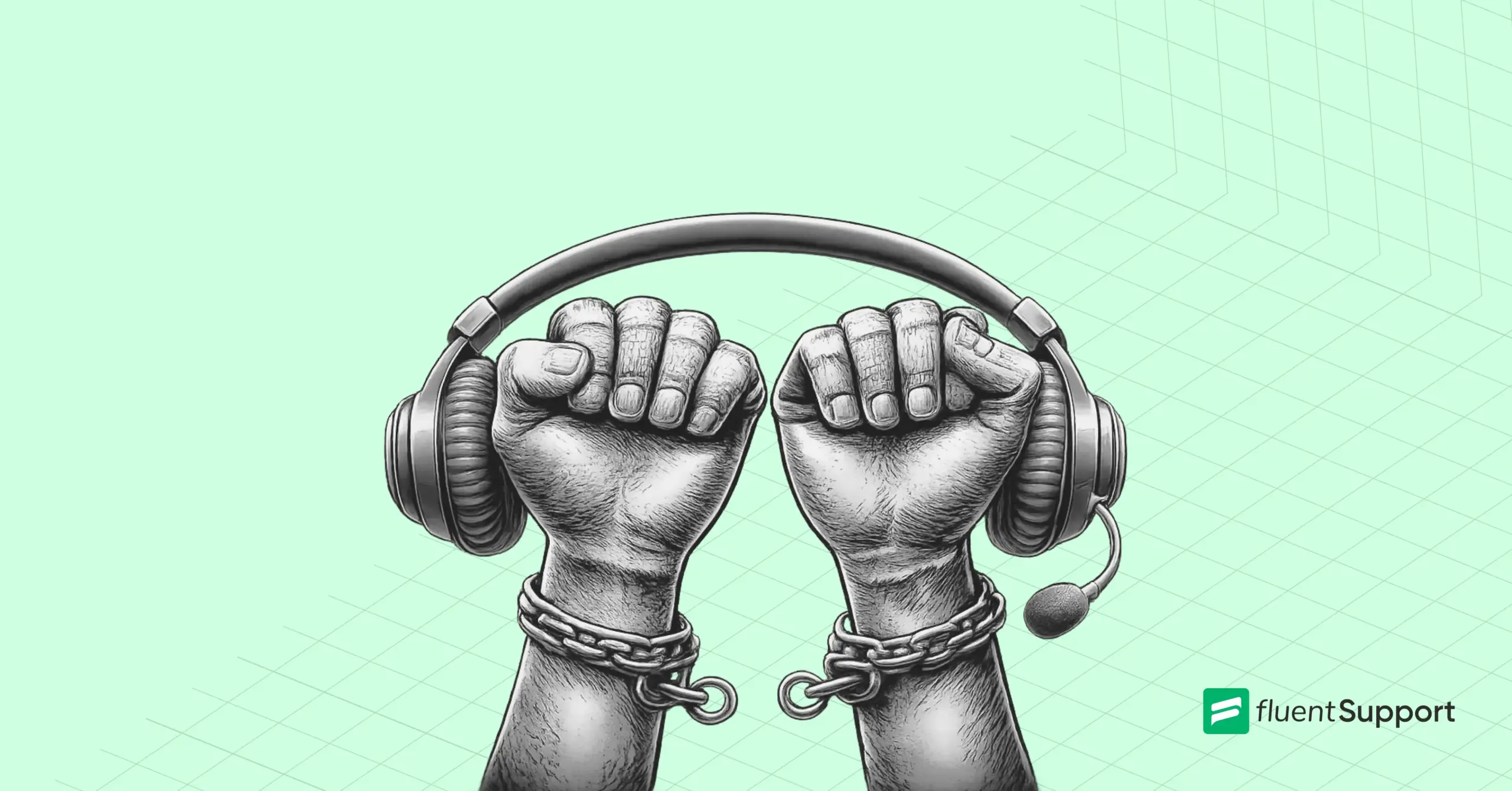


Most customer support failures look like people problems. An agent who sounds cold. A response that feels scripted. A ticket that slips through without a follow-up. The instinct is to blame the individual.
But from real support environments, the pattern is different. The agents are usually trying. The failure is in what surrounds them: the processes, the tools, the habits that have quietly become the default. That is where the real damage lives.
These are not just bad habits. They are structural failures that compound over time. And most teams commit at least three of them without realising it.
What Are the Deadly Sins of Customer Support?
The deadly sins of customer support are the recurring operational failures that erode customer trust, increase churn, and quietly undermine team performance. Unlike one-off mistakes, these sins are systematic. They repeat because they are baked into how a support operation is run, not just how individual agents behave.
Here are the 7 deadly sins of customer support:
- Slow first response
- Making customers repeat themselves
- Treating every ticket the same
- Closing tickets without confirmation
- Inconsistent answers across agents
- Collecting feedback but not acting on it
- Running a fully reactive operation
Sin 1: Slow First Response
The first reply a customer receives sets the tone for the entire interaction. A slow response does not just feel inconvenient. It signals to the customer that their issue is not a priority.
Research consistently shows that response speed is the single biggest driver of customer satisfaction. According to data cited across multiple studies, 71% of consumers aged 16 to 24 say that a fast response from a support team greatly improves their experience. (Comm100) The drop-off in satisfaction begins within hours of submission, not days.
Teams that struggle with first response time often have no formal SLA policy in place. Without a defined deadline, tickets sit in the queue ranked by nothing in particular. Agents work from the top of the list rather than by urgency or customer risk. The result is that every ticket gets slower service than it should.
The fix is structural. Set SLA targets for first response by ticket priority. Build visibility into which tickets are approaching breach. Make response time a metric your team sees every day, not just at the end-of-month review.
Sin 2: Making Customers Repeat Themselves
A customer explains their problem in a ticket. An agent picks it up, asks them to explain again. The ticket gets escalated. A second agent asks the same questions a third time.
This is one of the most reliably damaging experiences in customer support. According to Zendesk data, 68% of customers get frustrated when their call is passed between departments. The frustration is not about the handoff itself. It is about the information that does not travel with it.
This sin is a customer service communication failure at the system level. When context is not captured and passed forward, every handoff resets the customer’s experience to zero. The customer has to carry the burden of their own case history. That is not support. That is friction dressed up as support.
The practical response is to treat context preservation as a first-class obligation. Every ticket should carry a full record of what has been tried, what the customer has said, and what the next logical step is. Agents should be able to read a ticket and know exactly where things stand without asking the customer to start over.
Sin 3: Treating Every Ticket the Same
Not all tickets carry the same weight. A password reset and a billing dispute affecting a long-term customer are not the same kind of problem. Treating them identically is a prioritisation failure, and it has real costs.
Teams that lack a proper triage system end up serving tickets in the order they arrive rather than in the order they matter. A high-value customer with a critical issue waits behind a queue of routine requests. Meanwhile, the support ticket backlog builds because agents are spending equal time on unequal problems.
Good customer support strategy requires tiering. Not every customer needs the same response time. Not every issue carries the same urgency. Build a triage model that routes tickets by a combination of issue type, customer tier, and potential business impact. That structure protects both the customer and the team.
Just a heads up: If you need a better way to handle customer objections with ease you might try Fluent Support. This one is a robust helpdesk plugin built to track conversations, understand intent, and respond with confidence every time.
Sin 4: Closing Tickets Without Confirmation
Resolving a ticket and solving a customer’s problem are not always the same thing. A ticket gets closed when the agent believes the issue is resolved. The customer’s problem sometimes continues long after that.
From support environments with high ticket volumes, this pattern appears regularly. An agent sends a solution, the customer does not respond within a set window, and the ticket is automatically or manually closed. The underlying issue may be unresolved. The customer may simply have stopped trying to get help.
Closure without confirmation is a gap between operational efficiency and actual customer experience. The customer service metrics that track ticket volume and resolution time can look healthy while customer retention silently erodes.
A simple confirmation step before closure changes this. Ask the customer directly whether their issue has been resolved before marking a ticket closed. It adds minimal time and prevents the gap between what the system records and what the customer actually experienced.
Sin 5: Inconsistent Answers Across Agents
A customer contacts support on Monday and receives one answer. They follow up on Thursday and speak to a different agent who says something different. The customer now has no idea what is actually true.
This is a documentation failure. It is not that the second agent is wrong and the first is right. It is that there is no single source of truth for either of them to work from. Inconsistent answers are the natural output of a team that has not invested in a shared knowledge base and clear response standards.
Teams typically struggle with this as they grow. Two agents can align informally when a team is small. At ten agents, that informal alignment breaks down. The customer service phrases and good customer service practices that one agent has internalised do not automatically transfer to the next hire.
The solution is to build the knowledge infrastructure before the team needs it. A well-maintained internal knowledge base, clear escalation documentation, and consistent onboarding standards are the foundation. Without them, inconsistency is not a risk. It is a certainty.
Sin 6: Collecting Feedback But Not Acting on It
Most support teams collect CSAT scores. Fewer have a reliable process for actually using them.
Sending a feedback survey after ticket closure has become standard practice. What happens next is rarely standard. The scores get logged. A monthly report gets generated. The number either looks acceptable or it does not, and either way, the underlying patterns that drove it stay unexamined.
According to HubSpot’s State of Customer Service research, 93% of customer service teams agree that customer expectations are higher than ever. But the gap between collecting data and acting on it is where improvement stalls.
Customer service statistics are only useful if they inform decisions.Acting on feedback means reading the verbatim responses, not just the number. It means identifying which ticket categories consistently score low. It means tracing a low CSAT back to a specific process gap, not attributing it to a vague notion of agent quality.
Average handling time and CSAT should be tracked together, not in isolation. Speed without quality produces a number that looks efficient and feels poor.
Sin 7: Running a Fully Reactive Operation
Reactive support means waiting for customers to tell you something is wrong. Every interaction begins with a complaint, a question, or a failure. The team’s entire energy goes into responding.
The problem with a purely reactive posture is that it is always a step behind. By the time a customer reaches out, their frustration is already present. The support interaction starts at a deficit. And the customers who never reach out at all, who simply stop renewing, stop buying, stop engaging, are invisible in this model.
The types of customer service that high-performing teams invest in increasingly include proactive touchpoints: onboarding guidance, product update notifications, check-ins at natural friction points in the customer lifecycle. These reduce inbound volume, improve satisfaction, and address problems before they become reasons to leave.
Shifting toward proactive support does not require a complete operational redesign. It starts with identifying the top five recurring ticket categories and asking a straightforward question: could this have been prevented with earlier communication? For most teams, the answer to at least two of them is yes.
Wrapping Up
The reason these sins persist is not that support teams lack effort. It is that the systems around them were never built to prevent them. Slow responses, lost context, inconsistent answers, and unread feedback are all symptoms of operations that grew without a supporting structure underneath.
The practical takeaway is to treat your support operation as a system first and a people problem second. Audit your customer support strategy against each of the seven sins. Identify which ones are active in your team today. Then fix the process, not the person.
Every sin on this list has a structural fix. None of them require exceptional talent. They require deliberate design.Just a heads up: if you are running support on WordPress, Fluent Support gives your team a clean helpdesk to manage tickets, set SLA targets, and track the metrics that actually matter, all inside your WordPress dashboard.
Start off with a powerful ticketing system that delivers smooth collaboration right out of the box.
FAQ
The seven deadly sins of customer support are slow first response, making customers repeat themselves, treating every ticket the same, closing tickets without confirmation, inconsistent answers across agents, ignoring feedback data, and running a fully reactive operation. These are process failures, not personality traits.
Customers leave after bad support because the experience signals that their time and problem are not a priority. Repeated friction points, like slow responses, having to re-explain their issue, or receiving conflicting answers, erode trust faster than any single incident. A customer is four times more likely to switch to a competitor if their problem relates to poor service quality.
The fix is documentation infrastructure: a maintained internal knowledge base, clear response templates, and a structured onboarding process for every new agent. Consistency does not come from effort alone. It comes from every agent working from the same source of truth. Regular calibration sessions and shared customer service tips reinforce alignment as the team grows.
Reactive support waits for customers to report problems. Proactive support anticipates friction points and reaches out before a problem becomes a complaint. Proactive touchpoints include onboarding guidance, product update notices, and check-ins at known drop-off moments in the customer lifecycle. The result is lower inbound ticket volume and higher retention.
When every ticket enters the same queue regardless of urgency or customer value, critical issues wait behind routine ones. High-value customers receive the same response time as a basic inquiry. Over time, this drives churn among the customers a business can least afford to lose. A triage model that routes by priority, customer tier, and issue type prevents this.
Because it is the customer’s first signal of how their issue will be handled. A fast first reply builds confidence. A slow one creates doubt that compounds through the rest of the interac
tion. First response time is the most direct lever a support team has for shaping the customer’s perception before the problem is even resolved.
The root cause is almost always a documentation gap. There is no shared knowledge base, policies are stored in people’s heads rather than in a system, and new agents are onboarded inconsistently. Two agents give two different answers not because one is wrong but because neither has a reliable single source of truth to work from.

Related Articles
26 Best Ticketing System Software in 2026
The best ticketing system software in 2026 includes…Fluent Support 2.4.5: Remote Portal, New Workflow Triggers and more
Fluent Support 2.4.5 lets you run the customer…



Add your first comment to this post