


Service Request Management: What It Is, How It Works, and Why Most Teams Get It Wrong

By Md. Ariful Basher
May 27, 2026
Last Modified: May 22, 2026


Every support team has a process. The trouble is, most of those “processes” live in someone’s head, a shared inbox, or a Slack channel nobody checks after 5pm. A customer needs software access. A new hire needs their laptop set up. Someone’s VPN stopped working. All three land in the same pile, handled by whoever saw the message first, and the whole thing runs on vibes.
That’s where service request management breaks down in practice, even when teams think they have it figured out.
TL;DR
- A service request is a formal ask for something standard: access, equipment, information, a password reset
- Service request management is the structured process of receiving, routing, fulfilling, and closing those requests
- It’s distinct from incident management: incidents are unexpected breaks; requests are planned, predictable asks
- Good service request management reduces response time, improves visibility, and frees your team from firefighting
- The five core stages are: capture, categorization, authorization, fulfillment, and closure with feedback
- Automation and a solid service catalog are the two biggest levers for getting it right
- Without the right software, even good processes collapse under volume
What Is a Service Request, Really?
A new developer joins a company. Day one, she needs access to the code repository, a VPN license, and the project management tool her team uses. She asks her manager. Her manager pings IT. IT gets three different messages across two platforms and an email, with varying levels of detail. Two days later, she still can’t push code.
That’s a service request handled badly. Three completely routine, pre-approved asks, buried in noise.
A service request is a formal, user-initiated ask for something that already exists within an organization’s defined service offerings. It’s not a crisis, not an outage. It’s a standard provision: software, access, information, hardware, an onboarding workflow. The key word is “predefined.” The thing being requested is already known, already approved in principle, already part of how the business runs.
Service request management is the structured practice of handling those requests through a repeatable, trackable workflow from the moment someone submits a request to the moment it’s closed and the requester is confirmed satisfied.
The ITIL framework, which most IT service management practices are built on, treats service request management as a distinct practice with its own process, separate from incident management. This distinction matters more than most teams realize.
Service Request vs. Incident: The Distinction That Saves Your Team’s Sanity
Here’s where things get messy in the real world. Requests and incidents both land in the same queue. Both feel urgent to the person submitting them. Both eat the same support agent’s time.
But treating them the same way is the mistake.
An incident is unplanned. The website goes down. An integration breaks at 2am. A payment gateway stops processing. Incidents require immediate, investigative responses because something has gone wrong that shouldn’t have.
A service request is planned, or at least plannable. It’s something someone wants provisioned, approved, or explained. It follows a predictable path. And because it follows a predictable path, it can be automated, templated, routed intelligently, and measured consistently.
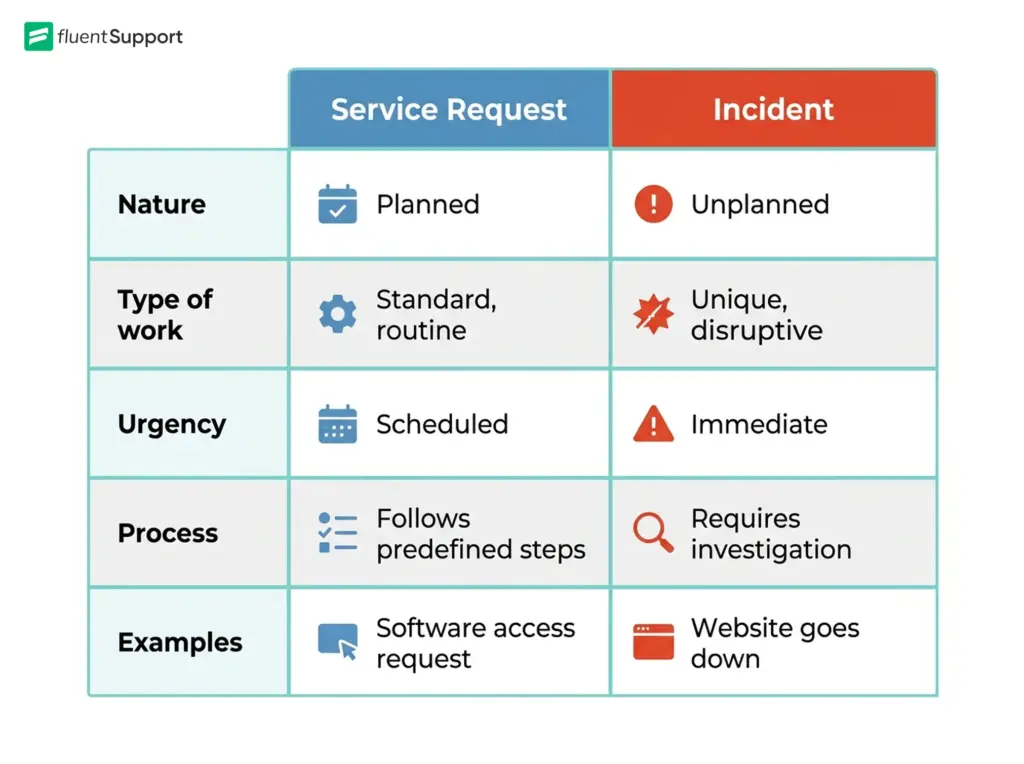
When these two types of work share the same queue without differentiation, incidents get deprioritized by the sheer volume of routine requests, and requests get over-escalated because the urgency signals are all wrong. Both outcomes cost time and damage trust.
The simple rule: if something broke, it’s an incident. If someone needs something new, it’s a service request.
The Service Request Management Process, Stage by Stage
The process isn’t complicated. What makes it hard is maintaining it consistently when volume picks up and people start inventing shortcuts.
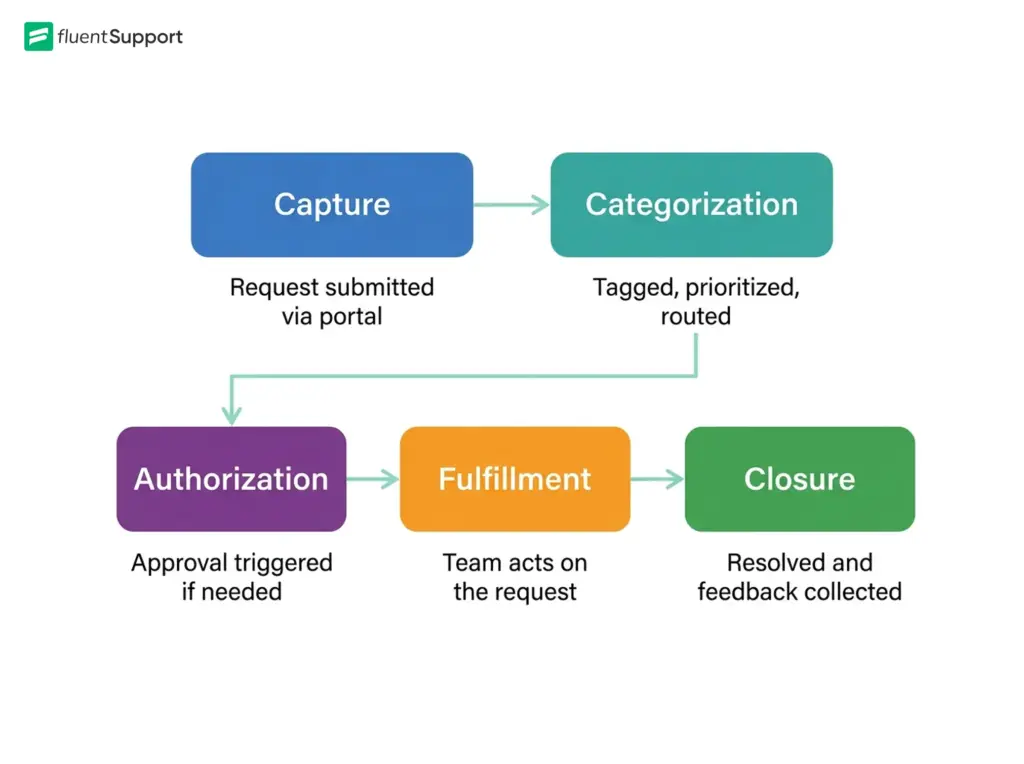
Capture and logging
Every request enters the system through a defined channel: a self-service portal, a support form, email, or chat. What matters is that every request lands in one place, not scattered across three platforms. The intake form collects the context needed to act on it: who’s asking, what they need, any relevant details. A form that’s too long frustrates users and creates abandonment. A form that’s too short creates back-and-forth that delays resolution. Getting this right is an underrated win.
Categorization and prioritization
Once a request is logged, it gets tagged by type and assigned a priority. This isn’t just administrative tidiness. Categorization determines routing. A software access request goes to IT. A time-off request goes to HR. A marketing content request goes to the creative team. The more accurately requests are categorized at intake, the less manual triage your agents do downstream.
Authorization
Some requests need approval before they can be fulfilled. Access to sensitive systems, expensive hardware, licensed software above a cost threshold. Approval workflows should be automated where possible. Manual approval chains sent over email are where requests go to die. When authorization is built into the workflow itself and routes to the right person automatically, the delay drops from days to hours.
Fulfillment
The assigned team acts on the request. This stage benefits most from automation. Routine requests like password resets or standard software installs can often be fulfilled without any human involvement at all. For more complex requests, clear task ownership and status visibility keep things moving.
Closure and0 feedback
The ticket is marked resolved and the requester is notified. Most teams stop here. The good ones add a feedback step, a quick survey asking whether the resolution actually solved the problem. This data feeds directly into process improvement and helps catch cases where a ticket was closed too early.
Why Service Request Management Software Changes Everything
Most businesses don’t figure this out until the volume of requests has already broken the informal system. A team of five can manage requests over Slack. A team of fifty cannot. The requests don’t scale linearly with the team; they scale with the whole organization.
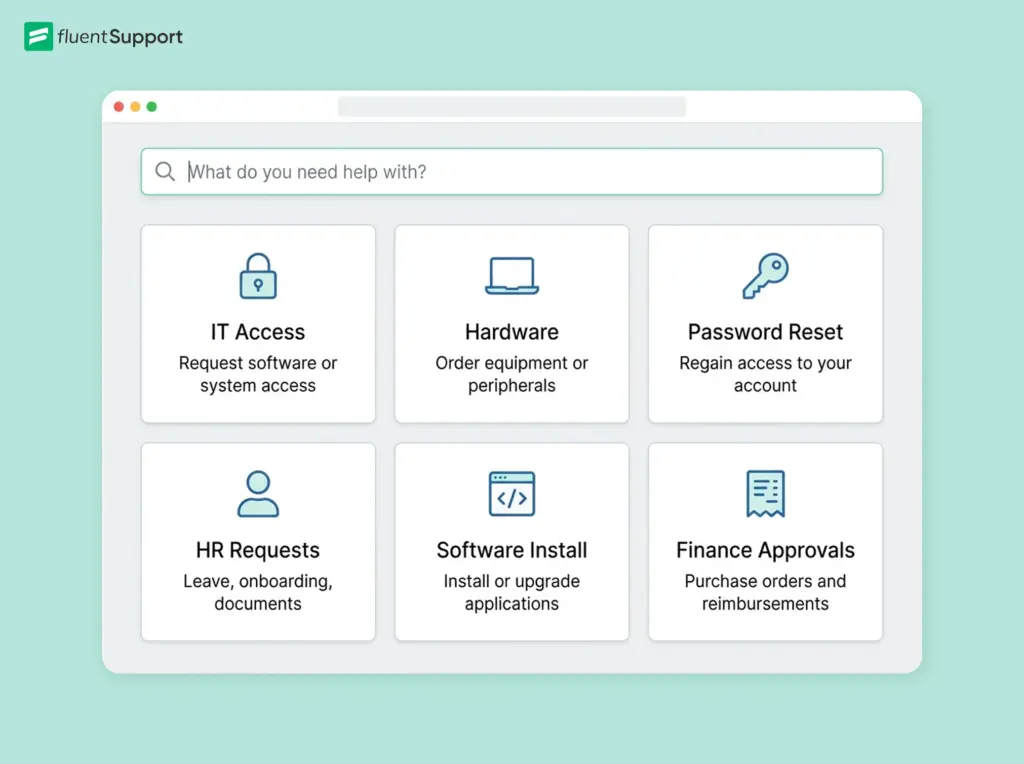
Service request management software exists to do three things informal systems can’t: centralize intake, enforce consistent process, and make everything visible.
Without software, approvals happen informally, over chat or in someone’s inbox. There’s no audit trail. No SLA tracking. No way for a manager to see at a glance how many requests are open, how long they’ve been waiting, or which team is bottlenecked. The moment a request falls through the cracks, there’s no system that catches it.
With software, every request gets a ticket number and a home. Routing rules decide who handles what without a human having to make that call each time. Status is visible to everyone involved. SLAs trigger alerts before a deadline is missed, not after.
The service catalog is the other critical piece. It’s the menu of everything users can request. When users can browse a clean, well-structured catalog and find exactly what they need, the quality of intake improves, incomplete requests drop, and agents spend less time chasing down missing information.
If you’re running a WordPress-based operation, something like Fluent Support handles a lot of this out of the box: ticket management, automated workflows, priority routing, and a clean agent interface that keeps everything in one place without needing a sprawling enterprise platform.
What Good Service Request Management Actually Looks Like
A few patterns consistently separate teams that handle requests well from teams that are always playing catch-up.
They start with the most common requests. Not the most complex. Not the most interesting. The ones that come in every single day. Defining the process for those first delivers immediate value and teaches the team how to build out more complex flows.
They invest in the knowledge base. A significant share of service requests are questions, not provisioning tasks. How do I reset my password? What’s the way o connect to the VPN? How do I submit an expense? If those questions have documented answers in a searchable knowledge base, users can self-serve. That deflects tickets before they’re even created.
They automate approval routing. The most common bottleneck in request fulfillment isn’t the technical work. It’s waiting for someone to approve something. When approval routing is automatic, built into the workflow, and sent to the right person immediately, resolution times shrink.
They measure the right things. Fulfillment time. SLA compliance. Request volume by category. Reopen rate. Customer satisfaction score. These numbers tell a team where the process is working and where it’s quietly failing. First response time is one of the most telling metrics: it signals to users that their request was received and is being handled, which dramatically affects how they perceive the whole experience.
They keep the feedback loop closed. Asking users whether their request was actually resolved, and using that data, is what keeps the process from going stale. Requests change. Business needs change. A process that worked six months ago may have gaps today.
Service Request Management Beyond IT
Most of the literature on service request management talks about IT teams. And yes, that’s where the practice originated, rooted in ITIL and IT service management. But the logic applies across any department that handles structured, repeatable requests at volume.
HR teams manage time-off requests, onboarding tasks, policy questions, and reimbursement approvals. Finance teams handle purchase order authorizations and budget sign-offs. Marketing teams field content requests from sales, leadership, and other departments. Facilities teams get equipment provisioning requests.
Every one of these is a service request. Every one of them benefits from the same structure: a defined intake channel, a clear workflow, routing to the right person, and a closed feedback loop.
The teams that figure this out create what’s sometimes called enterprise service management, extending the discipline of IT service management to every department that handles internal or external requests. The result is a customer service collaboration model where every function of the business operates from the same playbook for handling asks.
The One Thing Most Teams Skip
They build the process and forget the people.
Support teams handling high volumes of requests burn out. Requests exceed the team’s capacity. The people closest to the problem, the front-line agents, often have no structured way to surface recurring issues or push back on unrealistic SLAs. Without regular retrospectives or team health checks, the system runs on willpower until it doesn’t.
Customer support statistics consistently show that agent experience directly correlates with customer experience. Happy, supported agents resolve requests faster and with better quality. A service request management process that optimizes the workflow but ignores the people running it is solving the wrong problem.
The better approach is collaborative rather than tiered. When agents can swarm issues together, learn from each resolution, and feed observations back into process improvements, the whole system gets smarter over time. That’s what continuous improvement actually looks like in practice, not a quarterly review document, but a weekly rhythm of reflection built into how the team operates.
Choosing Service Request Management Software: What to Actually Look For
The market for service request management tools is enormous, from enterprise platforms like ServiceNow and Jira Service Management to more focused solutions built for specific contexts. The decision criteria depend heavily on what you’re managing, at what volume, and with what team size.
The core capabilities that matter in any tool: a configurable service catalog, customizable request forms, automated routing and approval workflows, SLA tracking with alerts, a knowledge base with search, reporting dashboards, and email management integration for teams that still rely on email-based intake.
Beyond features, the practical questions are: how much configuration does it require before it’s useful, how does it handle growth, and how well does it integrate with the rest of your stack?
A well-designed system should make the customer feedback loop automatic, capturing CSAT data after every closed ticket without requiring agents to manually send surveys. It should also surface patterns: which request types are reopened most often, which categories are consistently missing their SLA, which agents are handling the most volume.
Those patterns are where process improvement starts.
The Hard Truth About Service Request Management
According to a widely cited ITSM benchmark, while the majority of organizations have some form of service request management in place, a significant portion acknowledge they still need to improve it. That gap, between having a process and having one that actually works, is the whole game.
The difference isn’t usually the software. It’s whether the intake is clean enough to route correctly, whether approvals are fast enough to not create backlogs, whether the knowledge base is good enough to deflect routine questions, and whether the team has the feedback and data to keep improving.
Service request management done well is one of those things where the users barely notice it. Requests come in, get handled, and close without drama. That invisibility is the goal. When people stop complaining about the support process, you’ve got it right.
It is a discipline, not just a feature set, and the organizations that treat it that way are the ones that actually deliver on the customer experience they promise.
Start off with a powerful ticketing system that delivers smooth collaboration right out of the box.
Related Articles
How to Setup a Support Ticket System in WordPress?
Learn how to set up a support ticket…Fluent Support 2.4.0: Advanced Reports, AI Ticket Audit, and Portal Protection
Fluent Support 2.4.0 rebuilds reporting with a full…




Add your first comment to this post