

What Is Complaint Management? How to Handle It Right

By Uttam Kumar Dash
June 22, 2026
Last Modified: June 25, 2026


Every business gets complaints. What separates the ones that grow from the ones that lose customers is not whether complaints happen. It is what you do with them after.
Most guides will tell you to “acknowledge and resolve.” That is not enough. A complaint left without a system behind it is just a time bomb. Handled right, it is one of the most useful signals your business will ever receive.
In this blog, we will break down what complaint management actually means, how the process works step by step, what types of complaints you will face, what an effective program actually looks like, and how to pick the right tools.
Key Takeaways
- Complaint management is the structured process of receiving, tracking, resolving, and learning from customer grievances.
- The core steps are: acknowledge, empathize, clarify, investigate, resolve, and follow up.
- Common complaint types include billing issues, service failures, delivery problems, and product defects.
- Effective programs depend on centralized tracking, clear ownership, root cause analysis, and trend monitoring.
- The right software removes manual friction so your team can focus on resolution, not administration.
What Is Complaint Management?
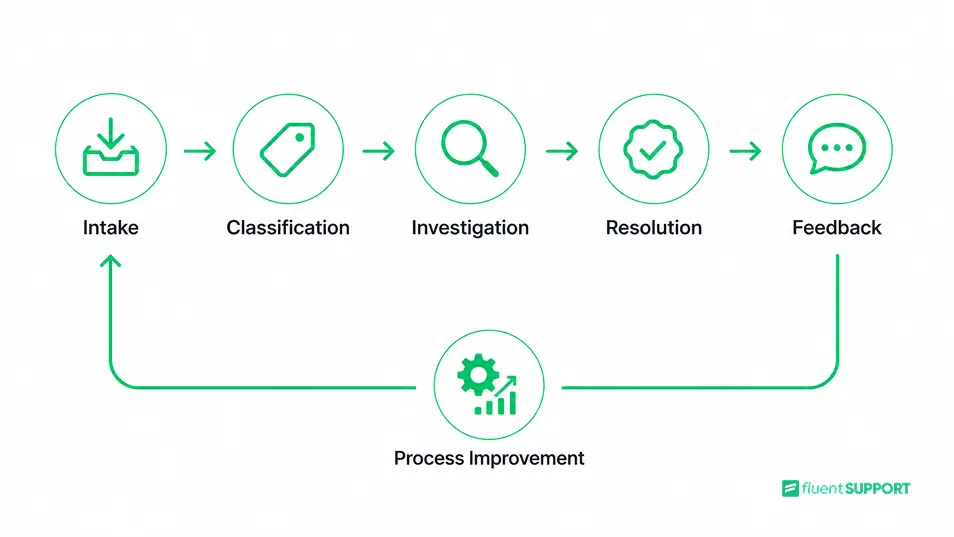
Complaint management is the systematic process an organization uses to receive, record, investigate, resolve, and analyze customer complaints. The goal is not just to fix one issue. It is to understand why the issue happened and prevent it from recurring.
A complaint is any expression of dissatisfaction from a customer, whether that comes through email, a phone call, a web form, or social media. Not every frustrated message is a formal complaint, but every formal complaint starts with a frustrated message. A good program captures both.
Why Complaint Management Matters
Unhappy customers who do not complain just leave. Those who do are actually giving you a second chance. That is the mindset a mature complaint program is built on.
Beyond retention, complaint data reveals patterns. A spike in billing complaints after a pricing change tells you something is unclear. Multiple complaints about the same product feature tell you it needs fixing. Without a system tracking this, the signal disappears into scattered inboxes.
Research cited by the Federal Reserve Bank of Minneapolis found that even a basic acknowledgement of a customer’s problem can rebuild loyalty before the issue is fully resolved. The act of being heard matters as much as the outcome.
There is also a regulatory dimension for industries like finance and healthcare. Regulators treat complaint logs as evidence of how seriously an institution takes consumer protection. Failing to document and address complaints systematically is not just a service gap. It is a compliance risk.
Common Types of Customer Complaints
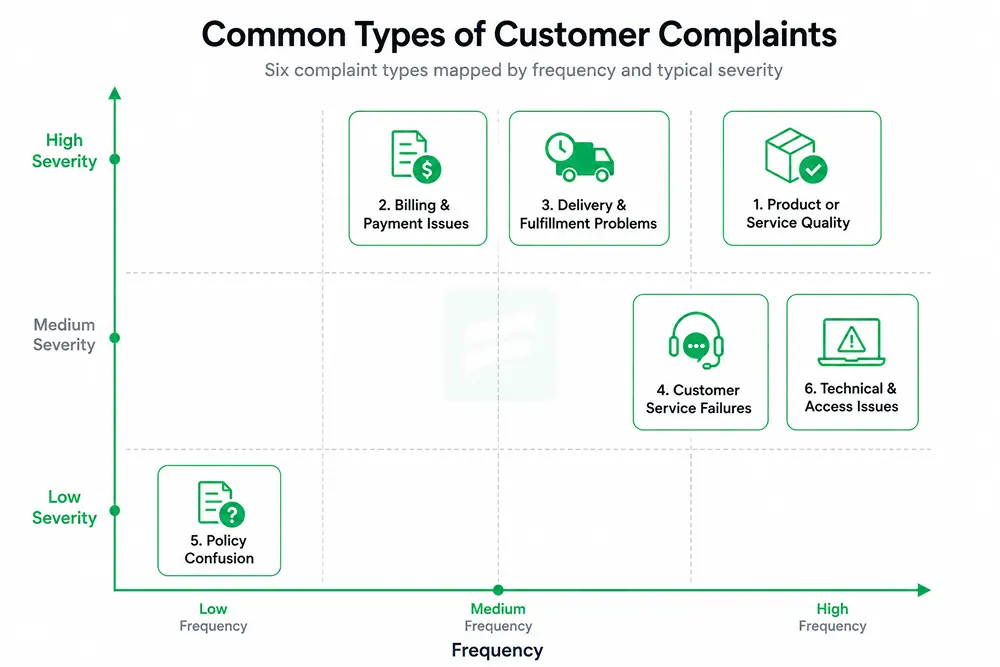
Understanding what categories of complaints you will face helps you route and resolve them faster.
- Product or service quality is the most common. Customers expected one thing and received another. This includes defective items, features that did not perform as described, or services that fell short of what was advertised.
- Billing and payment issues include unexpected charges, incorrect invoices, payment failures, or confusion about pricing. These escalate quickly because money is directly involved.
- Delivery and fulfillment problems cover late shipments, wrong items, damaged goods, or order tracking failures.
- Customer service failures happen when the support experience itself becomes the complaint. Slow responses, repeated transfers between agents, or unresolved follow-ups all fall here.
- Policy confusion arises when return policies, warranty terms, or service conditions are unclear. The customer did not get what they expected because the terms were not communicated well.
- Technical and access issues include broken links, login failures, app bugs, or anything that prevents a customer from using what they paid for.
The 5-Step Complaint Management Process
No matter the channel or issue type, a structured process keeps every complaint moving toward resolution.
1. Acknowledge
Confirm receipt immediately. Customers who hear nothing assume nothing is happening. An automatic acknowledgment with an expected timeline costs almost nothing and prevents a flood of follow-up messages. Log the complaint into your system the moment it arrives.
2. Empathize and Clarify
Before jumping into solutions, make sure you understand what the customer is actually upset about. Restate the issue back to them. This prevents wasted effort on the wrong fix and shows the customer they were heard correctly. Ask one clarifying question if needed, then move forward.
3. Investigate
Look into the account history, transaction records, agent notes, and any related documentation. The goal is not just what went wrong. It is why. Root cause analysis is what separates a complaint handled from a complaint solved. Without it, the same problem resurfaces with the next customer.
4. Resolve
Offer a fix that matches the situation. Sometimes that is a refund. Sometimes it is a correction or a clear explanation. The resolution should address the actual harm, not just close the ticket. Where relevant, check whether other customers were affected by the same underlying issue.
5. Follow Up
Check back after resolution. A short message confirming the issue is resolved and asking if anything else is needed goes a long way. It also catches cases where the resolution did not fully work. This step closes the customer feedback loop and prevents the same complaint from returning weeks later.
What Makes a Complaint Management Program Effective
A process is only as good as the infrastructure behind it. These are the elements that separate reactive complaint handling from a mature, scalable program.
- Centralized intake: It means all complaints from every channel, whether email, phone, social media, live chat, or web forms, flow into one place. Nothing gets lost in a personal inbox or a team Slack thread.
- Clear ownership and routing: Each complaint needs a named owner and defined timelines. Manual triage at any real scale creates delays and gaps. Automated ticket routing handles assignment faster and more consistently than any manual process.
- Documentation at every step: This is non-negotiable. Timestamped records of every action, internal note, and customer communication protect the business and make pattern analysis possible later. This matters even more in regulated industries.
- Trend analysis: It turns individual cases into strategic insight. When you can see that 30 percent of complaints this month point to the same product area, that becomes a product decision, not just a support queue item. Customer support analytics makes this possible at scale.
- Training: This ensures front-line staff can identify complaints correctly, respond with appropriate tone, and escalate when needed. The difference between a routine service inquiry and a formal complaint matters, especially for teams in regulated industries.
How to Choose a Complaint Handling System
The right software depends on your team size, channels, and how much customization you need.
Enterprise platforms like Zendesk or Salesforce Service Cloud offer deep integrations and AI-powered features, but come with high per-agent costs that scale directly with your headcount. Mid-market tools like Freshservice or Zoho Desk offer a reasonable balance of features and pricing for growing teams.
For businesses running on WordPress, Fluent Support is a strong option worth evaluating on its own terms. It operates as a full complaint handling system built natively into your WordPress environment, which means no separate SaaS subscription, no per-seat billing, and no data leaving your own server.
Here is how it maps to the core requirements of a complaint management system:
- Centralized intake: Complaints submitted through web forms or sent to a support email address are automatically converted into tracked tickets. Email piping means customers do not need to log into a portal. They send an email, and it becomes a complaint ticket with a full history attached.
- Automated routing and prioritization: Workflow automation lets you define trigger-based rules. A complaint tagged as a billing issue can be automatically routed to your finance team and flagged as high priority without any manual intervention.
- Categorization and trend visibility: Ticket tagging lets your team label complaints by type, such as product defect, shipping delay, or account access, and then filter across all tickets to spot recurring patterns. This is exactly what root cause analysis depends on.
- Flat licensing: Unlike SaaS helpdesks that charge per agent per month, Fluent Support uses a flat annual fee model. Your cost does not increase as complaint volume or team size grows.
For WordPress-based businesses managing customer complaints at any scale, that combination of native integration, automation depth, and predictable pricing is genuinely differentiated.
Wrapping Up
Complaint management is not a support function you configure once and forget. It is an ongoing system that reflects how seriously your business takes the customer relationship.
The fundamentals are clear: capture every complaint, route it to the right person, investigate the root cause, resolve it properly, and use the data to prevent the next one. What varies is how well your tools and processes support each of those steps when volume increases.
Whether you are building a complaint program from scratch or tightening up an existing one, start with centralization. Everything else gets easier when all complaints are visible in one place.
FAQ
What is a complaint management system?
A complaint management system is software that centralizes complaints from multiple channels into a single organized workflow, enabling teams to track, route, resolve, and report on complaints in a consistent and auditable way.
What is the difference between a complaint and a service inquiry?
A service inquiry is a routine question or minor issue that carries no indication of wrongdoing or systemic failure. A complaint expresses dissatisfaction, alleges harm, or suggests a product, policy, or service did not meet expectations.
How do you measure the performance of a complaint management program?
Key metrics include average resolution time, first-contact resolution rate, complaint volume by category, repeat complaint rate, and customer satisfaction scores collected after resolution.
Want a system that makes ticket handling this smooth? Fluent Support brings structure and clarity to every request so your team always knows exactly what to do next. See how it works.
Related Articles
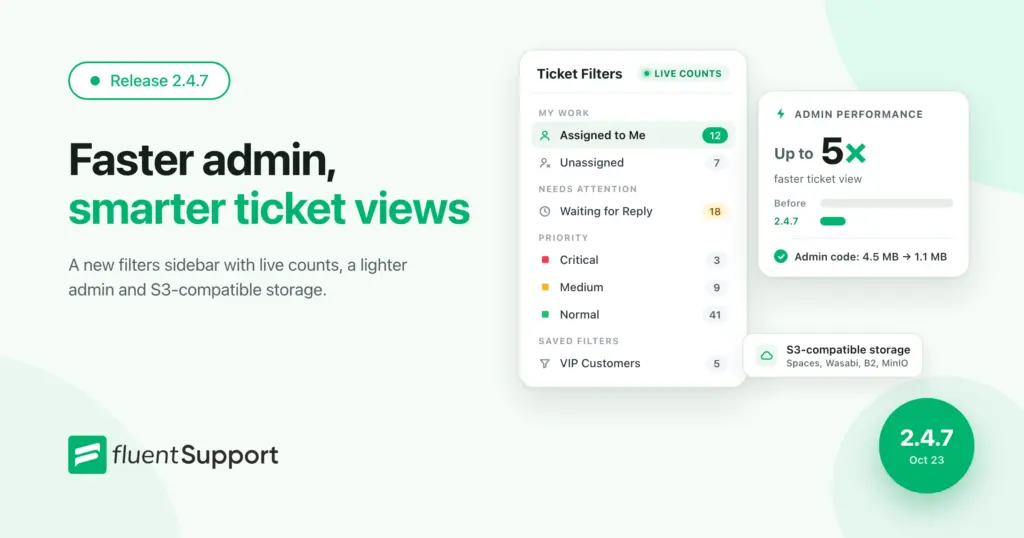
Fluent Support 2.4.7: Ticket Filters, 5x Faster Tickets and Smart Customer Search
Fluent Support 2.4.7 brings a Ticket Filters sidebar…Customer Success Best Practices for Small Teams
In this blog, we’ve discussed customer success in…


Add your first comment to this post