
Customer Experience Insights 2026: How CX Will Shape the Year Ahead

By Prosanjit Dhar
December 31, 2025
Last Modified: January 2, 2026


In 2026, customer experience is entering a decisive phase.
The moment when CX stops being treated as an operational hygiene factor and starts behaving like a macroeconomic force inside organizations, influencing revenue, pricing power, retention, and long-term brand equity.
Recent CX research, discussions, and industry data converge on a clear conclusion:
The next generation of CX winners will not be the most automated but the most orchestrated.
- Customer insight data from large-scale CX research
- Expert commentary from CX leadership discussions
- Verified metrics from enterprise CX trend reports
- And real-world operational patterns observed across support teams globally
What follows is not a trend list but a grounded and evidence-led view of where customer experience is heading in 2026 and why many brands will struggle to keep up.
CX has crossed a structural threshold
For years, CX leaders have argued that “experience matters.” In 2026, the debate is over.
Multiple enterprise studies now show that customer experience directly influences:
- Willingness to pay more
- Customer lifetime value
- Churn and retention
- Brand advocacy
According to large-scale customer research cited by CX leadership forums,
Around 70% of customers say they are willing to spend more with brands that consistently deliver excellent customer experiences.
This is not a marginal gain but reframes CX as a pricing lever, not just a service function.

In boardrooms, this is changing the language. CX is no longer discussed as a cost center to be optimized, but as a growth system to be engineered.
The experience gap is widening fast
One of the most critical insights shaping 2026 is what CX leaders increasingly call the experience gap.
Experience gap = customer expectations − actual experience delivered
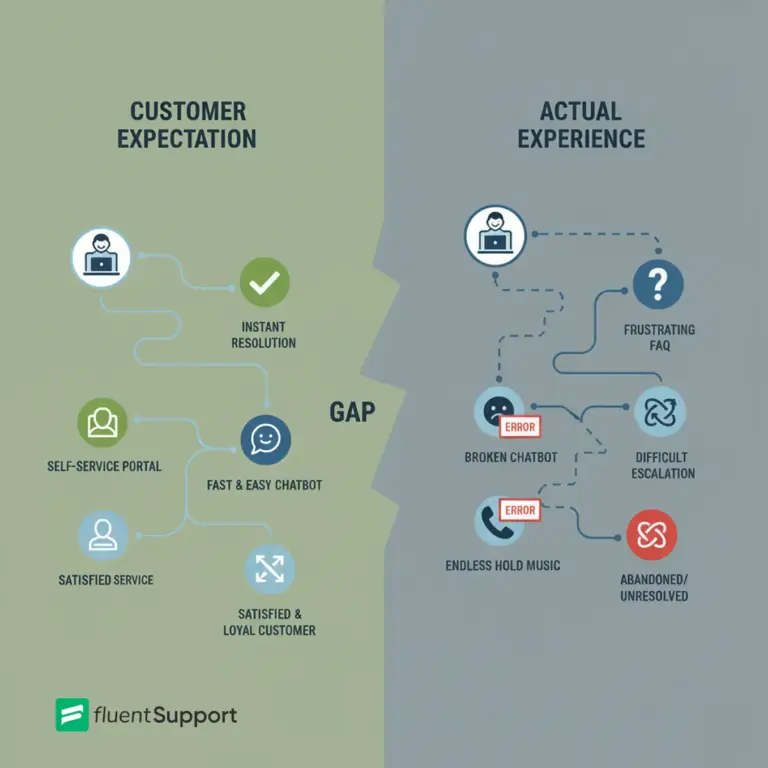
What makes this gap dangerous is not that it exists, but it’s that it is accelerating.
But there’s also another thing. That is,
Self-service paradox
According to the Transcom Consumer Insights Report (2024–2025), shared by Jeff Blair (Chief Growth Officer, Transcom) during the CX Today discussion:
Self-service usage has jumped from roughly 55% to nearly 80% in a single year.
Yet self-service consistently ranks among the least effective resolution methods in customer feedback studies.
Nearly half of customers abandon self-service flows when they fail, escalating issues to human channels with higher frustration and lower trust, according to Zendesk CX Trends 2026.
And, this creates a compounding problem:
- Abandoned self-service increases contact volume
- Frustration inflates handle time
- Repeated contacts erode loyalty
- Operational costs rise while satisfaction falls
The lesson for 2026 is uncomfortable but clear: customers want digital tools, but they punish poorly designed automation.
Automation alone will no longer be a differentiator
Between 2020 and 2024, customer service automation itself was a competitive advantage. In 2026, automation without orchestration will be a liability.
Across CX leadership discussions, a recurring pattern emerges:
- AI deployed in isolation
- Chatbots without escalation logic
- Knowledge bases without context
- Automation layered on broken processes
The result is speed without resolution and efficiency without trust.
High-performing organizations are already moving in a different direction. They are treating AI and humans as one operating system, not parallel channels.
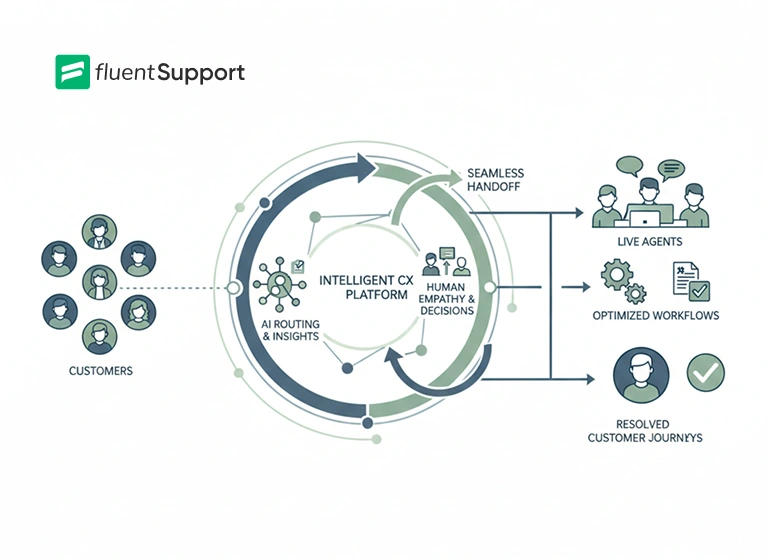
What works in 2026:
- AI handles repetition, routing, pattern recognition, and summarization
- Humans handle empathy, judgment, accountability, and exception handling
- Seamless handoff replaces forced containment
- Agents are augmented, not replaced
This hybrid model is now linked to measurable outcomes:
- Reduced average handle time
- Higher first-contact resolution
- Improved agent satisfaction
- Stronger customer trust during high-stakes interactions
CX metrics will be rewritten
Traditional CX metrics (e.g., CSAT, NPS, average response time) will no longer be sufficient on their own.
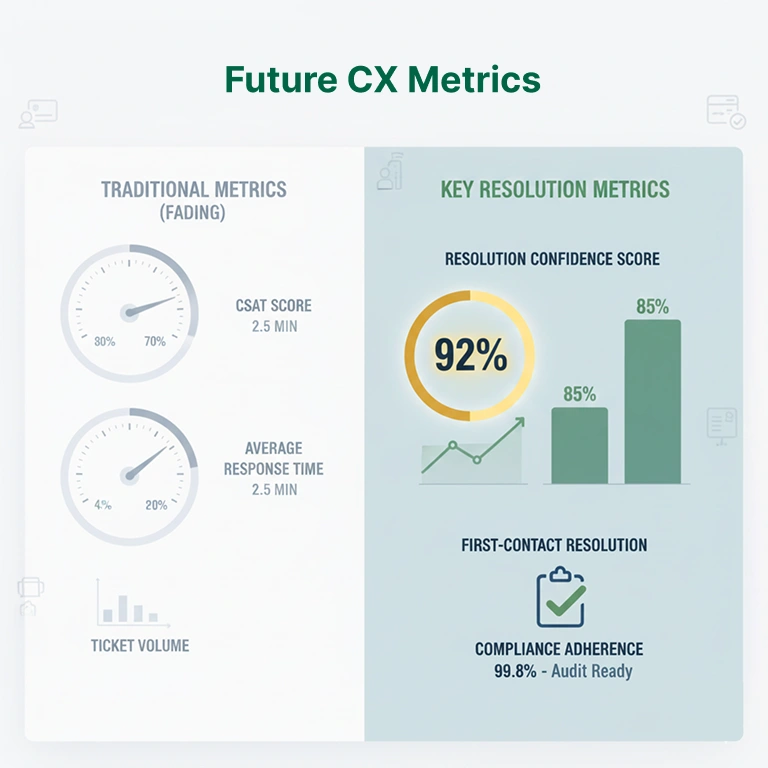
Customers in 2026 will be less interested in how fast a brand responds and more concerned with:
- Was my issue fully resolved?
- Was the process fair?
- Was I treated with clarity and respect?
- Do I trust the outcome?
Industry data shows that
Over 80% of CX leaders are now tracking new AI-driven metrics that focus on resolution quality, compliance adherence, and confidence outcomes rather than surface-level satisfaction.
At the same time, AI-driven conversation analysis allows brands to evaluate 100% of customer interactions, not just the small percentage who respond to surveys.
This will unlock:
- Early detection of churn risk
- Identification of broken self-service flows
- Insight into purchase blockers
- Faster feedback loops for product and policy teams
In 2026, the most valuable CX metric will not be sentiment, but it will be the truth at scale.
Transparency will become mandatory
Another defining shift for 2026 is the rising demand for explainability.
Customers no longer accept opaque outcomes:
- Why was my transaction flagged?
- Why was my refund delayed?
- Why was my request denied?
Research shows that:
Over 80% of business leaders believe clear AI explanations will be mandatory within the next two years.
A similar percentage of organizations are also willing to pay a premium for explainable AI systems.
50+ AI Customer Service Statistics: Insights and Trends for 2026.
This aligns with regulatory pressure, but more importantly, it aligns with human psychology.
A fast answer without explanation feels arbitrary and unfair.
In 2026, trust will not be built on speed alone, but on clarity + accountability.
Contact center will become an intelligence engine
One of the most underestimated changes in CX strategy is the evolving role of the contact center.
According to McKinsey & Company, leading companies are no longer treating support as the end of the customer journey. Instead, they are using it as a continuous insight engine feeding:
- Product development
- Marketing messaging
- Pricing strategy
- Policy design
- Risk management
With AI analyzing conversation patterns at scale, support data now reveals:
- Where customers hesitate before purchasing
- Which features cause repeated confusion
- Which policies generate friction
- Which journeys silently destroy loyalty
In 2026, organizations that fail to connect CX insights upstream will lose competitive ground. Not because they lack data, but because they fail to act on it.
Partner strategy will decide winners and losers
As CX becomes a growth driver, the criteria for choosing technology and service partners is changing.
Organizations are moving away from evaluating partners solely on:
- SLA compliance
- Cost efficiency
- Isolated AI pilots
Instead, partners are being assessed on three strategic dimensions:
- Insight depth – Can they translate CX data into business action?
- Scalability – Can improvements survive beyond pilots?
- Continuous innovation – Do they bring a roadmap, not just tools?
The core question has shifted from “How cheaply can this be delivered?” to “How quickly can this help us grow?”
Where platforms must adapt to the 2026 CX reality
As customer experience shifts from speed metrics to outcome accountability, one quiet but critical truth is emerging:
CX strategy fails when tools are built for inbox management, not experience orchestration.
Many support systems still reflect a 2015 worldview like tickets as messages, agents as responders, metrics as volume counters.
But the 2026 CX environment demands something different:
A system that understands context, continuity, ownership, and resolution as first principles.
This is where customer support systems like Fluent Support are evolving. Not by chasing AI headlines, but by aligning with how CX actually works in practice.
System that reflects this CX reality
The CX leaders are clear that AI only delivers value when the operational foundation is sound.
Fluent Support’s design reflects that reality:
- AI-assisted replies operate inside structured ticket box.
- Automation supports routing, prioritization, and workload balance.
- Agents remain the decision-makers, not only fallback options
This approach aligns with what customer research consistently shows:
Customers accept automation when it helps humans help them faster, not when it replaces judgment.
In other words, Fluent Support can be a great fit into the emerging CX model where:
- AI accelerates clarity
- Humans deliver trust
- Systems coordinate the handoff invisibly
Apart from these, can we actually predict the effect of CX in 2026?
What will 2026 reward CX
Based on current data and observable behavior patterns, 2026 will reward companies that:
- Close experience gaps instead of masking them with automation
- Invest in agent capability as aggressively as AI platforms
- Design CX systems around resolution, not deflection
- Treat transparency as a trust asset
- Use support data to shape upstream decisions
And it will punish those who:
- Chase AI hype without fixing fundamentals
- Optimize dashboards instead of customer reality
- Confuse speed with effectiveness
Final thoughts
Customer experience in 2026 will not be defined by who adopts the most technology. But by who understands their customers the best.
The brands that win will be those that treat CX as a living system. Where people, AI, insight, and empathy work together to remove friction before customers feel it.
In that sense, the future of CX is not artificial. It is intentionally human at scale.
Start off with a powerful ticketing system that delivers smooth collaboration right out of the box.
Related Articles
Is “AI Brain Fry” Burning Out Your Support Team?
AI brain fry is a new form of…10 Startups Leading The Way In Customer Service
Here are 10 genuine startups that are leading…



Leave a Reply