


The Ritz-Carlton Gives Employees $2,000 to Spend on You

By Prosanjit Dhar
April 8, 2026
Last Modified: April 8, 2026


You have probably heard the Ritz-Carlton’s customer service story.
That’s legendary!
But the more interesting question is how they actually achieve it.
One answer is that they empower their employees to solve guest problems on the spot without waiting for a manager. It’s a model that almost no other hotel has been willing to replicate.
And if you are one of their guests, this is worth knowing:
The Ritz-Carlton will spend up to $2,000 per incident to make your experience right.
Any employee on staff can authorise that spend. The authority belongs to whoever is standing in front of the problem.

The number that changes everything
Most coverage of the $2,000 rule focuses on what it says about employee empowerment. What that coverage consistently leaves out is the number that made the rule possible in the first place.
The average Ritz-Carlton guest spends $250,000 with the brand over their lifetime.
The Ritz-Carlton did not arrive at $2,000 through optimism or a belief in radical generosity. They studied their customers, calculated the lifetime value of those relationships, and set the per-incident limit accordingly.
When that context is present, spending $2,000 to protect a $250,000 relationship is not a risk. It is a straightforward business decision.
The $2,000 sounds bold on its own. But against $250,000, it sounds careful.
What the employee actually experiences
That context changes something fundamental for the employee handling a difficult situation.
When a guest’s anniversary dinner goes wrong, the Ritz-Carlton employee at the front desk already knows what she is authorised to do.
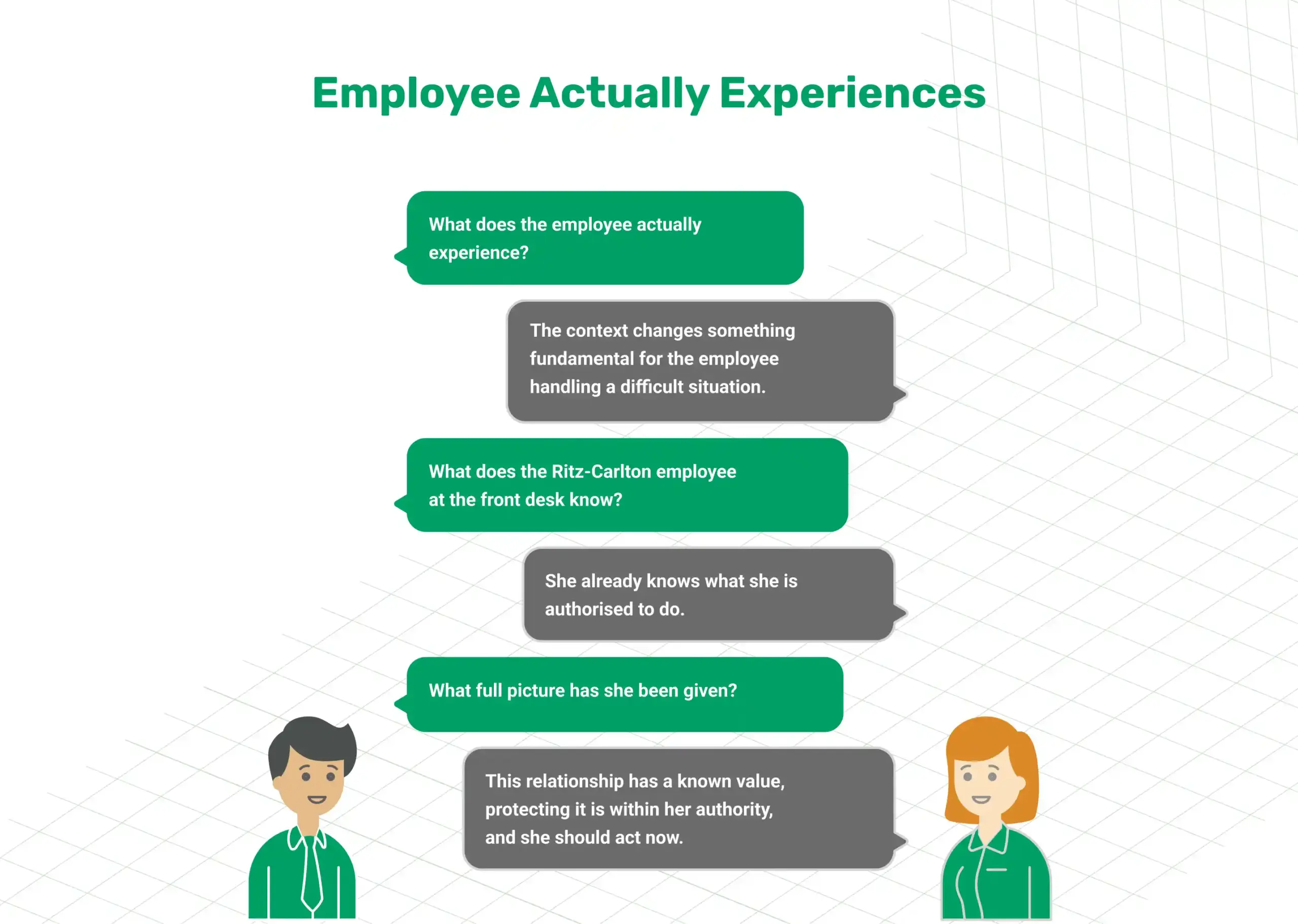
She has been given the full picture:
- This relationship has a known value
- Protecting it is within her authority
- And she should act now.
Most customer service employees work under entirely different conditions. Their authority ceiling is effectively zero.
Because they are trained on how to apologise or to escalate, and the best outcome they can produce for an upset customer is more waiting.
The gap between these two experiences is not a matter of attitude or effort. It is a matter of what information and authority the employee was given before the conversation started.
Where the real lesson lives
Every organisation that looks at the $2,000 rule and concludes that the lesson is about spending more money misses the actual point.
The rule works because it is grounded in a real understanding of customer lifetime value.
The Ritz-Carlton knew what their customer relationships were worth, and that knowledge gave them the confidence to extend genuine authority to their staff. The spending limit was not a leap of faith. It was the output of a calculation that most organisations have never bothered to run.
Customer support training matters enormously here, too. Giving employees a budget is not enough on its own.
The Ritz-Carlton invests heavily in training its staff to understand:
- When and how to use that authority
- How to read a situation
- And how to turn a service failure into a moment that strengthens the relationship rather than simply ending the complaint.
The combination of real authority and real training is what produces the service experience the Ritz-Carlton is known for. Either one without the other would not get them there.
Applying this without the $2,000
Most businesses do not have a $2,000 per-incident fund, and they do not need one to apply the same principle.
The starting point is calculating what a customer relationship is actually worth over its full lifetime. Once you know that number, it reframes almost every policy decision a support team faces.
Organisations that know their customer lifetime value make better decisions about how much authority to extend to their teams, how much to invest in training, and where the real cost of a poor service interaction actually lands.
Those who do not know it tend to manage support by minimising spend per ticket, which is an entirely different optimisation with entirely different results.
Wrapping up
The Ritz-Carlton built one of the most studied customer service philosophies in the world by answering one question honestly and then building everything else around that answer.
What a customer relationship is worth is not a philosophical starting point. It is a number. And it is the most useful number a service organisation can know.
Start off with a powerful ticketing system that delivers smooth collaboration right out of the box.
Related Articles
How to Setup a Support Ticket System in WordPress?
Learn how to set up a support ticket…Fluent Support 2.4.0: Advanced Reports, AI Ticket Audit, and Portal Protection
Fluent Support 2.4.0 rebuilds reporting with a full…






Add your first comment to this post