


How to Build Customer Trust That Lasts for Years

By Prosanjit Dhar
April 22, 2026
Last Modified: April 22, 2026


A late delivery, an unanswered call, or a data breach can shatter customer confidence instantly. According to PwC research, 32% of customers will walk away from a brand they love after just one bad experience.
Customer trust, once damaged, rarely recovers fully. Yet companies that earn and protect this trust consistently outperform competitors through higher retention, premium pricing, and powerful referrals.
What is customer trust?
Customer trust is the confidence a buyer places in a company’s ability to deliver on its promises. It represents accumulated faith that a business will act reliably and honestly over time.
This confidence operates on multiple levels: products work as advertised, support teams resolve problems, and personal data remains secure.
Customer trust emerges from consistent behaviour across every customer interaction. Also, the emotional dimension matters equally as customers want to feel valued.
Why customer trust drives business success
Customer trust directly affects your business revenue in measurable ways. Customers who trust a brand make repeat purchases more frequently, resist competitor offers more strongly, and forgive occasional mistakes more readily.
Research from Harvard Business Review shows that increasing customer retention by just 5% can boost profits by 25% to 95%.
These customer retention economics make customer trust a powerful financial asset. Acquiring new customers costs five to seven times more than keeping existing ones, while satisfied customers become advocates who recommend your business organically.
Companies who are known for trustworthiness can also command premium prices and customers willingly pay more for peace of mind.
3 Proven strategies to build customer trust
Building customer trust requires deliberate effort across multiple touchpoints. These strategies represent proven approaches that successful companies employ consistently.
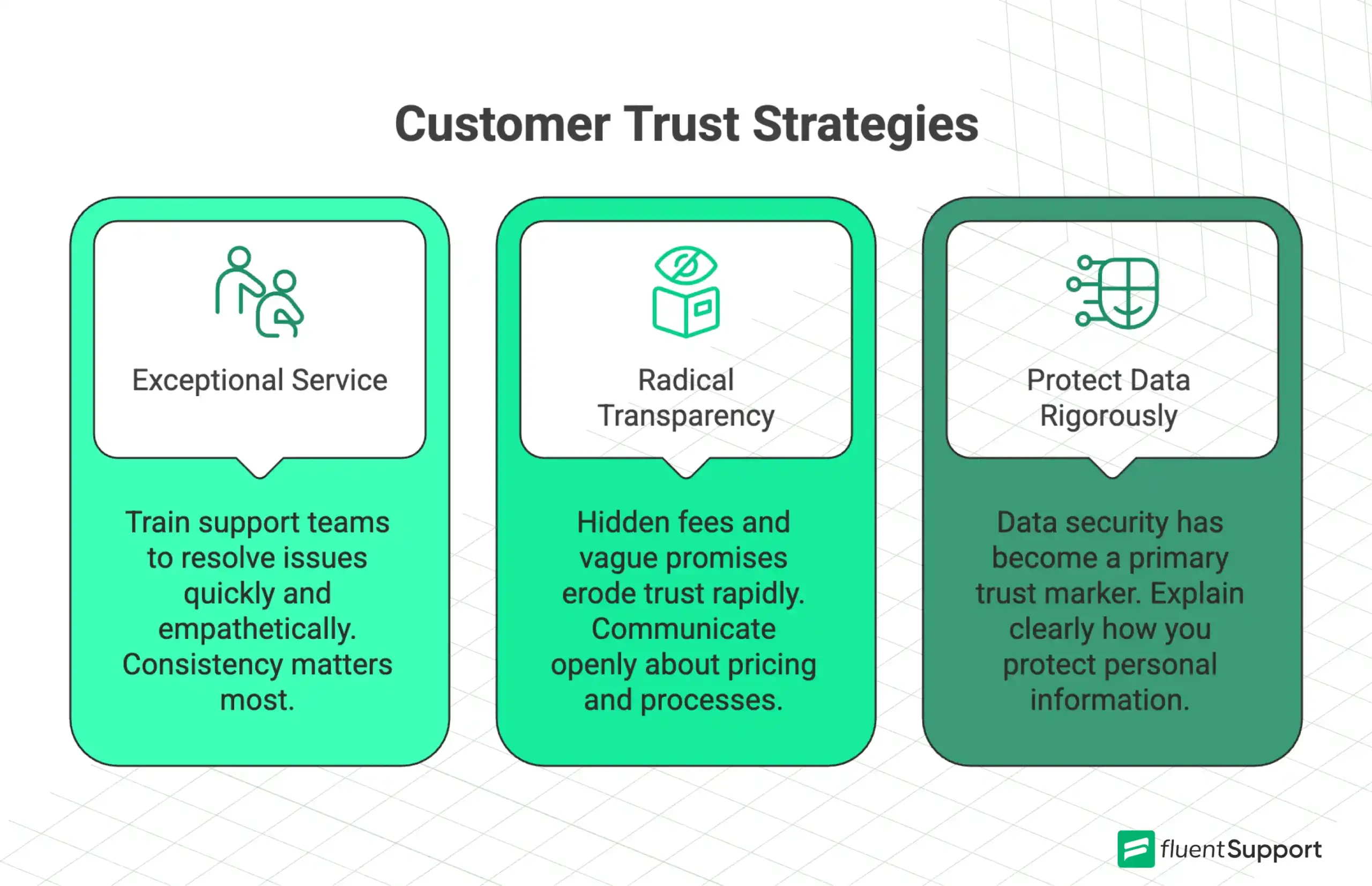
Deliver exceptional service consistently
Service quality shapes trust perceptions powerfully. Train support teams to resolve issues quickly and empathetically.
Create clear guidelines while empowering agents to handle complex situations. Consistency matters most because customers notice when service quality varies unpredictably.
Operate with radical transparency
Hidden fees, unclear policies, and vague promises erode trust rapidly. According to the Edelman Trust Barometer 2023, 71% of consumers say trusting a brand is more important today than in the past.
Just like communicating openly about pricing, processes, and potential problems. When mistakes happen, acknowledge them quickly because customers respect honesty far more than corporate spin.
Protect customer data rigorously
Data security has become a primary trust marker. Explain clearly how you collect, use, and protect personal information.
Invest in robust security measures and communicate these protections proactively to reinforce customer trust.
- Personalise experiences using customer history and preferences.
- Publish authentic reviews and testimonials, including negative ones.
- Act proactively and alert customers to problems before they discover them.
- Follow through on every promise, regardless of size.
- Seek feedback regularly and demonstrate how you’ve responded.
Common mistakes that destroy customer trust
Customer trust erodes faster than it builds. A single significant failure can undo years of positive interactions.
Companies frequently undermine trust through predictable mistakes that careful attention could prevent.
|
Trust-breaking behaviour |
Customer impact |
Trust-building alternative |
|---|---|---|
|
Breaking delivery promises |
Immediate frustration and doubt |
Under-promise and over-deliver |
|
Hidden fees at checkout |
Feeling deceived |
Display all costs upfront |
|
Ignoring complaints |
Feeling unvalued |
Acknowledge issues within hours |
|
Data breaches without disclosure |
Profound betrayal |
Notify affected customers immediately |
Many company executives overestimate how much customers trust their companies. This perception gap leads to complacency.
Regular measurement through surveys helps identify trust problems before they become crises. But measurement alone accomplishes nothing without genuine action.
The role of personalisation in building trust
Personalisation demonstrates that a company genuinely knows its customers.
A McKinsey report found that 71% of consumers expect personalised interactions, and 76% get frustrated when this doesn’t happen.
Remembering purchase history, preferences, and past interactions shows attentiveness that makes customers feel valued as individuals.
Effective personalisation extends beyond using someone’s name in emails. It means recalling why they bought something, not just what.
Also, technology enables personalisation at scale, but it should support human connection rather than replace it. The goal remains making each customer feel genuinely known.
Wrapping up
Customer trust functions as the foundation for sustainable business growth. Companies that consistently deliver on promises, protect customer data, and demonstrate genuine care earn loyalty that competitors cannot easily disrupt.
Start by auditing your current touchpoints for trust-breaking behaviours. Identify one area, whether service consistency, transparency, or data protection and implement measurable improvements this quarter.
Small and consistent actions build the customer trust that transforms occasional buyers into lifelong advocates.
Start off with a powerful ticketing system that delivers smooth collaboration right out of the box.
Related Articles
26 Best Ticketing System Software in 2026
The best ticketing system software in 2026 includes…Fluent Support 2.4.5: Remote Portal, New Workflow Triggers and more
Fluent Support 2.4.5 lets you run the customer…






Add your first comment to this post